Wanting More (a reading challenge starting with Advent)

If you would like a reading challenge, I would suggest getting acquainted with John Wesley’s sermons.  These sermons are a part of our doctrine and have the power to inspire and guide us into a new season of faithfulness – as individuals and as a church. 

With this motivation, I suggest this series that starts with Advent and goes through the liturgical year.  In each chapter there is a paraphrase of one of Wesley’s Sermons, a devotion on the same theme, and resources for reflection.  In terms of scholarship, one thing that makes this series attractive is the way Wesley’s sermons have been rearranged to fit within our regular liturgical rhythms.  We can truly go through the year with Wesley in a way that connects us to worship and to the seasons of our lives.

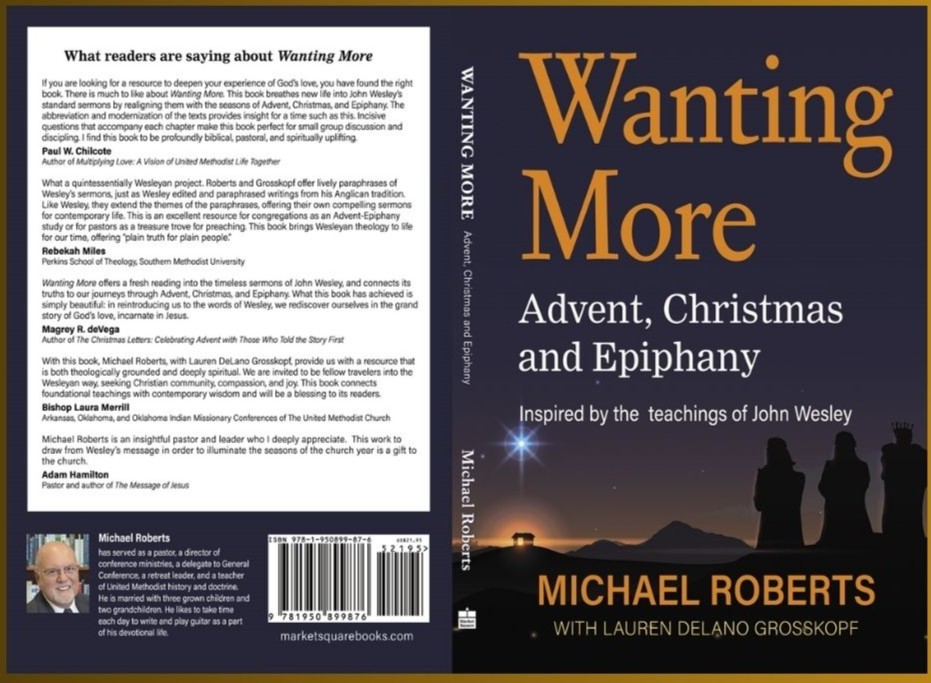
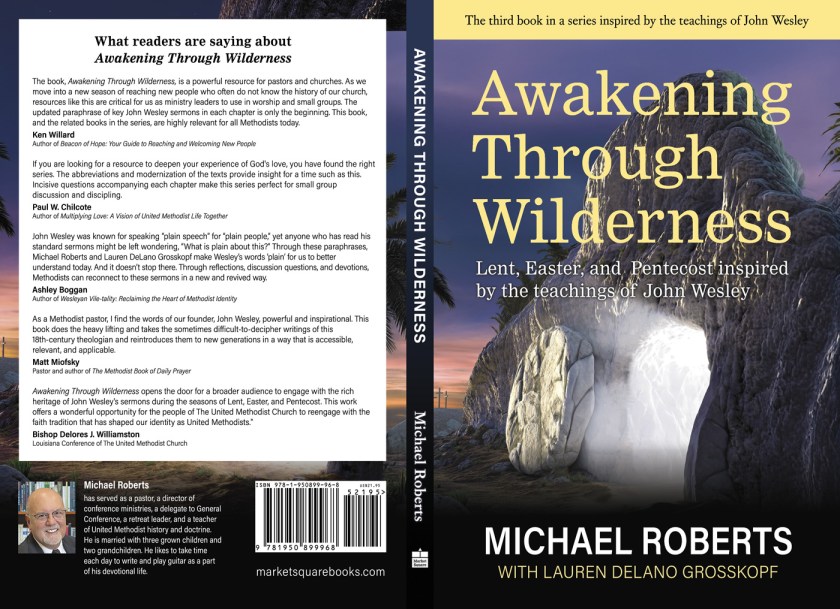
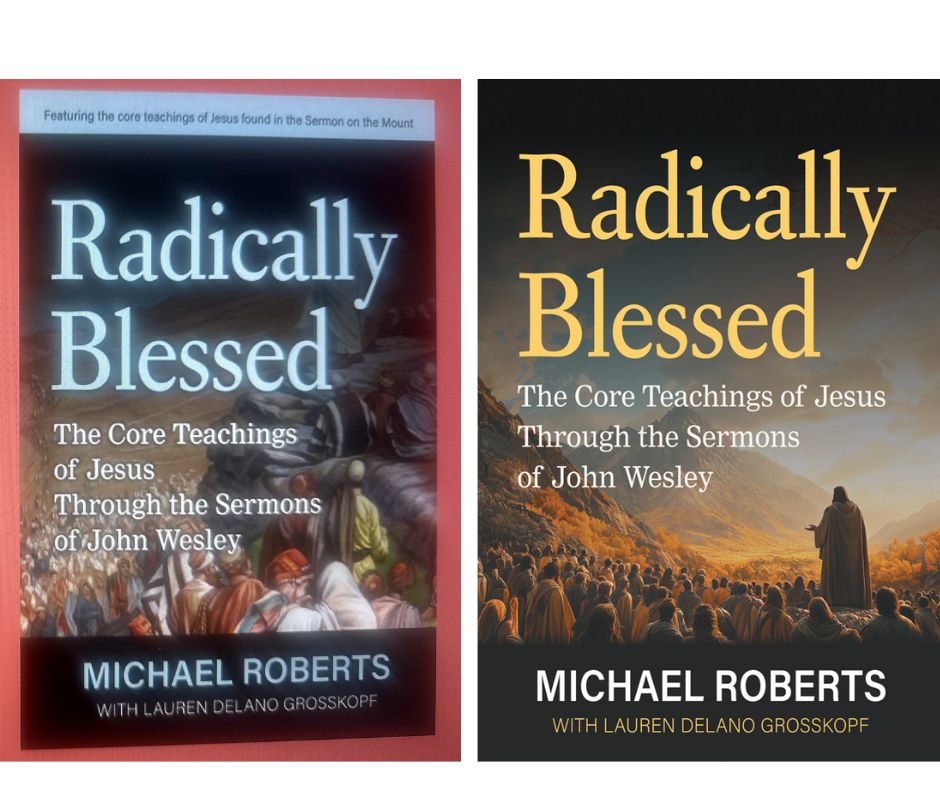
The journey starts with Wanting More: Advent, Christmas, and Epiphany Inspired by the Teachings of John Wesley.  The next book, Awakening Through Wilderness takes us through Lent, Easter, and up to Pentecost.  The third book – Radically Blessed – takes us through the sermon on the mount.  And a fourth book will be coming out for the Fall focusing on practical divinity. The title will be Heart to Holiness. 

As we move into a new season of faithfulness and hopefully fruitfulness, spending some time in our roots and history may be an important key.  I believe this is true. 

Give it a try.  There is a sample of the first book on Kindle.  Or it can be purchased through Market Square Books, Cokesbury, or Amazon/Kindle. I pray that this will be challenging, inspiring, and will help you and all of us bear good fruit into a new season. 

Awakening Through Wilderness (a devotional possibility for you and for UMCs)

No doubt we are moving into a new season in the life of the church.  In order to navigate this reality, I am convinced that we need to look into our past as much as we look towards the future.  Or maybe a better image is the need to attend to our roots in order to branch out and bear good fruit. 

With this motivation I, along with Lauran DeLano Grosskopf, have written a series of books where each chapter contains a paraphrase of one of Wesley’s sermons, a devotion on the same theme, and resources for reflection.  With this series, Wesley’s sermons have been rearranged to fit within the liturgical year, thus connecting them to our weekly rhythms.  My hope is that these resources will help us reacquaint ourselves with inspiration from our past and lead us to good fruit as we move into a new season as United Methodists. This would be a good way to go through the year with Wesley.

Below is a brief description of the latest book from the publisher. Within the book there are testimonies from Paul Chilcote, Ashley Boggan, Bishop Deloras Williamston, Ken Willard, Adam Hamilton, Bishop Laura Merrill, Rebekah Miles, and more.

  “Awakening Through Wilderness invites readers on a transformative journey through Lent, Easter, and Pentecost, exploring timeless truths through the voice and vision of John Wesley. This third installment in this acclaimed series builds on previous works, Wanting More and Radically Blessed, continuing the mission to make Wesley’s foundational teachings accessible and deeply relevant for today’s church.

 In this book, each chapter offers a devotional paraphrase of one of Wesley’s classic sermons, followed by a modern devotion and practical questions for reflection. Each chapter masterfully connects Wesley’s original passion for renewal and reform with the liturgical rhythms of the church year, guiding readers through themes of fasting, self-denial, temptation, grace, and resurrection.

 The wilderness becomes a powerful metaphor for life’s trials, doubts, and spiritual dry seasons-those times when God seems distant and faith is tested. Through Wesley’s insights and pastoral reflections from Michael and Lauren, readers discover that the wilderness is not merely a place of hardship but also a space for awakening, transformation, and renewed purpose.

 Whether read individually or used in a group study setting, Awakening Through Wilderness offers a clear, engaging path for spiritual growth. Each chapter’s discussion questions and reflection resources make it ideal for small groups, Bible studies, or personal devotion, especially during Lent.

 The books in this series are written with warmth and clarity, drawing on deep knowledge of Wesleyan theology and a pastoral heart for today’s church. Throughout we are reminded that “God’s love comes to us on its way to others,” inspiring readers to grow in grace and to live out their faith with courage and compassion.

    You are invited to step into the wilderness and emerge awakened to the transforming power of God’s love.”

These books are available through Market Square Books, Cokesbury, and Amazon/Kindle. I would be honored if you would take a look (you can get a sample through kindle) and if you feel so led, share these resources with others.  If you would like to talk about this, please know that I would love to have that conversation.  Many Blessings!

The Faith of Thomas and General Conference

Many have heard this post-Easter story recently in worship, found in John 20:24-29.  The anxiety was high.  The disciples had locked themselves in a room, worried about what would happen next.  And Thomas was really acting out.  We can hear him going off, giving ultimatums about what he would do or not do if he didn’t get what he wanted. He says, “Unless I see the nail marks with my own eyes, I will not believe.” 

We can make some loose comparisons to the times when we give anxiety-fueled ultimatums to God.  “Oh God, if you will just do this (we can fill in the blank) then I’ll make a commitment – as if faith was transactional. Or we might think of church conferences, like the upcoming General Conference, where it can be tempting to make ultimatums about what we will do or not do if certain decisions are made.  Many are experiencing this anxiety right now.  

In this light, there are a couple of things to note in this story. First of all, note that Thomas is still there. He stays connected to the community of faith, even with his uncertainty and fears and demands. It is also worth noting that he is not willing to believe what the other disciples believed about the resurrection – not in that moment.  But we get the sense that this is okay.  He is still there, included in the community. 

Secondly, if we read it carefully, we notice that Thomas does not do what he said he would have to do to believe.  The risen Christ appears to the disciples, behind the locked doors, and says, “Peace be with you.”  Shalom. It is a word that suggest harmony and coming together and it is the first word spoken by the risen Christ in this moment.  It sets the tone for what resurrection means for us.  And then Christ speaks directly to Thomas.  Christ offers to him exactly what he said he wanted.  “See my hands. Touch my side.”  But there is no indication that Thomas does any of this. He seems to have forgotten his ultimatum.  He simply exclaims, “My Lord and my God.” 

In this lesson, Christ speaks of those who will believe without seeing.  That would be us. Thomas was able to see, but he discovered that faith is not found in seeing or receiving some sterile proof.  Thomas comes to believe because of an experience with the risen Christ and the peace that comes from this relationship.  Thomas receives presence more than proof. He encounters God’s steadfast and eternal love, and this is so much more than the answers he had demanded. We are able to come to faith in this same way, as the living Christ continues to come and reveal this love for us, in us, and through us.   

Like with Thomas and the first disciples, may we be given the grace to turn from our human arrogance and turn to the One who has opened the way to so much more.  May our encounters with the living Christ move us beyond locked doors of fear, beyond our personal assumptions and biases that can cause harm, and into a commitment to love more fully, with patience, kindness, and with a humility that does not insist on its own way. May we be less focused on answers and more on questions that will lead us into life-giving relationships with those who come up with different answers than we do.  This is the kind of believing that God wants for us.

At General Conference, delegate-disciples from around the world will be confined together in a room.  There will be a diversity of answers proposed, along with a variety of expressions of faith.  It will produce anxiety.  It can also be seen as beautiful, with the possibility of being a life-giving witness to the world. May the living Christ, who is our peace, be encountered and may we all be moved to a bigger faith.