Naming Samaritans (and why this is relevant in our current cultural/religious tensions)

“Why do we need to point out people’s ethnicity or sexuality?” “Why can’t we just say that we welcome all people?”  I’ve had this conversation recently and found it helpful to remember how Jesus called attention to particular identities – Samaritans, Gentiles, Women, Eunuchs. In all of these cases, the purpose of naming these identities, is not to push a “Samaritan Agenda,” (or fill in the blank with the other identities); the purpose is to stand with those who have been harmed and to go the extra mile in honoring them as beloved children of God – and to put these two purposes together in a way that illuminates the calling that comes from God through Christ.  

To use the term “Samaritan” as an illustration, we see multiple examples of this counter-cultural calling. In the famous parable of the Good Samaritan, we are given an example of how we are all to be good neighbors (Luke 10:25-36).  It was shocking to the religious ones who heard the parable. In the story of ten persons being “made clean” with only one returning to give thanks, we are directly told that this one was a Samaritan, and he became an example of not only being made clean but also being made well or healed. (Luke 17:11-19). 

To the shock of even his disciples, Jesus takes time to talk to a Samaritan woman at a well.  She becomes the first preacher, we might say, and many believed because of her testimony (John 4:1-42). And she is just one example of Jesus honoring women and giving them a place and a voice at the proverbial table (See Luke 8:2; 10:38; 23:55; Mark 7:24-30; John 4:39; Acts 1:14, 2:14-17, 8:12, 9:36, 16:14-15, 21:9; Rom 16:1; 16:3; Phil 4:2; Gal 3:28; and more).   

At one point Jesus is called a “Samaritan” and it is not meant to be a compliment.  This is followed by the accusation that he has a “demon within him.” This accusation occurs in a conversation with religious leaders who firmly believe that God is on their side. Jesus makes it clear that this practice of using religion to divide and judge only serves the “father of lies.”  (John 8:39-58).  

This big lie can be illuminated by what John Wesley called the “wildness of enthusiasm.”  In this condition, we confuse our own opinions and biases with the will of God.  In another place Wesley uses the term “bigotry” to describe this big lie.  He defines bigotry as an extreme attachment to one’s own party, opinion, or religion to the point of causing bitterness and division, often in the name of God.  Jesus names particular identities in the hopes of challenging this evil among us. 

As we address the religious tensions among us today, naming particular identities is challenging. Accusations of bias and bigotry flow from multiple sides.  It is true that Jesus treated all with honor and respect, wanting all to know God’s love and to be able to live into this love.  In this light, the scriptures make it clear that we are all one in Christ and that God shows no partiality (Gal 3:28; Acts 10:34).  And, from the other side, the scriptures also name particular identities, not to promote what we might call “secular agendas” but to call attention to the sin that divides and demeans, often in the name of God.  In Christ, both of these approaches can be true, for biblical truth is that which reveals love and opens the way for true togetherness. In the spirit of grace and truth, we can hold both of these perspectives together. (Alethia – John 17:17; I Cor 13:8; Eph 4:1-16; Col 3:5-17).  

My hope is that this analysis will help us all make good decisions about how to be more welcoming. How can we go the extra mile in showing Christ-like love and cultivating opportunities for all to grow in this love, without putting up barriers that get in the way?  May we find the courage to do this well. 

Thoughts on Transformation and Truth (sparked by a handwritten sign)

As we arrived at worship, there was a man standing on the corner of our property with a two-sided handwritten sign.  One side said, “Trans Women are Men.”  The other side said, “Repent or Perish.”  Needless to say, this was upsetting to many.

When I hear this targeted message – in the name of the gospel – my heart goes out to some people that I know.  For one example, I think of one dear soul in the church who was born as a male.  Few knew this.  To most she was known as a sweet woman in the church who sang in the choir and served in the food pantry and shared the love of Christ.  I suspect that there are persons with similar stories in many congregations, and they have had to live in fear while wanting to be faithful.

I am grieved when people come to church and have to encounter bigotry in the name of righteousness. (And to be clear, I define bigotry, with the words of John Wesley, as an extreme attachment to one’s own party, opinion, or religion to the point of causing bitterness and division, often while thinking that they are in service to God).  It is hurtful when beloved souls are targeted and used to promote other agendas. I think of the Greek word “pornia,” which can be defined as the objectification of persons so that they can be used for our pleasure and purposes.  As I read the scriptures, those who engage in such practices are not giving witness to the kingdom of God.

When it comes to repentance and the dangers of siding with that which leads to death (the other side of the sign), we all need to start by looking in the mirror.  In this act of repentance, God will open the way to God’s forgiving, life-giving, eternal love.  This love does have the power to transform us, into the image of Christ – but let’s focus on the right things (II Cor 3:17-18). The hope is that we would be transformed from an eagerness to divide and judge to an eagerness to hold one another in love, with patience, kindness, and a humility that does not insist on its own way. The hope is for a transformation from “arrogance of spirit” to a desire for “unity of spirit.”  The hope is to give witness to the God and Father “of all, who is above all, and at work through all, and in all” – a big God. (See I Cor 13:1-8; Eph 4:1-6; Col 3:12-17; Rom 12:1-18, just to start).

May this experience give us the courage to be bold in our witness – as a congregation and as individuals.  Many beloved souls in our community need those willing to stand with them in a time when the lies of division, judgement, and objectification are being masqueraded in such obscene ways as truth (Aletheia -that which opens the way to what is life-giving and glorifies God).  

Just recently, for another instance, we have had people take fragments of curriculum that we have used and weaponize it by telling lies about what is being taught.  And before we judge too harshly, know that we all need to pay attention. It is so easy to be tempted by the “father of lies,” to borrow a term from Jesus. Jesus uses this term in a conversation with religious leaders claim that God is on their side and who call Jesus is a “Samaritan” (it is not a compliment) with a demon in him (John 8:39-59). Promoting faith in that way is the opposite of truth.

May we be among those who live into the words of the Creed, that we proclaimed last Sunday,  as those “kept in perpetual remembrance of the truth of Christ,” a truth found in a God “whose mercy is over all his works,” a truth that “manifest itself in the service of love” (as defined above), a truth “set forth in the example of our blessed Lord, to the end that the kingdom of God may come upon the earth. Amen (may it be so).”

Published on my Facebook page as well

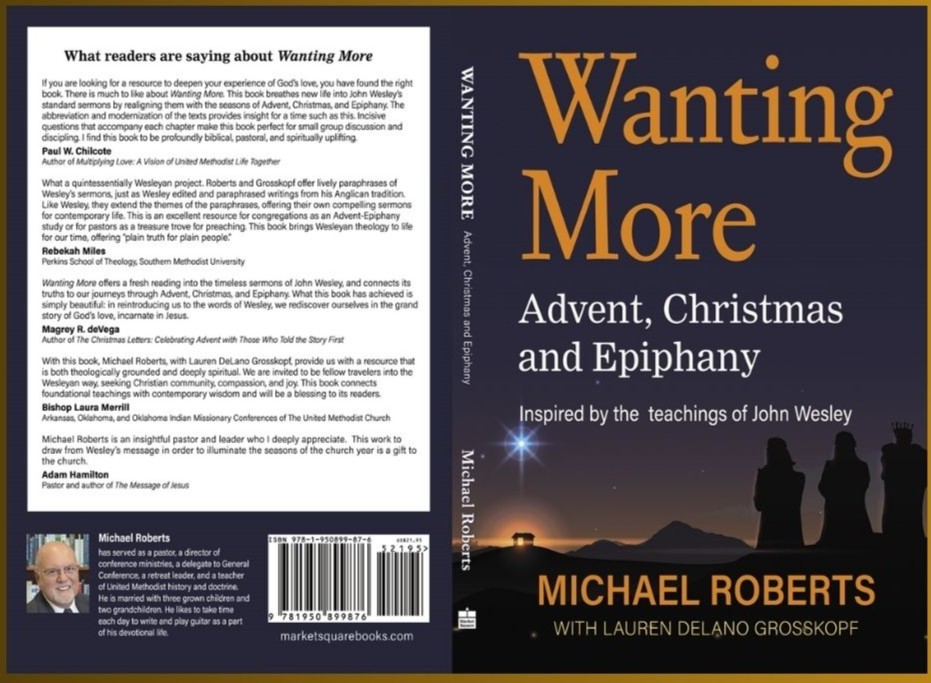
Wanting More (a reading challenge starting with Advent)

If you would like a reading challenge, I would suggest getting acquainted with John Wesley’s sermons.  These sermons are a part of our doctrine and have the power to inspire and guide us into a new season of faithfulness – as individuals and as a church. 

With this motivation, I suggest this series that starts with Advent and goes through the liturgical year.  In each chapter there is a paraphrase of one of Wesley’s Sermons, a devotion on the same theme, and resources for reflection.  In terms of scholarship, one thing that makes this series attractive is the way Wesley’s sermons have been rearranged to fit within our regular liturgical rhythms.  We can truly go through the year with Wesley in a way that connects us to worship and to the seasons of our lives.

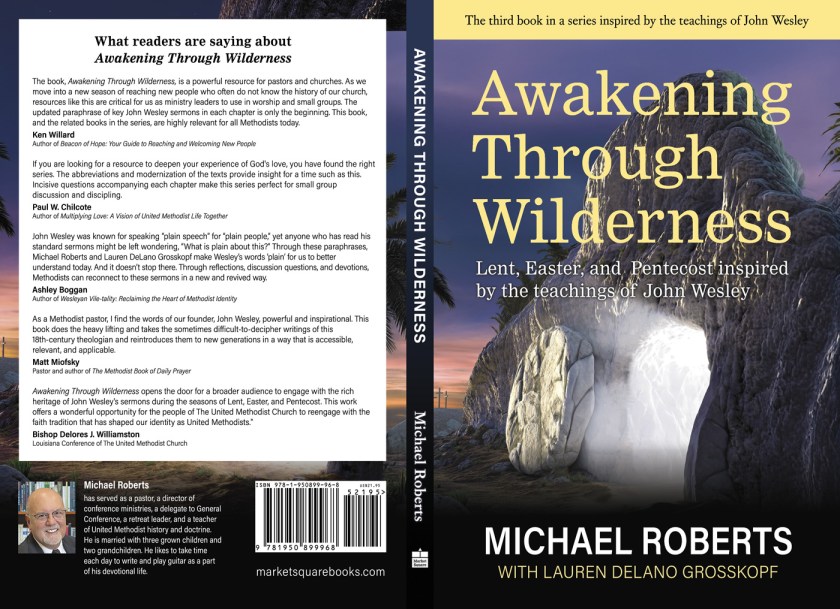
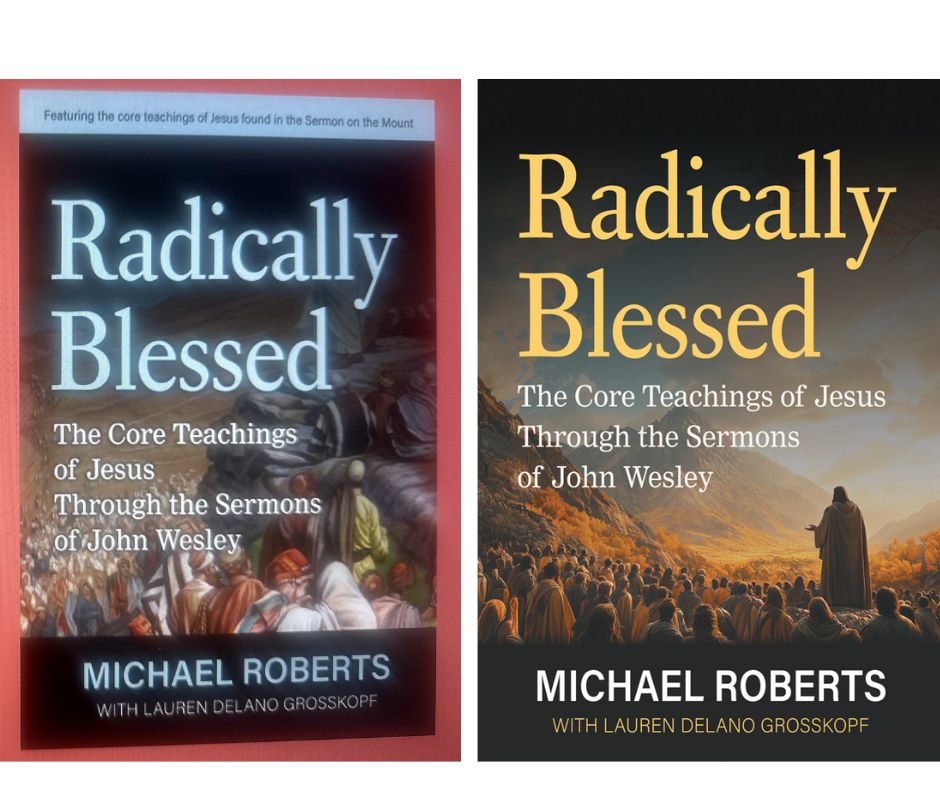
The journey starts with Wanting More: Advent, Christmas, and Epiphany Inspired by the Teachings of John Wesley.  The next book, Awakening Through Wilderness takes us through Lent, Easter, and up to Pentecost.  The third book – Radically Blessed – takes us through the sermon on the mount.  And a fourth book will be coming out for the Fall focusing on practical divinity. The title will be Heart to Holiness. 

As we move into a new season of faithfulness and hopefully fruitfulness, spending some time in our roots and history may be an important key.  I believe this is true. 

Give it a try.  There is a sample of the first book on Kindle.  Or it can be purchased through Market Square Books, Cokesbury, or Amazon/Kindle. I pray that this will be challenging, inspiring, and will help you and all of us bear good fruit into a new season. 

Awakening Through Wilderness (a devotional possibility for you and for UMCs)

No doubt we are moving into a new season in the life of the church.  In order to navigate this reality, I am convinced that we need to look into our past as much as we look towards the future.  Or maybe a better image is the need to attend to our roots in order to branch out and bear good fruit. 

With this motivation I, along with Lauran DeLano Grosskopf, have written a series of books where each chapter contains a paraphrase of one of Wesley’s sermons, a devotion on the same theme, and resources for reflection.  With this series, Wesley’s sermons have been rearranged to fit within the liturgical year, thus connecting them to our weekly rhythms.  My hope is that these resources will help us reacquaint ourselves with inspiration from our past and lead us to good fruit as we move into a new season as United Methodists. This would be a good way to go through the year with Wesley.

Below is a brief description of the latest book from the publisher. Within the book there are testimonies from Paul Chilcote, Ashley Boggan, Bishop Deloras Williamston, Ken Willard, Adam Hamilton, Bishop Laura Merrill, Rebekah Miles, and more.

  “Awakening Through Wilderness invites readers on a transformative journey through Lent, Easter, and Pentecost, exploring timeless truths through the voice and vision of John Wesley. This third installment in this acclaimed series builds on previous works, Wanting More and Radically Blessed, continuing the mission to make Wesley’s foundational teachings accessible and deeply relevant for today’s church.

 In this book, each chapter offers a devotional paraphrase of one of Wesley’s classic sermons, followed by a modern devotion and practical questions for reflection. Each chapter masterfully connects Wesley’s original passion for renewal and reform with the liturgical rhythms of the church year, guiding readers through themes of fasting, self-denial, temptation, grace, and resurrection.

 The wilderness becomes a powerful metaphor for life’s trials, doubts, and spiritual dry seasons-those times when God seems distant and faith is tested. Through Wesley’s insights and pastoral reflections from Michael and Lauren, readers discover that the wilderness is not merely a place of hardship but also a space for awakening, transformation, and renewed purpose.

 Whether read individually or used in a group study setting, Awakening Through Wilderness offers a clear, engaging path for spiritual growth. Each chapter’s discussion questions and reflection resources make it ideal for small groups, Bible studies, or personal devotion, especially during Lent.

 The books in this series are written with warmth and clarity, drawing on deep knowledge of Wesleyan theology and a pastoral heart for today’s church. Throughout we are reminded that “God’s love comes to us on its way to others,” inspiring readers to grow in grace and to live out their faith with courage and compassion.

    You are invited to step into the wilderness and emerge awakened to the transforming power of God’s love.”

These books are available through Market Square Books, Cokesbury, and Amazon/Kindle. I would be honored if you would take a look (you can get a sample through kindle) and if you feel so led, share these resources with others.  If you would like to talk about this, please know that I would love to have that conversation.  Many Blessings!

The Ten Commandments – Manipulated and Mandated by the State

In Arkansas a law has been passed mandating that the Ten Commandments be on display in all classrooms (See Bill 433, now Act 573). This week the University of Arkansas will become the first public university in the country to post the Ten Commandments in this way (in the midst of challenges, stays, and appeals). Since this law enters into my domain as a pastor and person of faith, I have some thoughts.

I want to weigh in specifically on the actual words that are mandated. A particular version of the commandments is found within the Bill itself.  Comparing the Bill to the scriptures, it is interesting to note what has been left out and what has been left in. In addition, it is noteworthy to see how an old translation (the King James Version), complete with “thou’s” and “shalt’s,” has been manipulated and then promoted as an official version.  The Bill begs questions about motivation and intent.  

I’ll start with the most alarming, in my opinion. While several of the commandments have been abbreviated, with many of the original words left out, the last one is given in full.  To fit with the others, it could have read “Thou shalt not covet.”  One has to wonder why this version does not focus on the dangers of coveting in a more general way – like we see with the other commandments here.  Instead, specifics that are included in the original texts are shown. We read, “Thou shalt not covet thy neighbor’s wife, nor his manservant, nor his maidservant, nor his cattle…”  Is the intent here to suggest that this is really only for men (males)?  This possibility gains credibility when we note that the pronoun “his” is used three times in this one verse.  This is redundant and unnecessary if translated from the original language.  In addition, does this expanded listing imply that slavery is to be condoned or that women in positions of authority can be tolerated and useful if they know their place as maidservants?  It makes me want to see a counter-list of all the passages that lift others up rather than marginalize.  And for an almost humorous note, the original words in the KJV list other animals.  Why is “cattle” the only animal in this version?

For the first example of important words being left out, the whole list starts with “I am the Lord thy God.  Thou shalt have no other gods before me.”  In the scriptures more is given between these two sentences. We hear of God speaking to a specific people who had been delivered out of Egypt and out of bondage. This group of people are invited (not forced) into this covenant (See Ex 20:1-17; Deut 5:6-21).

The third commandment, in this mandated version, reads, “Thou shalt not make to thyself any graven images.” In the KJV version of scripture, it is worded a little differently and there is no period after the word “images.”   With a comma we are beckoned to read more.  The commandment goes on for three long verses with words from a jealous God who will visit iniquity on those who break this commandment, to the third and fourth generation, and will show mercy on those who keep these commandments – with some debate about whether this refers to these first two commandments or all the commandments. 

As one who truly believes in a living God, I would worry about whether this Bill could be considered a form of creating a graven image.  In addition, a larger theological reason for this commandment is to help this community avoid limiting God to one perspective or trying to control God.  That’s what graven images can do.  God is bigger than that.

In the scriptures, the commandment around the sabbath goes on for four verses, with details and specifics. In the spirit of making a list for a mandated 16inch-by-20inch framed poster, it is understandable why these details would be left out – along with the possibility that we really don’t want to encourage people to abide by this weekly rhythm.  It still begs the questions, why was this one abbreviated and others not? What is the real message here? It would seem like that would be important for us to discern if this kind of investment is going to be made.  

It does strike me that this mandate possibly goes against the spirit of the commandments themselves.  Is God’s name being used – in vain – to intimidate and create division?  Does this law manipulate the words of scripture to promote an agenda that is arguably intended to marginalize some?  I hope that this analysis has sparked a willingness for more discernment – perhaps with a healthy dose of fear and trembling.   

As a Christian, I am all for honoring the Ten Commandments.  In my tradition as a United Methodist, I also believe that these words are to be interpreted through the lens of what we call the royal law of love. Jesus himself followed this method of interpreting scripture when he said that all the law and the prophets can be summed up in the commandment to love (Matt 22:37-40).  And we know what this love looks like.  It is illuminated with patience, kindness, and a humility that does not insist on its own way.  This love believes in others; it hopes for all that is good for others (I Cor 13).  It builds up rather than breaks down.  It unites rather than divides. It is the more excellent way.  And this way can be seen in the Hebrew tradition as well, especially through the prophets.  

I wonder what it would look like if we gave this witness, not with mandated posters, but with actions based on words written upon the heart.

Methodism Exposed (exploring the real method that leads to life)

The word “exposed” is meant to be provocative.  Other terms would be “revealed” or “illuminated.”  Going back to Wesley, a lot of misconceptions have existed around the use of the word “method” in Methodism.  Its deeper meaning is often lost.

The method of Methodism is often defined as the disciplined and intentional practice of the Means of Grace – prayer, worship, searching the scriptures, conferencing, service, etc.  There is truth in this, but we miss much inspiration if we stop here. [i]   While Wesley does give praise for the Means of Grace, he balances this praise with strong warnings. We can engage in all of these practices, and they can still sink us into a living hell.  The Means of Grace can be more of a burden than a blessing. They can lead us into the form of religion without the power.  This happens when we turn the “means” into the “end,” and begin to think that faith is found in the practices themselves. [ii] (For more see the notes below)

When Wesley uses the term “method” he most often speaks of the method that God uses to bring us into life.[iii]  Wesley describes God’s method with the word “reconciliation” in one place.  In another place, we are told that Jesus is God’s method for healing souls that could never be healed by human endeavor. The outcome of God’s method is the renewal of the image of God within us.

In more than one place, Wesley gives us an outline of how this method typically works. [iv]    The first step is an awakening in the soul to the mystery and reality of God. This awakening often starts with fear.  We recognize our sin and how short we fall from the glory of God.  How can we ever be justified – in alignment and harmony with God?  How can we ever be saved?  This fear often leads to attempts to justify ourselves.  And these attempts always leave us wanting.  When religion is defined in this way, we only bring God down to our level.  From here, we are led into the heart of God’s method. We are awakened to God’s eternal love and this changes everything.  It leads us into a desire to practice the Means of Grace, along with disciplined and daily self-examination, with the hope of being transformed, from one degree to another, into the very image of Christ and Christ’s love. This is a way to describe the method that God uses to bring us into life.[v]

And now, here is a more poetic way of describing God’s method, using a Charles Wesley hymn as inspiration:

This is how it works. 

Love comes first.

It opens our heart to a new reality. 

We sense that we’re a part of something bigger than ourselves,

And more than any finite thing.

This love works to pave the way

And plants the seeds of living faith. 

This is how it works. God’s love comes first

And it leads to,

A faith that works by love, a faith that works for love. Love!

This is how it works, our hearts are changed;

We turn towards life-giving grace.

We sense that heaven has begun in us,

And new life has been won. 

This love works to make us whole,

And forms the Savior in the soul.

This is how it works. God’s love comes first. 

And it leads to,

A faith that works by love, a faith that works for love.  Love! 

(Lyrics to a worship song entitled, “Faith that Works for Love,” inspired by the Hymn “Let Us Plead for Faith Alone.”  For a version of the song, additional verses, and commentary on how this method contrasts with other understandings of faith, see Hymn Inspired Worship Songs, YouTube, Michael Roberts. This was a part of my pandemic project)


[i] It is worth noting that Wesley does not tie the word “method” to the Means of Grace. In the sermon on the Means of Grace, for example, no version of the word “method” or “methodism” is found. 

[ii] Moving in the other direction, in Wesley’s famous pamphlet entitled “Character of a Methodist,” he does not directly talk about the “means of grace” or focus on what we do.  In fact, he says that our “schemes of religion” are “quite wide of the point.”  For methodists, faith is so much more than “just believing” or “accepting” what God has done for us. A methodist is one who has been awakened to God’s love.  In faith, we give ourselves into this love.  The experience of this love leads to peace with God and this peace leads us to “abound in love and in good works.”  To paraphrase Wesley, “Methodists are those who think, speak, and live, according to the method laid down in the revelation of Jesus Christ. Their souls are renewed after the image of God, and in all true holiness. Having the mind that was in Christ, they walk as Christ also walked.” 

[iii] Key sermons from Wesley on this topic include Righteousness of Faith where we read of God’s “method of reconciliation.” In the sermon Original Sin we hear that Jesus is God’s method for healing souls that could never be healed by any human endeavor.  Through Christ God heals our “functional atheism” by giving us faith – that divinely given conviction that God is with us and that nothing can separate us from God’s love. This leads to repentance, to trust, and transformation into the love of God. In the sermon Laying the Foundation we hear, once again, that methodism is not a new religion. It is the restoration of the image of God, centered in love, which is the summary of all the law and the prophets. Methodism is about intentionally cultivating the blessings of love, joy, and peace in the Holy Spirit.  It is not rooted in orthodoxy of opinion.  In this sermon Wesley speaks of this divisive temptation and then gives thanks for being delivered from this misguided zeal. God’s method is never meant to lead to the arrogance of spirit that causes division and harm within the Body of Christ. In the sermon Use of Law we hear that the ordinary method of God is to first convict us of our sin and our need.

[iv] God’s method involves movement along the Way of Salvation. This movement is described often with the key terms of Justification to Sanctification (and later others built upon what Wesley said about Preventing Grace and added Prevenient Grace as a way to describe the movement of God in our lives).  In another place, this movement is described with different States of Being in which we may find ourselves.  In our Natural State there is a false peace with no thought of God.  This can lead to a Legal State, where there is no peace at all. Next is the Evangelical State or the State of Love where we experience the peace of God. 

[v] Perhaps more than practicing the traditional Means of Grace, (or perhaps at the heart of this practice) we participate in God’s method through disciplined and regular self-examination.  Wesley consistently posed questions to the people called Methodists, calling for daily reflection. Is heaven in your heart? Is your heart being transformed into the likeness of Christ? Are you growing in holiness, defined by the virtues of patience and kindness and a humility that does not insist on its own way? Are you attending to the means of grace that will open the way for this love? Are you becoming less judgmental and more compassionate?  Do you know the peace of God?  Do you let other theological/political matters distract you from our core purpose? Do you understand that the narrow way leads us into the wideness of God’s mercy and the wide way of the world leads us into narrowness of spirit? These are the kinds of questions that Wesley posed over and over again as a way for us to participate in God’s method.

Why Would Anyone Want to Get Married in the UMC?

Marriage! This word that signifies coming together in unity and love has also been used to create so much judgment and division in our denomination.  In the midst of this tension, I recently had an appointment to do pre-marital counselling and was inspired to approach this meeting in a new way.  I started with the Book of Discipline.  It can be so helpful to actually look at what the B.O.D. says. With the changes and additions at the last General Conference, we have renewed our focus on the values of marriage that are life-giving for all – “fidelity, monogamy, commitment, mutual affection and respect, careful and honest communication, mutual consent, and growth in the grace and in the knowledge and love of God.” 

Imagine using this list as a theological and moral foundation to move into conversations about all the topics in a pre-marital meeting – family history, birth order, finances, religion and faith, expectations, personality types, etc. And to be clear, this particular list is found under Clergy Qualifications but can definitely be used to help us understand the values needed for a healthy marriage and for life-giving relationships in general.

We can also use the Book of Discipline to affirm marriage as “a sacred and lifelong covenant.”  Marriage is a union with “one another and into a deeper relationship with God and the community of faith.”  Marriage “reflects a continued willingness to grow together in Christ and a commitment to cultivate a covenantal bond that encompasses intimacy, grace, and love.” And there is so much more.* These statements are important because they call those getting married in the church to be a part of the faith community. Imagine using these statements to explore how being a part of the larger community can be a blessing.

We can compare these statements to what we see in another methodist denomination, which says: “We believe that human sexuality is a gift of God that is to be affirmed as it is exercised within the legal and spiritual covenant of a loving and monogamous marriage between one man and one woman.”  One might ask: Is this the only way to understand human sexuality?  Our new statements give us the opportunity to view human sexuality in a larger context, expressed in many ways, from our style and dress, to our natural attractions, to how we interact with one another.  It can be expressed through our desire for intimacy at all levels of relationship, from holding hands, to a kiss, to decisions about commitments, and how we might express the values listed above. The affirmation, support, forgiveness, and teachings of the church can be helpful all along the way.  And we can share this grace with a focus on calling, character, faithfulness and fruitfulness – and do this for all without having to automatically exclude some.

As evidenced by the recent Judicial Council ruling, tensions remain.* These tensions, however, do not have to divide. We do not have to give in to the arrogance of spirit that causes so much harm and keeps us from honoring one another.  To come full circle, as if it was a ring upon our finger or a seal upon our heart, perhaps the way we relate to one another can be inspired by the values we want marriages to model.   How might these values this understanding of marriage be life-giving for the church as a whole?

* For more see: “Beyond Soundbites and Towards Holy Conferencing (A Series on the Actions of General Conference)” at connectedinchrist.net  One section in the document on marriage has been revised after the recent decision from the Judicial Council giving clergy the responsibility for deciding whether they will perform the religious marriage service of a couple within the church, and in light of the call of our bishops who expect pastors to “exercise their authority with deep pastoral sensitivity to the congregation and community to which they are appointed.” This means that Holy Conferencing is always in order. Looking at what the BOD actually says can be so helpful.

Wesley on Elections (and the challenge of staying in my lane)

After the recent election, I found myself in a fog and unsure of what to say as a pastoral leader. I ended up – thank God – in a familiar place and one that rarely fails to inspire.  I began to wonder – What does John Wesley have to say about elections?  I will jump into the theological deep end and then explore some implications on our human elections.

Generally speaking, there are two very different understandings of election within the Body of Christ.  A perspective born out of Augustinian/Calvinist theology uses this word to describe how some are predestined to salvation and others are damned based on an irrevocable decision from a God who is sovereign and knows all, an absolute decree made from the “foundation of the world.” (Matt 25:34; Eph 1:4; Heb 9:26).  This perspective puts a lot of weight on, what is called, the foreknowledge of God (Rom 8:28-30; Acts 2:22-24; Rom 11:1f). This perspective is popular in our culture and is being expressed in some bold, even militant forms.

While still using the terms election and predestination, Wesley offers a more nuanced perspective, seeking to honor both the scriptures and our experience of having free will and learning to love in relationship.  We are elected or chosen to give witness to a grace and a way of salvation that is available to all. Our election is about so much more than “just believing.” We are invited to open our hearts to God’s transforming grace and to reflect the image of God.  Our participation is a part of God’s election, God’s purpose for us, from the “foundation of the world.”  And to be clear there are reformed theologies that share a softer approach, to use Wesley’s language. 

These two perspectives lead to different understandings of God’s sovereignty.  One is often viewed through the metaphor of a monarch (or dictator) with an emphasis on the depravity of humanity and the need to control and protect from the top down. From this perspective we might ask, why would we be more merciful than God?   A Wesleyan perspective can be seen through the metaphor of a loving parent, where authority is revealed as respectful, trusting, and empowering love.  In this love we are chosen, not for special privilege but to be a blessing (2 Pet 2:9-10; Col 3:12-17).  This view is much more optimistic about our capacity to reflect the image of God in the world.  From one perspective holiness is viewed through the lens of obedience and perseverance (key terms in Calvinist theology); from the other perspective holiness is seen through the virtues of patience, kindness, humility and a grace that can overcome even our human trespasses with restorative justice rather than punitive or retributive justice.

From Wesley’s perspective, the more hardline perspective turns Christ into a hypocrite. It portrays Christ as one who offers something that he never intends to give (like a cynical view of some politicians). It leads to a “sharpness of temper” that is inconsistent with the virtues to which we are elected or chosen.  The “elect of God” practice mercy, humility, kindness, and patience (I Cor 13:1-4; Col 3:12-17).  The “elect of God” “bear one another in love” and actively seek “unity of spirit in the bond of peace.” (Eph 4:1-3).  In connection to these “tempers” and virtues, Wesley uses the phrase “the elect of God” in at least five of his sermons.

In the scriptures we read that God’s desire is that all would come to salvation (John 1:29; II Peter 3:9).  We read that Christ died for the sins of the whole world, not only some who are “unconditionally elected.” (John 4:42; Acts 10:34-36; I Tim 4:1; Heb 2:9; I John 2:2).  We read that in Adam all die and in Christ shall all be made alive, but each in their own order (Rom 5:18; I Cor 15: 21-23; there is a mystery to it all).  These passages give important clues for how we are to relate to others – even our enemies.

What happens when the “elect of God” betray this trust?  It can look like being “mad with party-zeal,” to use a phrase from Wesley.  For the sake of the whole body, it is important to remember that the word “party” is built on the word “part.” Attempts to turn a part into the whole, and the arrogance of spirit that is necessary for this endeavor, can be so destructive.  Wesley calls the “elect of God” to purify themselves from all party-zeal, from all bigotry and narrowness of spirit, from impatience with differences, and every degree of unmercifulness.  All of this only leads us to “bite and devour one another.” (Gal 4:14-15).  This is a betrayal of our election.

In addition, please do not think that election from God is a call to be passive or weak. Anchored in these virtues, the “elect of God” work for peace, as peacemakers rather than peacekeepers, and there is a difference. Peacemakers acknowledge brokenness and harm among us, and yet continue to work for reconciliation in a way that restores justice and reveals God’s love for all. The “elect of God” stand with the marginalized, feed the hungry, welcome the stranger/immigrant, and stand with those who are marginalized by the “madness.” (See Matt 25:31-46 in the context of the that can save us from a fate that we deserve).

For a recent (and political) example, I think of how the statement “Your body, my choice” has been used over 50,000 times on Facebook (and that’s only one social media site).  I know that some boys in our community are vocalizing this and similar phrases, acting on the bullying and demeaning and abusiveness that has been normalized and is seen as strength in the hearts of many.  If our children are scared (and some are), we need to listen and stand with them.   This is what the elect of God do.

I think of political ads that stereotype, demean, and misrepresent particular minority groups to score political points. It reminds me of the Greek word “pornia” which can be defined as the objectification of others as a way to justify using them for our own perverted ends.  This word is about so much more than the way it is typically applied.  The “elect of God” are those called to speak up.

Concerning predestination and election, Wesley is willing to engage in the philosophical argument, but only to a point. He is keenly aware that we can only speak in human terms about the deep things of God. It is a mystery to us how eternity works, with all things being present at once.  There is, however, nothing in our experience that should make us think that things happen because they are known.  It may also be that God, infinite in wisdom and love, is able to set aside this so-called foreknowledge in time and space for the sake of relationship.  Perhaps God can even be surprised, grieved, and overjoyed by what happens in creation.  Such attempts to speculate can only carry us so far.  It is our experience that we are able to choose and participate in our own salvation, using our God-given free-will.

Therefore, as Wesley says often, a choice is before us.  In our culture, it is popular to see elections as win/lose, us/them, righteous/damned.  Reading scripture through a Wesleyan lens offers us a different way to see it.  The question becomes, which way is more life-giving for you?  Which way rings true in your spirit?  Which way will lead us into the goodness that God wants for us?  I invite you to ponder these things in your heart. 

(For a deeper dive, I recommend Wesley’s sermons: Free Grace, On Predestination, The Wedding Garment, Eulogy for George Whitefield, and On Working Out Our Own Salvation, among others. I hope to share a paraphrase of “Free Grace” soon).

We Believe in the Trinity! So What?

This past Sunday we celebrated Trinity Sunday, which sparked these reflections (which were shared in our weekly church newsletter).  In my mind, these thoughts seem so relevant in a time when the spirits of division and fear are so active among us.

As United Methodists we believe in the Trinity.  It is the first doctrinal statement in our Articles of Religion. All of our official creeds are written in trinitarian form, and we use one of these creeds in all of our worship services almost every Sunday. In the sanctuary, we also sing the doxology regularly, giving praise to our triune God.

My question right now is “so what?”  How does this affirmation affect our actual living?  First of all, this understanding helps us to know that God is always bigger than any one perspective or description.  The God we worship is more than creator, savior or spirit, judge, redeemer, or sustainer, parent, friend, or bestower of gifts. No one name will suffice, when trying to comprehend the fullness of a God whose ways are not our ways (Isaiah 55:8-9).  This perspective helps to keep us humble, curious, and open.  It has the power to spark a desire to grow in the ways of God (Psalm 85:10-13).

For another answer, this understanding of God gives us an option to the binary way of thinking that gets us in such trouble.  Either/Or, Win/Lose, Red/Blue, In/Out.  The outcome of this perspective too often leads to division, judgment, competition, exclusion, and so much fear.  Is there a better witness?    

What would a trinitarian witness look like? Within the Trinity we see cooperation rather than division, mutual trust rather than competition, grace rather than judgment, inclusion rather than exclusion.  Within the Trinity, the value is not power over others; the value is love.  And we know what this love looks like.  It is patient and kind. It serves with a humility that does not insist on its own way (I Cor 13:4-8; Eph 4:1-6).  It is so different from a witness that calls for uniformity of opinion rather than unity in love. 

I invite you to take a moment and reflect on these two different witnesses? Which perspective gives glory to God, honors Christ, and bears the fruits of the Holy Spirit?  Which perspective is more likely to be life-giving for relationships?  Which perspective comes closer to illuminating the fullness of God?      

We believe in the Trinity!  So what?  “May the grace of the Lord Jesus Christ, the love of God, and the fellowship of the Holy Spirit be with all of you” (2 Cor 13:14).

The Faith of Thomas and General Conference

Many have heard this post-Easter story recently in worship, found in John 20:24-29.  The anxiety was high.  The disciples had locked themselves in a room, worried about what would happen next.  And Thomas was really acting out.  We can hear him going off, giving ultimatums about what he would do or not do if he didn’t get what he wanted. He says, “Unless I see the nail marks with my own eyes, I will not believe.” 

We can make some loose comparisons to the times when we give anxiety-fueled ultimatums to God.  “Oh God, if you will just do this (we can fill in the blank) then I’ll make a commitment – as if faith was transactional. Or we might think of church conferences, like the upcoming General Conference, where it can be tempting to make ultimatums about what we will do or not do if certain decisions are made.  Many are experiencing this anxiety right now.  

In this light, there are a couple of things to note in this story. First of all, note that Thomas is still there. He stays connected to the community of faith, even with his uncertainty and fears and demands. It is also worth noting that he is not willing to believe what the other disciples believed about the resurrection – not in that moment.  But we get the sense that this is okay.  He is still there, included in the community. 

Secondly, if we read it carefully, we notice that Thomas does not do what he said he would have to do to believe.  The risen Christ appears to the disciples, behind the locked doors, and says, “Peace be with you.”  Shalom. It is a word that suggest harmony and coming together and it is the first word spoken by the risen Christ in this moment.  It sets the tone for what resurrection means for us.  And then Christ speaks directly to Thomas.  Christ offers to him exactly what he said he wanted.  “See my hands. Touch my side.”  But there is no indication that Thomas does any of this. He seems to have forgotten his ultimatum.  He simply exclaims, “My Lord and my God.” 

In this lesson, Christ speaks of those who will believe without seeing.  That would be us. Thomas was able to see, but he discovered that faith is not found in seeing or receiving some sterile proof.  Thomas comes to believe because of an experience with the risen Christ and the peace that comes from this relationship.  Thomas receives presence more than proof. He encounters God’s steadfast and eternal love, and this is so much more than the answers he had demanded. We are able to come to faith in this same way, as the living Christ continues to come and reveal this love for us, in us, and through us.   

Like with Thomas and the first disciples, may we be given the grace to turn from our human arrogance and turn to the One who has opened the way to so much more.  May our encounters with the living Christ move us beyond locked doors of fear, beyond our personal assumptions and biases that can cause harm, and into a commitment to love more fully, with patience, kindness, and with a humility that does not insist on its own way. May we be less focused on answers and more on questions that will lead us into life-giving relationships with those who come up with different answers than we do.  This is the kind of believing that God wants for us.

At General Conference, delegate-disciples from around the world will be confined together in a room.  There will be a diversity of answers proposed, along with a variety of expressions of faith.  It will produce anxiety.  It can also be seen as beautiful, with the possibility of being a life-giving witness to the world. May the living Christ, who is our peace, be encountered and may we all be moved to a bigger faith.