Wanting More (a reading challenge starting with Advent)

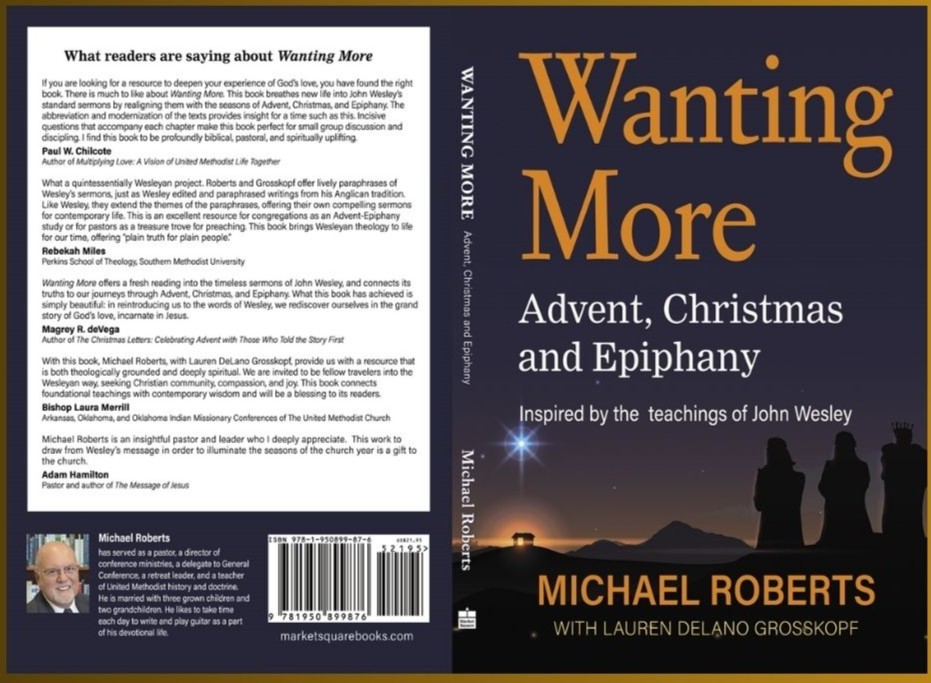
If you would like a reading challenge, I would suggest getting acquainted with John Wesley’s sermons.  These sermons are a part of our doctrine and have the power to inspire and guide us into a new season of faithfulness – as individuals and as a church. 

With this motivation, I suggest this series that starts with Advent and goes through the liturgical year.  In each chapter there is a paraphrase of one of Wesley’s Sermons, a devotion on the same theme, and resources for reflection.  In terms of scholarship, one thing that makes this series attractive is the way Wesley’s sermons have been rearranged to fit within our regular liturgical rhythms.  We can truly go through the year with Wesley in a way that connects us to worship and to the seasons of our lives.

The journey starts with Wanting More: Advent, Christmas, and Epiphany Inspired by the Teachings of John Wesley.  The next book, Awakening Through Wilderness takes us through Lent, Easter, and up to Pentecost.  The third book – Radically Blessed – takes us through the sermon on the mount.  And a fourth book will be coming out for the Fall focusing on practical divinity. The title will be Heart to Holiness. 

As we move into a new season of faithfulness and hopefully fruitfulness, spending some time in our roots and history may be an important key.  I believe this is true. 

Give it a try.  There is a sample of the first book on Kindle.  Or it can be purchased through Market Square Books, Cokesbury, or Amazon/Kindle. I pray that this will be challenging, inspiring, and will help you and all of us bear good fruit into a new season. 

Pride and Protest (and being a Protestant with a Catholic Spirit)

As I wrote in my church newsletter – As an ally, parent, pastor, and friend I want to express my pride, using this word in its best sense, meaning to express honor, appreciation, and support. I am proud to be a part of a church that honors the sacred worth of all and is willing to stand with those who have been harmed because of their sexual and gender identity. I want to express my appreciation and give honor to all who strive to be who God has created them to be, and during this time, especially to those who have been turned into an issue and/or rejected when trying to be true to who they are as a child of God. As the popular Facebook meme for Pride Month says, “This pastor loves you.” 

It seems that this June is also becoming a month of Protest.  As your pastor, I want to speak to this as well. The word “protest” literally means to advance, proactively, a testament or witness.  The word is most often associated with a proactive testament against something, but this is often accompanied by a proactive hope as well.  For a protest to have moral power, it needs to be rooted in a commitment “for” something, not only “against” something. 

From a Methodist/Wesleyan perspective, we are called to be protestants (note the word protest) with a “catholic spirit.”  John Wesley used this term to promote universal (catholic) love for all.  He asked, “May we not be of one heart, though we are not of one opinion?  We can if we understand that our calling is to “forward one another in love.”  This is what we are “for.”  We are “for” honoring one another, caring for one another, and building a community together, where our diversity is seen as a great blessing, and where we focus on values that are life-giving for all, rather than judging some by another standard. 

In light of calls by major Christian denominations to overturn Supreme Court Precedents on Marriage, and in light of active efforts to devalue beloved children of God and to cause harm seemingly only for political power, there is a need for people of faith to express both pride and to protest, recognizing that sometimes these are the same thing.  And for us, both must be expressed in a spirit of love – with patience, kindness, and a humility that does not insist on its own way.  Both must give witness to the peace in which we are all called.  We do both, trusting that God is at work for good.  Both Pride and Protest can be holy work.

Wesley on Elections (and the challenge of staying in my lane)

After the recent election, I found myself in a fog and unsure of what to say as a pastoral leader. I ended up – thank God – in a familiar place and one that rarely fails to inspire.  I began to wonder – What does John Wesley have to say about elections?  I will jump into the theological deep end and then explore some implications on our human elections.

Generally speaking, there are two very different understandings of election within the Body of Christ.  A perspective born out of Augustinian/Calvinist theology uses this word to describe how some are predestined to salvation and others are damned based on an irrevocable decision from a God who is sovereign and knows all, an absolute decree made from the “foundation of the world.” (Matt 25:34; Eph 1:4; Heb 9:26).  This perspective puts a lot of weight on, what is called, the foreknowledge of God (Rom 8:28-30; Acts 2:22-24; Rom 11:1f). This perspective is popular in our culture and is being expressed in some bold, even militant forms.

While still using the terms election and predestination, Wesley offers a more nuanced perspective, seeking to honor both the scriptures and our experience of having free will and learning to love in relationship.  We are elected or chosen to give witness to a grace and a way of salvation that is available to all. Our election is about so much more than “just believing.” We are invited to open our hearts to God’s transforming grace and to reflect the image of God.  Our participation is a part of God’s election, God’s purpose for us, from the “foundation of the world.”  And to be clear there are reformed theologies that share a softer approach, to use Wesley’s language. 

These two perspectives lead to different understandings of God’s sovereignty.  One is often viewed through the metaphor of a monarch (or dictator) with an emphasis on the depravity of humanity and the need to control and protect from the top down. From this perspective we might ask, why would we be more merciful than God?   A Wesleyan perspective can be seen through the metaphor of a loving parent, where authority is revealed as respectful, trusting, and empowering love.  In this love we are chosen, not for special privilege but to be a blessing (2 Pet 2:9-10; Col 3:12-17).  This view is much more optimistic about our capacity to reflect the image of God in the world.  From one perspective holiness is viewed through the lens of obedience and perseverance (key terms in Calvinist theology); from the other perspective holiness is seen through the virtues of patience, kindness, humility and a grace that can overcome even our human trespasses with restorative justice rather than punitive or retributive justice.

From Wesley’s perspective, the more hardline perspective turns Christ into a hypocrite. It portrays Christ as one who offers something that he never intends to give (like a cynical view of some politicians). It leads to a “sharpness of temper” that is inconsistent with the virtues to which we are elected or chosen.  The “elect of God” practice mercy, humility, kindness, and patience (I Cor 13:1-4; Col 3:12-17).  The “elect of God” “bear one another in love” and actively seek “unity of spirit in the bond of peace.” (Eph 4:1-3).  In connection to these “tempers” and virtues, Wesley uses the phrase “the elect of God” in at least five of his sermons.

In the scriptures we read that God’s desire is that all would come to salvation (John 1:29; II Peter 3:9).  We read that Christ died for the sins of the whole world, not only some who are “unconditionally elected.” (John 4:42; Acts 10:34-36; I Tim 4:1; Heb 2:9; I John 2:2).  We read that in Adam all die and in Christ shall all be made alive, but each in their own order (Rom 5:18; I Cor 15: 21-23; there is a mystery to it all).  These passages give important clues for how we are to relate to others – even our enemies.

What happens when the “elect of God” betray this trust?  It can look like being “mad with party-zeal,” to use a phrase from Wesley.  For the sake of the whole body, it is important to remember that the word “party” is built on the word “part.” Attempts to turn a part into the whole, and the arrogance of spirit that is necessary for this endeavor, can be so destructive.  Wesley calls the “elect of God” to purify themselves from all party-zeal, from all bigotry and narrowness of spirit, from impatience with differences, and every degree of unmercifulness.  All of this only leads us to “bite and devour one another.” (Gal 4:14-15).  This is a betrayal of our election.

In addition, please do not think that election from God is a call to be passive or weak. Anchored in these virtues, the “elect of God” work for peace, as peacemakers rather than peacekeepers, and there is a difference. Peacemakers acknowledge brokenness and harm among us, and yet continue to work for reconciliation in a way that restores justice and reveals God’s love for all. The “elect of God” stand with the marginalized, feed the hungry, welcome the stranger/immigrant, and stand with those who are marginalized by the “madness.” (See Matt 25:31-46 in the context of the that can save us from a fate that we deserve).

For a recent (and political) example, I think of how the statement “Your body, my choice” has been used over 50,000 times on Facebook (and that’s only one social media site).  I know that some boys in our community are vocalizing this and similar phrases, acting on the bullying and demeaning and abusiveness that has been normalized and is seen as strength in the hearts of many.  If our children are scared (and some are), we need to listen and stand with them.   This is what the elect of God do.

I think of political ads that stereotype, demean, and misrepresent particular minority groups to score political points. It reminds me of the Greek word “pornia” which can be defined as the objectification of others as a way to justify using them for our own perverted ends.  This word is about so much more than the way it is typically applied.  The “elect of God” are those called to speak up.

Concerning predestination and election, Wesley is willing to engage in the philosophical argument, but only to a point. He is keenly aware that we can only speak in human terms about the deep things of God. It is a mystery to us how eternity works, with all things being present at once.  There is, however, nothing in our experience that should make us think that things happen because they are known.  It may also be that God, infinite in wisdom and love, is able to set aside this so-called foreknowledge in time and space for the sake of relationship.  Perhaps God can even be surprised, grieved, and overjoyed by what happens in creation.  Such attempts to speculate can only carry us so far.  It is our experience that we are able to choose and participate in our own salvation, using our God-given free-will.

Therefore, as Wesley says often, a choice is before us.  In our culture, it is popular to see elections as win/lose, us/them, righteous/damned.  Reading scripture through a Wesleyan lens offers us a different way to see it.  The question becomes, which way is more life-giving for you?  Which way rings true in your spirit?  Which way will lead us into the goodness that God wants for us?  I invite you to ponder these things in your heart. 

(For a deeper dive, I recommend Wesley’s sermons: Free Grace, On Predestination, The Wedding Garment, Eulogy for George Whitefield, and On Working Out Our Own Salvation, among others. I hope to share a paraphrase of “Free Grace” soon).

Naming the Joy (of Being UMC in this Moment)

Let me count the ways for why I am proud to be a United Methodist in this moment and give thanks to God:

* Because the word “incompatibility,” as it has been used to create a judgement and a barrier only for some, is gone!

* Because barriers have been removed that have kept us from considering candidates for ministry based first on calling and character and commitments to Christ.

* Because we have new Social Principles that focus more on how we are to treat one another rather than offering hardline stances that divide and are intended to be general enough to find meaningful application in different contexts and cultures.

* Because we can now more freely promote values and virtues that are life-giving for all, rather than setting up a double standard for some.  

* Because a path has been opened to practice ministry in ways that honor different contexts and cultures, while also emphasizing our unity in mission and in sharing a Wesleyan witness in the world.

* Because there is a spirit of grace among us that honors those who are not as eager to celebrate yet are willing to give room for this and who continue to be in community.  Thank you! After General Conference 2019, I (and many) had to make decisions about staying/remaining/abiding, as Christ calls us to do. Reasons included those that we have heard in recent appeals from the Conference – a resolve to share convictions in a spirit of trust, humility and grace, in great appreciation for a community of faith where we can struggle together and love one another even as we disagree.  This is the United Methodist way. It is hard.  It is beautiful. And it is sometimes pretty messy as well.  

* Because there is room for all in the wideness of God’s mercy.  And as human beings we all need this!

How might you name this joy? What language would you use to invite others into this hope, and into a new season of ministry as the UMC?  

Spiritual Elegance (Reflections from a Funeral and on the Hymn “When We All Get to Heaven”)

I was at the funeral of a beloved aunt and will admit walking into the familiar funeral home with much pain. This pain was mostly work related, and for me work means church. I was surrounded by extended family and was particularly sensitive to how tensions in relationships, often around matters of life and faith, are felt in such settings.

It was also an opportunity to sit in a pew and receive. I took solace in the Hymn “When We All Get to Heaven.” As one who studies hymns and uses them regularly for devotion, I reflected on this one as memorials were given. This hymn, by Eliza Hewitt, debuted at the Great Auditorium just outside Asbury Park in New Jersey. It is a place known for the Methodist camp-meeting movement and famous for being a place where early American hymnody developed. Just think of this hymn and add Blessed Assurance and Great is Thy Faithfulness, to name a few. The street leading up to Great Auditorium is called the “Pilgrim Pathway,” referenced in the hymn.

“Sing the wondrous love of Jesus. Sing his mercy and his grace.” At the funeral God’s love was a theme. We heard from I Corinthians 13 and were told that this was read repeatedly during the last season of life. We really can’t get enough of this — this hearing that love is patient and kind, not arrogant or rude, and does not insist on its own way (verses 4-5).

I sat there and reflected on how some do not feel welcomed at occasions like this because of the judgement that is felt. I hear this a lot. It is hard knowing that you will be judged, not by character or calling or a desire to be faithful, but by dimensions of one’s life that are a part of your incarnate being. It can be hard to know that you are seen, even in church and family circles, as an issue rather than as a person. It is hard to be in an environment where some see “insisting on our own way” as a mark of courage and even righteousness. As I reflected on the love being described, it became clearer to me that the weight of concern must go to those who feel hurt and harmed. Love demands that.

“While we walk the pilgrim pathway, clouds will overspread the sky.” Oh yes. It can seem that the clouds can overcome the light. I thought of the line in I Corinthians 13 of how we see dimly in the present age and can only know in part (verse 12). This is truth. This is the arena that makes love even more important, even essential for life. And still, it is hard to be humble in this way, especially when there are such loud voices calling for something so different. As I reflected, I wondered if this reality could be a call to sing even more of love, mercy, and grace, especially in the midst of cloudy confusion – internal and external.

And this leads to the call – “to be true and faithful, trusting, serving every day.” My aunt was described with words like this. I was especially drawn to the word “elegant.” I had never thought of this virtue as something to which I needed to aspire, but I was inspired by it. Refined. Graceful. Sophisticated. Beautiful in a way that causes others to appreciate and aspire. This was all true of her, in a worldly sense, and in a spiritual sense. I liked this new thought of spiritual elegance. I was truly moved when one family member used the description of wisdom in the book of James. “The wisdom from above is first pure, then peaceable, gentle, willing to yield, full of mercy and good fruits, without a trace of partiality or hypocrisy. And the fruit of righteousness is sown in peace by those who make peace” (James 3:17-18). That’s it! I want to practice this kind of elegance. And I also know that there are those around who can be especially helpful in showing the way.

“When we all get to heaven.” All! That is such a good thought. There we shall “tread the streets of gold.” I recall the commentary that pointed out the political reality of this image. In the world, golden streets would only be for those behind the walls of power and privilege. In God’s economy, all will walk along this pathway together.

It will be so good to walk among those who have been so transformed that they (we) will be able to practice spiritual elegance in this way. In the meantime, may we be among those who are able, at least at times, to give “just one glimpse” of this “beauty we’ll behold.”

Wesley on Human Sexuality – Part Two

It was a modest project – to look directly at Wesley’s notes on the passages that are often used and to see what he had to say.  I was not expecting to find some of the things I did. With all the attention the previous post received, I want to look again, in light of some of the comments, and ask if my conclusion needs to be modified.

Concerning Wesley’s notes on Romans 1:26-27, much more can be said. Wesley speaks of three degrees of ungodliness – uncleanliness (v.24), being given up to vile affections (vs.25-27) and the vilest abominations (vs.28-31).   The word “abominations” is reserved for his long list that includes envy, deceit, covetousness, gossip, and fornication, which Wesley specifically used as a blanket term for all “pornia.”  Under the second category of “vile affections,” Wesley’s illustration is the “heathen Romans…and none more than the emperors themselves.”  As a point of interest, he also speaks of “American heathens,” in the note on v.31.  Under this category, Wesley speaks of idolatry being “punished with unnatural lust.” The only other time “lust” is mentioned in his commentary on Romans is in the note on 7:7 where it is specifically defined as “evil desires.”  Once again, we can conclude that Wesley wants to point us beyond sexuality only. 

Referring to Wesley’s note on I Cor 6:9-10, I can state it even more emphatically. Wesley wants us to think beyond sex!  He struggles with the word translated as “effeminate” or “soft.”  He gives this definition – those “who live in an easy, indolent way; taking up no cross, enduring no hardship.” At the same time, he does address the type of person that people would have had in mind. He asks, “How is this? These good-natured, harmless people are ranked with idolaters and sodomites!  Wesley has trouble with this group being on the list – whoever he had in mind.  I included more commentary in the previous post, making sure I didn’t make too much of this or impose too much of a 21st century perspective.  With statements like this, I do wonder how this matter can rise to the level of schism.

Referring to Wesley’s note on I Timothy 1:8-11, Wesley gives no commentary on the word “sodomite.” Here I did have to look in other places.  There are a handful of mentions in the Notes. When he elaborates beyond an assumed definition, he points us beyond sexuality.  He equates this word to idol worship (2 Kings 23:2), to corrupt principles and practices of government (Deut 32:32), and all things abominable (Rev 21:8).  In addition to this, he elaborates on the sin of Sodom in his note on Ezekiel 16:47, mentioned in the earlier post.  It is clear that sodomy is not good. It is also clear that we cannot project the sin onto a particular group of people.  Wesley wants us all to understand our complicity and involvement in sin as a step into a life-giving relationship with God.

I spent a lot of time on Wesley’s commentary on Matthew 19 in the previous post.  In the notes of this chapter, and in other notes mentioned, Wesley does have some thought-provoking things to say about eunuchs, including that we cannot always take the term literally.  In the context of current discussions, his words are remarkable – as seen in the previous post.

To conclude, I want to state my previous and modest conclusion with more fervor. ”Wesley’s willingness to struggle with these texts gives us permission to do so as well.” To state it another way, there is much room in Wesley for other perspectives. An honoring of perspectives is woven into Wesley’s larger corpus of teachings.  To paraphrase Wesley’s own words, a Methodist is not distinguished by this or that opinion or scheme of religion.  All of that is “quite wide of the point.”  I love that line! Methodists are to be distinguished by the love of God in our hearts.

Yes, there is room in Wesley.  The question is – is there room in the church? For you? For me? For us together in communion? I say “yes,” with Wesley among our guides.

Better Questions? (Reflections on our Financial Crisis and the Recent Webinar for Delegates)

Over the weekend, our delegation attended the webinar for all U.S. delegates to the GC/JC Conferences.  Here are some personal observations and lots of questions…  

The Zoom gathering started well.  We were invited to reimagine our future and to discern how we can best live into our commitments and values.  From there we moved to our primary agenda, which was to deal with a looming financial crisis, and specifically the episcopal fund (the fund used to support our bishops and provide them with resources to lead the church). We also considered how this fund impacts many other dimensions of our shared ministry.

With many graphs and statistics, we were shown that what we are doing is unsustainable.  The list of reasons is long and includes demographic shifts (ie.,aging membership), a pandemic, and theological tensions.  As one bishop put it – in a wonderfully understated way – “while we can’t predict the future, it seems unlikely that this will improve.”  

Concerning the Episcopal Fund, all recommendations called for a reduction in the number of bishops.  The recommendation from our own Jurisdictional Episcopal Committee called for a reduction of two bishops in our Jurisdiction.  This would result in Arkansas and Louisiana becoming one episcopal area (meaning that we would share a bishop).  Several other options were given, with all of them revolving around the question of “how many” positions should be eliminated. To further magnify the crisis, these proposals were called “interim” moves, suggesting that more reductions would be needed in the future.

This led me to ask this question in the Q and A: “Given the need to reimagine the future, and deal with a reality that is unsustainable, could we consider a reduction in compensation for bishops, aligning salaries to values of justice, equity, servant leadership, etc?  And as a witness.” 

There were many similar questions, and this idea became a major point of conversation.  In my breakout room, for example, we wondered if these recommendations were not a “bandaid” reaction. We discussed the need to view this need through a theological lens rather than solely as an economic problem. What if we started with our calling to cultivate social structures that are consistent with the gospel and focused on the kind of witness we are called to give the world?

In the larger Q andA times, there were some attempts to answer the question.  At one point it was said that this approach was not considered because GCFA sets salaries and that such a recommendation was beyond the authority of those involved in making these recommendations.  At another point, it was said that the possibility of reducing salaries was considered, but it was decided to revisit this if the collection rate of apportionments fell to 65%.  In these responses, it did seem that economic paradigms continued to overwhelm any theological considerations. I admit that continuing this discussion is “opening a can of worms.” Perhaps that explains our hesitation to explore the issues.

Is it time for this proverbial “can” to be opened?  Irrespective of how many bishops are needed, (and I am not necessarily arguing for more) what kind of leadership do we need and how should we pay for it? How could we use this crisis to cultivate more just, equitable, and loving systems – and not just for bishops?  If the General Conference cannot do this, could a system be developed where pastoral leaders could voluntarily enter into a covenant together?  What might this look like?  

For one more thought. Some wondered, during this gathering, why we were putting so much energy into this when there were bigger concerns.  As I heard, it was like pouring energy into policy issues – like how to report online attendance – when a struggle for the survival of the denomination is at hand (It was also noted that we see this dynamic as a nation as well). So, this leads to one more set of questions for me: How might we align this financial crisis to our hope to create a church that truly makes room for all?  How might we put this concern into the larger context and use it to bring health to the whole body?  How might we turn this crisis into an opportunity for increased faithfulness and fruitfulness?  May this be our aim.  

Caught Sleeping (as we wait for General Conference)

Here are some quick responses if you ever get caught sleeping on the job. “They told me this might happen after I gave blood this morning.” Or, “I wasn’t sleeping; I was meditating on our mission statement and envisioning new possibilities for implementation.”  Or my favorite, “In Jesus name, Amen.”

After devoting attention elsewhere in the midst of a pandemic, I have recently been reawakened by renewed conversations about the future of the UMC.  I’ve also discovered that some have been wide awake all along.  This week, I watched a presentation by Tom Lambrecht, from the WCA, that was very similar to a presentation given in Arkansas last year.  In this one, however, there were more details about the start of a new denomination, with or without the approval of the next General Conference, and included strategies to invite whole annual conferences to join.  Can you imagine that coming up at Annual Conference? 

The narrative is alarming – and wakeup worthy.  In this narrative, matters of sexuality are only the “presenting issue.” The real issue is that too many no longer see the bible as God’s self-revelation but see it as “a record of human encounters with God,” as “helpful but not authoritative.” With each step, we are warned against those who see the quadrilateral as “four equal sources of authority.” We hear of those who do not want to limit marriage to two people, ignoring the fact that the plan mentioned uses the word monogamy repeatedly. Adam Hamilton is misrepresented as an example of one who “knows good Christians who are gay” and thus “elevates experience over scripture.”  The conclusion is this: the faithful simply cannot stay in a church where so many “discount biblical teaching in favor of human experience and give priority to cultural values over scripture.”

As I listened, I wondered who was being talked about. The people I know, who are being lumped into this category, would agree that scripture is primary and authoritative.  Their convictions are deeply rooted in scripture, believing that faithfulness calls us to move beyond proof-texting and invites us to follow the method of interpretation that Jesus used when he summarized all the law and the prophets through the lens of love.  It is attention to scripture that motivates a desire to make room for all, including those with traditional, centrist, and progressive perspectives.  It is a deeply rooted faith in Jesus Christ that leads many to seek unity in love rather than uniformity by law.  And in the light of the “presenting issue,” and the harmful rhetoric around it, many feel an explicit need to affirm our LGBTQ+ siblings and to honor the gifts they bring. In this light, there is a need to promote a sexual ethic rooted in the life-giving values of the gospel rather than judging people by how they personally identify themselves.

To characterize these commitments as giving priority to cultural values over scripture is unfair and hurtful.   At best, this characterization involves the fallacy of hasty generalization or the taking of an isolated or extreme example and using it to cover others; at worst it is an intentional lie to vilify and mislead!  Of course, if schism is the goal then looking for good in the other is probably not a good idea.  With this goal, we may not want to start with common ground.

Friends, the alarm is going off. At one of these meetings in Arkansas, available on the WCA Facebook page, a pastor said that the most important vote of our lifetime is coming, that small churches will be the key to success, and that funds are available to help pay expenses to help delegates get to Annual Conference when the time comes.  Do we need to wake up?  Do we need to resume the work of cultivating a different narrative? The option may be waking up and finding ourselves in a new denomination. 

Communion and Social Distancing (Crossing the Virtual Line?)

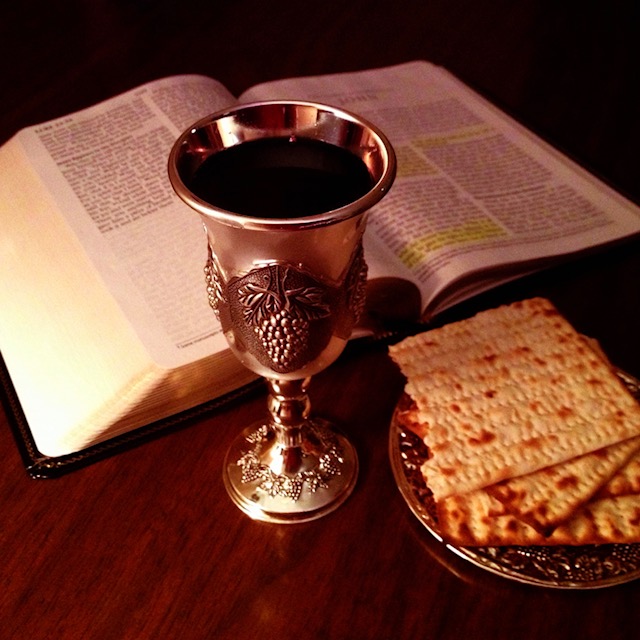
pic- bible and communionOur Bishop and Appointive Cabinet have given permission to practice alternative forms of Holy Communion where we “extend the table” through the distribution of pre-packaged elements or inviting participates to provide their own elements during a “live” gathering via Facebook or Zoom.  I am thankful for these guidelines as we all seek to do ministry in new and creative ways.  The guidelines given, however, focus more on logistics than on theology, which has led me to some needed reflection.  Not “can we”, but should we practice online communion during this time of social distancing?  How might this distort our understanding of the sacrament or cause unintended consequences?

To get into these questions, I started with the exercise of giving an “elevator speech” for how we understand holy communion. Here’s what I might say: “We believe that Holy Communion is a sacrament, which means that as we do what Jesus invites us to do, God is present and promises to act. Our communion together becomes an outward and visible channel of God’s grace in our lives, where we are incorporated into the story of salvation, fed with holy food, and connected together in peace and love.  This is not “magic” or “hocus pocus (a phrase possibly derived from the Latin where it is said that the bread becomes the body of Christ).  It is, however, a mystery. Communion is an opportunity for us to participate in the mystery of God who, through Christ and the Holy Spirit, comes into our lives in real, tangible, and incarnate ways.  We need more of this mystery in our lives!”

“When Jesus said ‘do this,’ he meant more than taking the elements; rather, he meant the whole experience – of gathering in real time, sharing in a blessing that includes an account of how God’s comes to save and the words that Jesus said over the bread and cup, followed by an invocation of the Holy Spirit to be present in our receiving and sharing. Next, the one who is duly called and ordained to administer the sacrament in keeping with the Apostolic Tradition, breaks the bread to be shared. In often open hands, each participate receives a portion of the larger loaf, shared from a common table that extends, from a spiritual perspective, beyond time and space into heaven itself.  In Holy Communion we become a part of something so much bigger than ourselves.  As we “do this” the healing, strengthening, and transforming love of Christ is given so that we might be the body of Christ in the world.  And finally, Christ is the host of this event; therefore, we do not judge who can come.  All who long for this love, who want to come and receive, and who desire to live in peace with others, are invited.”

Yes, that may be a little long for an elevator ride.  But if this summary has theological merit, then the question remains – not can we, but should we engage in online communion?  For my initial thoughts, I would give a cautious and qualified “yes.” I would say every effort needs to be made to keep it in “real time.” The notion of the incarnate presence of God is inherent in the nature of our understanding of the sacraments. It is about real, tangible, incarnate grace given in real time and space.  Facebook Live, for example, could work, but it would need to be clear that any views after the event should not to be used as communion.   Zoom might be a better medium, with its face to face feature in real time. Both of these options provide for the corporate nature of the sacrament – to some extent.

These virtual mediums also allow for the elements to be consecrated by one who is duly ordained to administer the sacraments. This is important as a way to honor the Apostolic Tradition – the passing on the faith of the Apostle and maintaining the traditions of the larger church, bringing the blessings of the church, beyond time and space, into our time and space and into our lives. As an Elder in the Church, I can’t just make stuff up.  While I am also called to be creative and adapt, I must do so in this larger context and in respect to the liturgy that has been given to me.  That’s what an elder is to do.  It is our job to struggle with such questions and work towards this balance.

With that said, Maundy Thursday is approaching.  To honor the mandate for social distancing, I will likely lead my congregation in some form of virtual communion. Our current plan is to do a Facebook Live Devotion early in the day, which will include an invitation to one of several Zoom gatherings for holy communion, asking people to provide their own bread and juice, while mentioning that both elements are not required.  We believe Zoom will provide us with a “real time” and “in-person” experience, needed to maintain the integrity of the sacrament.   At the same time, I will trust that God’s grace is big enough to overcome many shortcomings – which is a part of our understanding of sacraments.  Ultimately it is something that God does for us, and often in spite of us.  I invite your thoughts and wisdom.

Christology and Inclusion (in response to recent calls for schism among us)

Last week I was at a gathering for general conference delegates, held at an event sponsored by the Reconciling Ministries Network. I’ve been in several gatherings like this to prepare for General Conference and heard many different perspectives.  At this gathering, Bishop Karen Oliveto preached a sermon using, as her text, the story of Jesus and the woman at the well.  She offered up a very high Christology, pointing out how Jesus revealed to this marginalized person that he was the Messiah, the Christ. She called Jesus also our everlasting God. In the context of listening to calls for schism within our Conference because of “low Christology,” my radar was up, and I was pleased to hear this affirmation of Christ.

At this gathering, I heard many testimonies of people whose lives have been transformed by the living Christ, people who are so attracted to the message of Jesus that we are willing to stay in a church even in the face of harm, wanting to give witness to Christ’s steadfast and eternal love for all. I heard from people who want to be in a church where they can be held accountable for growth in faithfulness and the virtues of love.  It was made so clear that this movement was not about pushing some secular agenda.  This movement is made up of committed United Methodist Christians wanting a church that makes room for all, reads the whole of scripture without selective literalism to justify exclusion, and practices true Wesleyan holiness.  Many of these siblings remain committed to our beloved church because of Jesus Christ in their lives, certainly not to fight against him.

This experience serves as a backdrop for how I want to respond to recent calls to schism from colleagues in our conference.  To justify the call to intentionally bring division to the Body of Christ, we are being invited to look beyond differences of opinion on matters of human sexuality and towards the claim that the United Methodist Church is increasingly becoming “unitarian” in our theology, where we deny both the divinity of Christ and the primacy of scripture.  I do not believe that this projected narrative is based in any reality.  Furthermore, it is alarming to see our Living Lord and Savior being used in this way to justify division within the body of Christ.

In one sermon, the evidence of this heresy included a search of church websites where no information about Christ could be found on the home page, or beyond.  This example was shocking to me since the home page of the congregation lifted up as a model had no mention of Christ, or the congregation’s mission statement, on its home page. At the time that I looked, such statements could be found in subsequent pages, but this would be the case for many.  Is it fair to judge the Christological witness of others because of poor website management?  If there was a mass movement to disavow creeds in worship, or not baptize in the name of the Trinity, then I would consider joining in this response, but that is simply not my experience.   I would even say it is a false witness.

Other “evidence” revolved around statements from two bishop, one of them not United Methodist, who have probably not been quoted by a United Methodist pastor in 20 years – and even back then, it would have been rare.  In some quick research on one of them, I found that this bishop did not deny the resurrection, but questioned whether the resurrection involved a resuscitation of the physical body. I suspect he used standard scriptures to share this perspective – the way the risen Christ was able to transcend time and space in the gospel accounts and the Apostle Paul’s affirmation that we are raised with a new spiritual body.  Out of a high view of the whole of scripture, it is possible to engage in theological reflection around such topics, as we open ourselves to the mysterious, sovereign, uncontrollable nature of a God who will not be boxed in by our limited perspectives. Scriptures support that. Today, such theological explorations are common even in the most conservative of circles for those who dig deep into the Word.  Schism will not move the church away from this kind of theological exploration.

In this call to “split,” a quote was used from Bishop Oliveto.  It was lifted out of context from an online devotion dealing with a very challenging passage of scripture from the lectionary that week — Matthew 15:21-28. In this passage Jesus encounters a gentile woman asking for healing for her daughter and is likened to a dog.  With her push back, Jesus seems to change and takes time to bring healing to her family.  In her devotion, Bishop Oliveto clearly named Jesus as our “wonderful counselor, mighty God, everlasting one, and prince of peace.”  She framed her struggles through this text with a very high Christology, but here dealt with humanness of Christ, the one “who did not count equality with God a thing to be exploited but emptied himself…”- and came all the way into our humanity.  In this humanness he gives us an example of how we might need to be transformed.  While one might argue with the interpretation, this one reference, from one of many bishops, does not seem to be adequate grounds to incite division of the body.

As we move towards General Conference, I want to be a part of the strong movement that believes in both inclusion and in Jesus Christ as Lord and Savior.  In this movement, these two commitments go together, and by putting them together God is truly glorified. To separate these two commitments and try to paint those who want inclusion as those who practice a low Christology is, in my opinion, a false characterization that is harmful and divisive to the body of Christ.  Frankly it hurt!

Please know that I share this witness out of a sincere hope for reconciliation and for peace among us.  I truly believe that is what God wants from us and for us. In this light, you are invited to choose reconciliation over schism. Please prayerfully reflect on which one of these choices truly glorifies Christ.

(Up next – I was asked “What would Wesley have to say about this?” I’ll try to address that)