
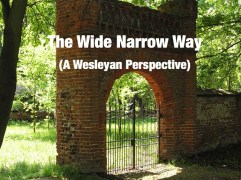
The Wide Narrow Way (A Wesleyan Perspective)

phonto-1How’s this for a timely thought from John Wesley? Wesley calls us to purify our hearts from “all party-zeal,” from “prejudice, bigotry, narrowness of spirit; from impetuosity, and impatience of contradiction…” (Sermon: National Sins and Miseries).  I want to explore a few of these conditions.

Party zeal! Wesley speaks often of the problems caused by zealousness for the “part” rather than the whole within the body of Christ.  In contrast, he calls is to be peacemakers, willing to step “over all these narrow bounds” with a love that is patient and kind, never insisting on its own way. Sometimes, “party-zeal” leads us into the trap of too hastily judging others, based on our “opinions,” while seeing little need to be patience with ourselves because we are already models of true faithfulness – at least in our own eyes.

Impatience with contradiction!  As finite beings, our relationships are rarely neat and uniform, free of differences or paradox. Within the church there is so much diversity among those seeking to be faithful in the midst of such varied circumstances.  This diversity is the context in which we learn how to love, and thus be the church. Impatience with contradictions betrays the call to this holy and humble love.

Narrowness of spirit!  Our orthodox faith, built upon the doctrine of the trinity, is meant to expand our understanding of God and actually keep us from narrow agendas.  In reality, however, the opposite can happen.  A focus on “right belief” and “right opinion” can lead to a narrowing of our capacity to love. The way out of this temptation is to focus on “holy virtues” over “right opinions,” and on people more than positions. With this focus, we are able to glorify God rather than just call attention to ourselves.

The Narrow Way! The way into God’s kingdom is by the narrow gate.  As Wesley makes clear, the wide and easy way is the way of division, contention, power, and judgment. That’s the way of the world.  The true narrow way is the way of “poverty of spirit” — recognizing that we all lack the means to achieve what we really want.  Into our poverty, Christ comes with the indescribable riches of God’s grace, with light to overcome all forms of darkness. In this same vein, the narrow way is the way of “holy mourning, of meekness, of mercy.” These are the virtues by which we connect to others and, together, show the way of God.  The narrow way is the way of “ordering conversations aright,” and thus working for unity of spirit always in the bond of peace. Along this way, we discover the wideness of God’s mercy and grace.

At one point, Wesley says that he would rather listen to a “generous heathen” than a “poor narrow-souled Christian.” As a hindrance to the health of the Body, Wesley also speaks of the “enthusiasm of weak and narrow souls,” who are “always righteous over much.” (See Sermon: The Spirit of Bondage and of Adoption).   We might conclude that narrow souls follow the wide way of the world — allowing party zeal, impatience, judgment, bigotry and bitterness to “disease” the whole body.  Souls that are wide in love follow the narrow way, the “road less travelled.”  And make no mistake, this narrow way is hard, for it requires us to give up our righteousness and to risk the wrath of those bound by fear.  Following this way can only be done by a deep trust in God.

Through this narrow gate, Wesley pushes us even farther.  We may strive to enter by the narrow way and still build a barrier to the holy love that God desires for us. The deepest places in our hearts may still be wide open to the ways of the world.  This is one reason why, for Wesleyans, the “road less traveled” always calls for deep and constant self-examination more than a focus on others. There is always spiritual work to be done within ourselves as we enter into the fields of God’s abundant love.  (See Sermon: Upon the Sermon on the Mount, Discourse 11).  That’s the Wesleyan way!

(Up Next: Patience as a Way Forward) 

Party Zeal and the Call to be Peace-makers

img_0491Party, Partisanship, Partners, Partakers. All of these words have the word “part” in common.  In a “party,” the healthy perspective is to see yourself as a part of a larger whole.  There is great danger in believing that the part can be the whole, that any part can possess all truth unto itself.

Wesley would agree.  This is why he cautioned us against “party zeal” in the church and contrasted this zealousness with the call to be peace-makers.  Here’s Wesley’s definition: A peace-maker is one filled with the love of God and all people, one who is not confined to expressing this love only to family, friends, or party – those of like opinion or “partakers of like precious faith,” but who steps over all these narrow bounds, and manifest love to others, even strangers and enemies. In another place, Wesley insisted that followers of Christ purify themselves from all “party-zeal” and purify their own hearts before casting any judgment on others.   To give into such zeal is to become a “narrow soul.” This doesn’t mean that we give up our opinions, but it does mean that we engage others in opinion-sharing in a very different way than we often see modeled in the world. (See Sermons: Upon the Lord’s Sermon on the Mount, Discourse 3 and National Sins and Miseries).

If politics is the art of making good decisions for the whole, and not the part only, then politics requires meeting in the middle, opening ourselves to new perspectives, and coming up with solutions that are “win-win” rather than “win-lose.”  Wesley actually uses the word “middle” as the proper place for true Christian witness and the best platform upon which we might see more of the whole and thus be instruments of peace.  Extremes bring harm. This may not be the way politics is practices in the world, but it is the way we are called to practice politics AS the church.

In this light, Wesley asks this question: How can we bear the name of the Prince of Peace and wage war with each other – “party against party,” faction against faction!”    For the church, this happens when we are “drunk with the blood of the saints.” In this state, we allow contention and malice to drive us, “even where [we] agree in essentials, and only differ in opinions, or in the circumstantials of religion!”  Our true calling, says Wesley, is to “follow after only [his emphasis] the things that make for peace, and things wherewith one may edify another.”  Anything other than this is to “devote each other to the nethermost hell.”

Wesley makes it clear.  If the world is looking at us and saying anything other than “look at how they love one another” then our witness is causing harm. That happens when a lust for rightness and power becomes our focus, usually justified as righteousness. (Sermon on the Mount, Discourse 2). For Wesley, “true religion is nothing short of holy tempers.” – humility, patience, and love above all, virtues to be practiced as parts of a larger whole, virtues that make for peace.  In these anxious times we need peace-makers… and a lot of them.

Up next: The Narrow Way (A Wesleyan Perspective) 

The Madness of Building on Sand (Another Word on Wesleyan Orthodoxy)

It is madness, says Wesley, to hold to a set of “notions” and suppose that they are “more rational or scriptural than others,” as if we can be “right” or “orthodox” in this way, and as if this were at the heart of our witness. Wesley compared this zeal for orthodoxy to building our spiritual home on sand. In fact, Wesley says it is worse than that; it is more like building on the “froth of the sea.” (See “Upon our Lord’s Sermon on the Mount, Discourse 13).

Wesley rarely (I believe I could say never) used the term orthodoxy in a positive way. At the same time, it is clear that he promoted key doctrines and core beliefs. Doctrines of the trinity and the incarnation, for example, expand our understanding of God and keep us from getting locked into narrow agendas.  They enhance faith…BUT only when in service to the call to love.  When they are used to set up “us and them” categories, or to promote positions over people, or to justify division in the body of Christ, or to lay claim to “faithfulness” for ourselves, they do great harm. When used in service to ourselves and our causes, these good doctrines are placed into the service of the devil, says Wesley. They promote a Pharisaic faith, as Wesley argues elsewhere.  They inspire building on sand.  Yes, Wesley used multiple metaphors to keep us from missing the message, and yet he still might have underestimated how alluring this mode of faith can be. We are prone to such madness!

It makes me wonder why so many Methodists are enamored with the notion of orthodoxy today. What does the word “Wesleyan” refer to in the phrase “Wesleyan Orthodoxy?” Is it simply a reference to our historic roots and a way to make a connection in order to promote a new theological agenda?  I wonder, what might happen if we actually engaged Wesley and let him, as our spiritual father, guide us through our current struggles.  Would that not be our better hope for a Wesleyan revival?

If we did this, I suspect that talk of splitting or schism would not even be on our radar.  I suspect that there would be a lot less labeling. I suspect that we would put a lot less energy into creating like-minded political camps.  Instead, we would distinguish ourselves not by doctrine or code words, but by the love in our hearts and our desire to glorify, not ourselves, but the One who is saving us – even us — by much needed grace.  Our focus would be on how we might “outdo one another” in showing this love.

From a Wesleyan perspective, that’s the way to build our spiritual home on a solid foundation, one with the strength to hold us together by something more than our opinions and positions.  What if we let the Holy Spirit do this work, of bringing us together upon the solid foundation of God’s peace which passes human understanding? What if we poured our energy into growing together in the holy virtues of meekness, patience, gentleness, and compassion, to name those on Wesley’s frequent list. That possibility moves me to joyful tears.

The word “orthodox” is not the only word being used to divide, and I dare say, to do harm. Others include evangelical, justice, rights, tradition, faithfulness, truth, and even love. While I do trust that God can use even our harm to do good, I also see that Wesley wants us to pay a lot more attention to the “woes” that are pronounced upon those who do the harm, especially when the harm is justified as righteousness. I wonder if we need to be a lot more fearful about that – of God taking an anointing away.  What if our focus was on our common “solid” foundation? What might it look like if we were all more Wesleyan in this way?  And thus less mad?

Up Next: Is it time to split? (Wesley had a lot to say about it).

Orthodoxy and Our Treatment of Others

In continuing the previous post, there is no doubt that Wesley was orthodox in the sense of affirming the Trinitarian faith.  The “rightness” of this doctrine is illuminated in the way it expands our understanding of God and keeps us from getting locked in our prejudices and narrow theological agendas. Likewise, Wesley affirmed the divinity and humanity of Christ. This full understanding of the nature of Christ keeps us from over-spiritualizing, on the one hand, or over-moralizing, on the other; it also has implications for the way we embrace grace and holiness, evangelism and social justice, knowledge and vital piety, among other blessed tensions within the faith – tensions which lead to wholeness.

What Wesley DID NOT like is the term “orthodoxy” itself. It would seem that too many in his day were using this term as a label to claim “right belief” over others. Too many were placing “right belief” at the core of faith.   Seeing this, Wesley says that orthodoxy or “right opinion” is “at best a very slender part of religion, if it can be allowed to be any part of it at all.”  In even stronger statements, he equates those who claim to be orthodox as promoting a form of “salvation by works,” and even condemns it as the “faith of the devil.”  For Wesley, our life-giving faith grows through how we threat one another. It does not grow through our need to win or defend our version of “true faith.” In faith, God does not need defended in this way.  That stance leads to haughtiness, arrogance, divisiveness, anger, abuse, self-righteousness, and self-proclaimed faithfulness – the opposite of the life-giving witness manifested through the virtues of humility, patience, kindness, and love (a few of Wesley’s favorites as he describes true holiness).

Centering faith in “right opinion” rather than in relationship is more than misguided; it can be insidious, it can be violent; it can do great harm.  As we struggle through issues as the body of Christ, we need to be cautious about following those who are “drunk with the blood of the saints,” to use another image from Wesley.

So how might we approach someone whom we suspect believes “wrongly?” From a Wesleyan perspective, when we engage others our focus can never be on what they believe or don’t believe, or on any “externals,” as Wesley calls them, even on good works.  Our focus must be on “nothing short of ‘the mind that was in Christ,’ the image of God stamped upon the heart… attended with the peace of God and joy in the Holy Spirit.”  In other words, we focus on our heart and our desire to show pure love.  This approach opens a way for the Holy Spirit to do the work of building relationships and creating unity, not in opinion or even practice, but in love.

In this holy relationship, our hope is to see peace and joy, humility and love in the other, but what if we see no evidence of these virtues?  At this point, we look, not for some fault with them, but inward once again. We ask: Is there something in me that is blocking me from seeing these blessings in the other? Any questions about the character or actions of the other are a very distant second, if ever asked at all.  If it turns out that the blessings of peace and joy, faithfulness and fruitfulness, are not in the other, then our next response is not condemnation, judgement, or argument; our response is to actively stay engaged, show mercy, and to pray that we might be instruments that help produce these blessings. That’s the “right” way for the people called Methodists. (See “A Plain Account of the People Called Methodists”). 

Oh, if only this could be our focus. If only this could be our hope for one another. If only this could be our witness in the world. Is this not worth being more than a dream?

(Up Next: Orthodoxy and the Pharisees, another word from Wesley)