If you would like a reading challenge, I would suggest getting acquainted with John Wesley’s sermons. These sermons are a part of our doctrine and have the power to inspire and guide us into a new season of faithfulness – as individuals and as a church.
With this motivation, I suggest this series that starts with Advent and goes through the liturgical year. In each chapter there is a paraphrase of one of Wesley’s Sermons, a devotion on the same theme, and resources for reflection. In terms of scholarship, one thing that makes this series attractive is the way Wesley’s sermons have been rearranged to fit within our regular liturgical rhythms. We can truly go through the year with Wesley in a way that connects us to worship and to the seasons of our lives.
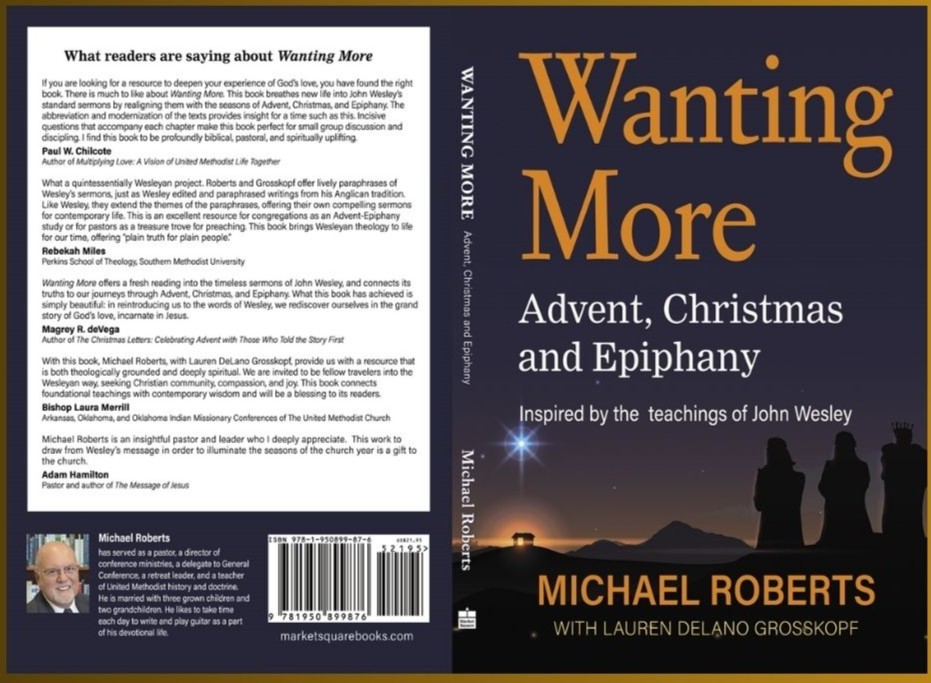
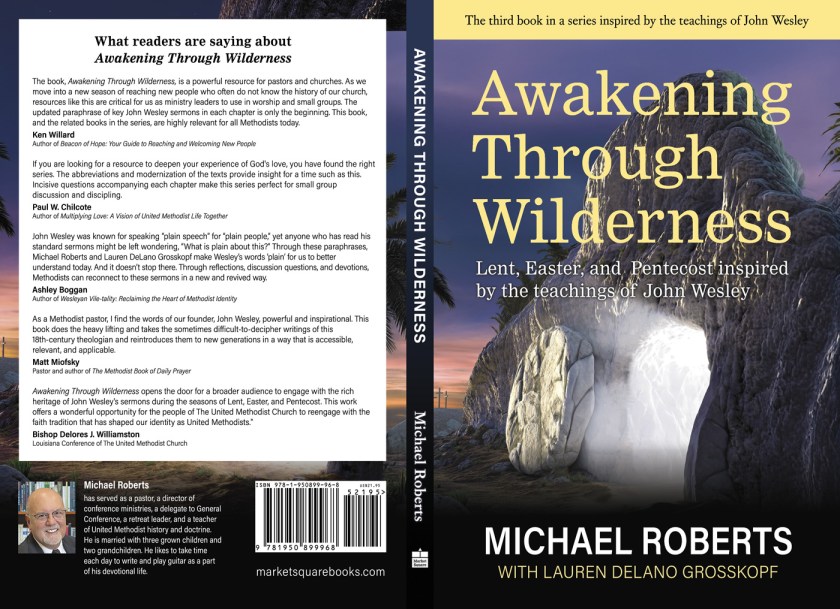
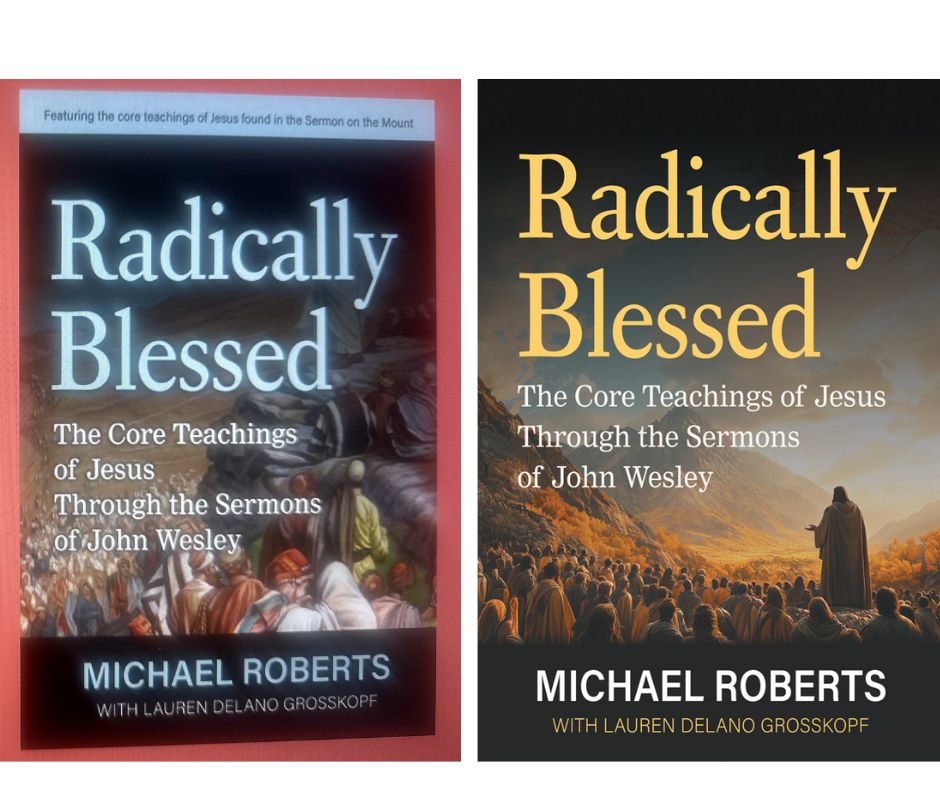
The journey starts with Wanting More: Advent, Christmas, and Epiphany Inspired by the Teachings of John Wesley. The next book, Awakening Through Wilderness takes us through Lent, Easter, and up to Pentecost. The third book – Radically Blessed – takes us through the sermon on the mount. And a fourth book will be coming out for the Fall focusing on practical divinity. The title will be Heart to Holiness.
As we move into a new season of faithfulness and hopefully fruitfulness, spending some time in our roots and history may be an important key. I believe this is true.
Give it a try. There is a sample of the first book on Kindle. Or it can be purchased through Market Square Books, Cokesbury, or Amazon/Kindle. I pray that this will be challenging, inspiring, and will help you and all of us bear good fruit into a new season.
No doubt we are moving into a new season in the life of the church. In order to navigate this reality, I am convinced that we need to look into our past as much as we look towards the future. Or maybe a better image is the need to attend to our roots in order to branch out and bear good fruit.
With this motivation I, along with Lauran DeLano Grosskopf, have written a series of books where each chapter contains a paraphrase of one of Wesley’s sermons, a devotion on the same theme, and resources for reflection. With this series, Wesley’s sermons have been rearranged to fit within the liturgical year, thus connecting them to our weekly rhythms. My hope is that these resources will help us reacquaint ourselves with inspiration from our past and lead us to good fruit as we move into a new season as United Methodists. This would be a good way to go through the year with Wesley.
Below is a brief description of the latest book from the publisher. Within the book there are testimonies from Paul Chilcote, Ashley Boggan, Bishop Deloras Williamston, Ken Willard, Adam Hamilton, Bishop Laura Merrill, Rebekah Miles, and more.
“Awakening Through Wilderness invites readers on a transformative journey through Lent, Easter, and Pentecost, exploring timeless truths through the voice and vision of John Wesley. This third installment in this acclaimed series builds on previous works, Wanting More and Radically Blessed, continuing the mission to make Wesley’s foundational teachings accessible and deeply relevant for today’s church.
In this book, each chapter offers a devotional paraphrase of one of Wesley’s classic sermons, followed by a modern devotion and practical questions for reflection. Each chapter masterfully connects Wesley’s original passion for renewal and reform with the liturgical rhythms of the church year, guiding readers through themes of fasting, self-denial, temptation, grace, and resurrection.
The wilderness becomes a powerful metaphor for life’s trials, doubts, and spiritual dry seasons-those times when God seems distant and faith is tested. Through Wesley’s insights and pastoral reflections from Michael and Lauren, readers discover that the wilderness is not merely a place of hardship but also a space for awakening, transformation, and renewed purpose.
Whether read individually or used in a group study setting, Awakening Through Wilderness offers a clear, engaging path for spiritual growth. Each chapter’s discussion questions and reflection resources make it ideal for small groups, Bible studies, or personal devotion, especially during Lent.
The books in this series are written with warmth and clarity, drawing on deep knowledge of Wesleyan theology and a pastoral heart for today’s church. Throughout we are reminded that “God’s love comes to us on its way to others,” inspiring readers to grow in grace and to live out their faith with courage and compassion.
You are invited to step into the wilderness and emerge awakened to the transforming power of God’s love.”
These books are available through Market Square Books, Cokesbury, and Amazon/Kindle. I would be honored if you would take a look (you can get a sample through kindle) and if you feel so led, share these resources with others. If you would like to talk about this, please know that I would love to have that conversation. Many Blessings!
In Arkansas a law has been passed mandating that the Ten Commandments be on display in all classrooms (See Bill 433, now Act 573). This week the University of Arkansas will become the first public university in the country to post the Ten Commandments in this way (in the midst of challenges, stays, and appeals). Since this law enters into my domain as a pastor and person of faith, I have some thoughts.
I want to weigh in specifically on the actual words that are mandated. A particular version of the commandments is found within the Bill itself. Comparing the Bill to the scriptures, it is interesting to note what has been left out and what has been left in. In addition, it is noteworthy to see how an old translation (the King James Version), complete with “thou’s” and “shalt’s,” has been manipulated and then promoted as an official version. The Bill begs questions about motivation and intent.
I’ll start with the most alarming, in my opinion. While several of the commandments have been abbreviated, with many of the original words left out, the last one is given in full. To fit with the others, it could have read “Thou shalt not covet.” One has to wonder why this version does not focus on the dangers of coveting in a more general way – like we see with the other commandments here. Instead, specifics that are included in the original texts are shown. We read, “Thou shalt not covet thy neighbor’s wife, nor his manservant, nor his maidservant, nor his cattle…” Is the intent here to suggest that this is really only for men (males)? This possibility gains credibility when we note that the pronoun “his” is used three times in this one verse. This is redundant and unnecessary if translated from the original language. In addition, does this expanded listing imply that slavery is to be condoned or that women in positions of authority can be tolerated and useful if they know their place as maidservants? It makes me want to see a counter-list of all the passages that lift others up rather than marginalize. And for an almost humorous note, the original words in the KJV list other animals. Why is “cattle” the only animal in this version?
For the first example of important words being left out, the whole list starts with “I am the Lord thy God. Thou shalt have no other gods before me.” In the scriptures more is given between these two sentences. We hear of God speaking to a specific people who had been delivered out of Egypt and out of bondage. This group of people are invited (not forced) into this covenant (See Ex 20:1-17; Deut 5:6-21).
The third commandment, in this mandated version, reads, “Thou shalt not make to thyself any graven images.” In the KJV version of scripture, it is worded a little differently and there is no period after the word “images.” With a comma we are beckoned to read more. The commandment goes on for three long verses with words from a jealous God who will visit iniquity on those who break this commandment, to the third and fourth generation, and will show mercy on those who keep these commandments – with some debate about whether this refers to these first two commandments or all the commandments.
As one who truly believes in a living God, I would worry about whether this Bill could be considered a form of creating a graven image. In addition, a larger theological reason for this commandment is to help this community avoid limiting God to one perspective or trying to control God. That’s what graven images can do. God is bigger than that.
In the scriptures, the commandment around the sabbath goes on for four verses, with details and specifics. In the spirit of making a list for a mandated 16inch-by-20inch framed poster, it is understandable why these details would be left out – along with the possibility that we really don’t want to encourage people to abide by this weekly rhythm. It still begs the questions, why was this one abbreviated and others not? What is the real message here? It would seem like that would be important for us to discern if this kind of investment is going to be made.
It does strike me that this mandate possibly goes against the spirit of the commandments themselves. Is God’s name being used – in vain – to intimidate and create division? Does this law manipulate the words of scripture to promote an agenda that is arguably intended to marginalize some? I hope that this analysis has sparked a willingness for more discernment – perhaps with a healthy dose of fear and trembling.
As a Christian, I am all for honoring the Ten Commandments. In my tradition as a United Methodist, I also believe that these words are to be interpreted through the lens of what we call the royal law of love. Jesus himself followed this method of interpreting scripture when he said that all the law and the prophets can be summed up in the commandment to love (Matt 22:37-40). And we know what this love looks like. It is illuminated with patience, kindness, and a humility that does not insist on its own way. This love believes in others; it hopes for all that is good for others (I Cor 13). It builds up rather than breaks down. It unites rather than divides. It is the more excellent way. And this way can be seen in the Hebrew tradition as well, especially through the prophets.
I wonder what it would look like if we gave this witness, not with mandated posters, but with actions based on words written upon the heart.
The word “exposed” is meant to be provocative. Other terms would be “revealed” or “illuminated.” Going back to Wesley, a lot of misconceptions have existed around the use of the word “method” in Methodism. Its deeper meaning is often lost.
The method of Methodism is often defined as the disciplined and intentional practice of the Means of Grace – prayer, worship, searching the scriptures, conferencing, service, etc. There is truth in this, but we miss much inspiration if we stop here. [i] While Wesley does give praise for the Means of Grace, he balances this praise with strong warnings. We can engage in all of these practices, and they can still sink us into a living hell. The Means of Grace can be more of a burden than a blessing. They can lead us into the form of religion without the power. This happens when we turn the “means” into the “end,” and begin to think that faith is found in the practices themselves. [ii] (For more see the notes below)
When Wesley uses the term “method” he most often speaks of the method that God uses to bring us into life.[iii] Wesley describes God’s method with the word “reconciliation” in one place. In another place, we are told that Jesus is God’s method for healing souls that could never be healed by human endeavor. The outcome of God’s method is the renewal of the image of God within us.
In more than one place, Wesley gives us an outline of how this method typically works. [iv] The first step is an awakening in the soul to the mystery and reality of God. This awakening often starts with fear. We recognize our sin and how short we fall from the glory of God. How can we ever be justified – in alignment and harmony with God? How can we ever be saved? This fear often leads to attempts to justify ourselves. And these attempts always leave us wanting. When religion is defined in this way, we only bring God down to our level. From here, we are led into the heart of God’s method. We are awakened to God’s eternal love and this changes everything. It leads us into a desire to practice the Means of Grace, along with disciplined and daily self-examination, with the hope of being transformed, from one degree to another, into the very image of Christ and Christ’s love. This is a way to describe the method that God uses to bring us into life.[v]
And now, here is a more poetic way of describing God’s method, using a Charles Wesley hymn as inspiration:
This is how it works.
Love comes first.
It opens our heart to a new reality.
We sense that we’re a part of something bigger than ourselves,
And more than any finite thing.
This love works to pave the way
And plants the seeds of living faith.
This is how it works. God’s love comes first
And it leads to,
A faith that works by love, a faith that works for love. Love!
This is how it works, our hearts are changed;
We turn towards life-giving grace.
We sense that heaven has begun in us,
And new life has been won.
This love works to make us whole,
And forms the Savior in the soul.
This is how it works. God’s love comes first.
And it leads to,
A faith that works by love, a faith that works for love. Love!
(Lyrics to a worship song entitled, “Faith that Works for Love,” inspired by the Hymn “Let Us Plead for Faith Alone.” For a version of the song, additional verses, and commentary on how this method contrasts with other understandings of faith, see Hymn Inspired Worship Songs, YouTube, Michael Roberts. This was a part of my pandemic project)
[i]It is worth noting that Wesley does not tie the word “method” to the Means of Grace. In the sermon on the Means of Grace, for example, no version of the word “method” or “methodism” is found.
[ii]Moving in the other direction, in Wesley’s famous pamphlet entitled “Character of a Methodist,” he does not directly talk about the “means of grace” or focus on what we do. In fact, he says that our “schemes of religion” are “quite wide of the point.” For methodists, faith is so much more than “just believing” or “accepting” what God has done for us. A methodist is one who has been awakened to God’s love. In faith, we give ourselves into this love. The experience of this love leads to peace with God and this peace leads us to “abound in love and in good works.” To paraphrase Wesley, “Methodists are those who think, speak, and live, according to the method laid down in the revelation of Jesus Christ. Their souls are renewed after the image of God, and in all true holiness. Having the mind that was in Christ, they walk as Christ also walked.”
[iii]Key sermons from Wesley on this topic include Righteousness of Faith where we read of God’s “method of reconciliation.” In the sermon Original Sin we hear that Jesus is God’s method for healing souls that could never be healed by any human endeavor. Through Christ God heals our “functional atheism” by giving us faith – that divinely given conviction that God is with us and that nothing can separate us from God’s love. This leads to repentance, to trust, and transformation into the love of God. In the sermon Laying the Foundation we hear, once again, that methodism is not a new religion. It is the restoration of the image of God, centered in love, which is the summary of all the law and the prophets. Methodism is about intentionally cultivating the blessings of love, joy, and peace in the Holy Spirit. It is not rooted in orthodoxy of opinion. In this sermon Wesley speaks of this divisive temptation and then gives thanks for being delivered from this misguided zeal. God’s method is never meant to lead to the arrogance of spirit that causes division and harm within the Body of Christ. In the sermon Use of Law we hear that the ordinary method of God is to first convict us of our sin and our need.
[iv]God’s method involves movement along the Way of Salvation. This movement is described often with the key terms of Justification to Sanctification (and later others built upon what Wesley said about Preventing Grace and added Prevenient Grace as a way to describe the movement of God in our lives). In another place, this movement is described with different States of Being in which we may find ourselves. In our Natural State there is a false peace with no thought of God. This can lead to a Legal State, where there is no peace at all. Next is the Evangelical State or the State of Love where we experience the peace of God.
[v]Perhaps more than practicing the traditional Means of Grace, (or perhaps at the heart of this practice) we participate in God’s method through disciplined and regular self-examination. Wesley consistently posed questions to the people called Methodists, calling for daily reflection. Is heaven in your heart? Is your heart being transformed into the likeness of Christ? Are you growing in holiness, defined by the virtues of patience and kindness and a humility that does not insist on its own way? Are you attending to the means of grace that will open the way for this love? Are you becoming less judgmental and more compassionate? Do you know the peace of God? Do you let other theological/political matters distract you from our core purpose? Do you understand that the narrow way leads us into the wideness of God’s mercy and the wide way of the world leads us into narrowness of spirit? These are the kinds of questions that Wesley posed over and over again as a way for us to participate in God’s method.
Marriage! This word that signifies coming together in unity and love has also been used to create so much judgment and division in our denomination. In the midst of this tension, I recently had an appointment to do pre-marital counselling and was inspired to approach this meeting in a new way. I started with the Book of Discipline. It can be so helpful to actually look at what the B.O.D. says. With the changes and additions at the last General Conference, we have renewed our focus on the values of marriage that are life-giving for all – “fidelity, monogamy, commitment, mutual affection and respect, careful and honest communication, mutual consent, and growth in the grace and in the knowledge and love of God.”
Imagine using this list as a theological and moral foundation to move into conversations about all the topics in a pre-marital meeting – family history, birth order, finances, religion and faith, expectations, personality types, etc. And to be clear, this particular list is found under Clergy Qualifications but can definitely be used to help us understand the values needed for a healthy marriage and for life-giving relationships in general.
We can also use the Book of Discipline to affirm marriage as “a sacred and lifelong covenant.” Marriage is a union with “one another and into a deeper relationship with God and the community of faith.” Marriage “reflects a continued willingness to grow together in Christ and a commitment to cultivate a covenantal bond that encompasses intimacy, grace, and love.” And there is so much more.* These statements are important because they call those getting married in the church to be a part of the faith community. Imagine using these statements to explore how being a part of the larger community can be a blessing.
We can compare these statements to what we see in another methodist denomination, which says: “We believe that human sexuality is a gift of God that is to be affirmed as it is exercised within the legal and spiritual covenant of a loving and monogamous marriage between one man and one woman.” One might ask: Is this the only way to understand human sexuality? Our new statements give us the opportunity to view human sexuality in a larger context, expressed in many ways, from our style and dress, to our natural attractions, to how we interact with one another. It can be expressed through our desire for intimacy at all levels of relationship, from holding hands, to a kiss, to decisions about commitments, and how we might express the values listed above. The affirmation, support, forgiveness, and teachings of the church can be helpful all along the way. And we can share this grace with a focus on calling, character, faithfulness and fruitfulness – and do this for all without having to automatically exclude some.
As evidenced by the recent Judicial Council ruling, tensions remain.* These tensions, however, do not have to divide. We do not have to give in to the arrogance of spirit that causes so much harm and keeps us from honoring one another. To come full circle, as if it was a ring upon our finger or a seal upon our heart, perhaps the way we relate to one another can be inspired by the values we want marriages to model. How might these values this understanding of marriage be life-giving for the church as a whole?
* For more see: “Beyond Soundbites and Towards Holy Conferencing (A Series on the Actions of General Conference)” at connectedinchrist.net One section in the document on marriage has been revised after the recent decision from the Judicial Council giving clergy the responsibility for deciding whether they will perform the religious marriage service of a couple within the church, and in light of the call of our bishops who expect pastors to “exercise their authority with deep pastoral sensitivity to the congregation and community to which they are appointed.” This means that Holy Conferencing is always in order. Looking at what the BOD actually says can be so helpful.
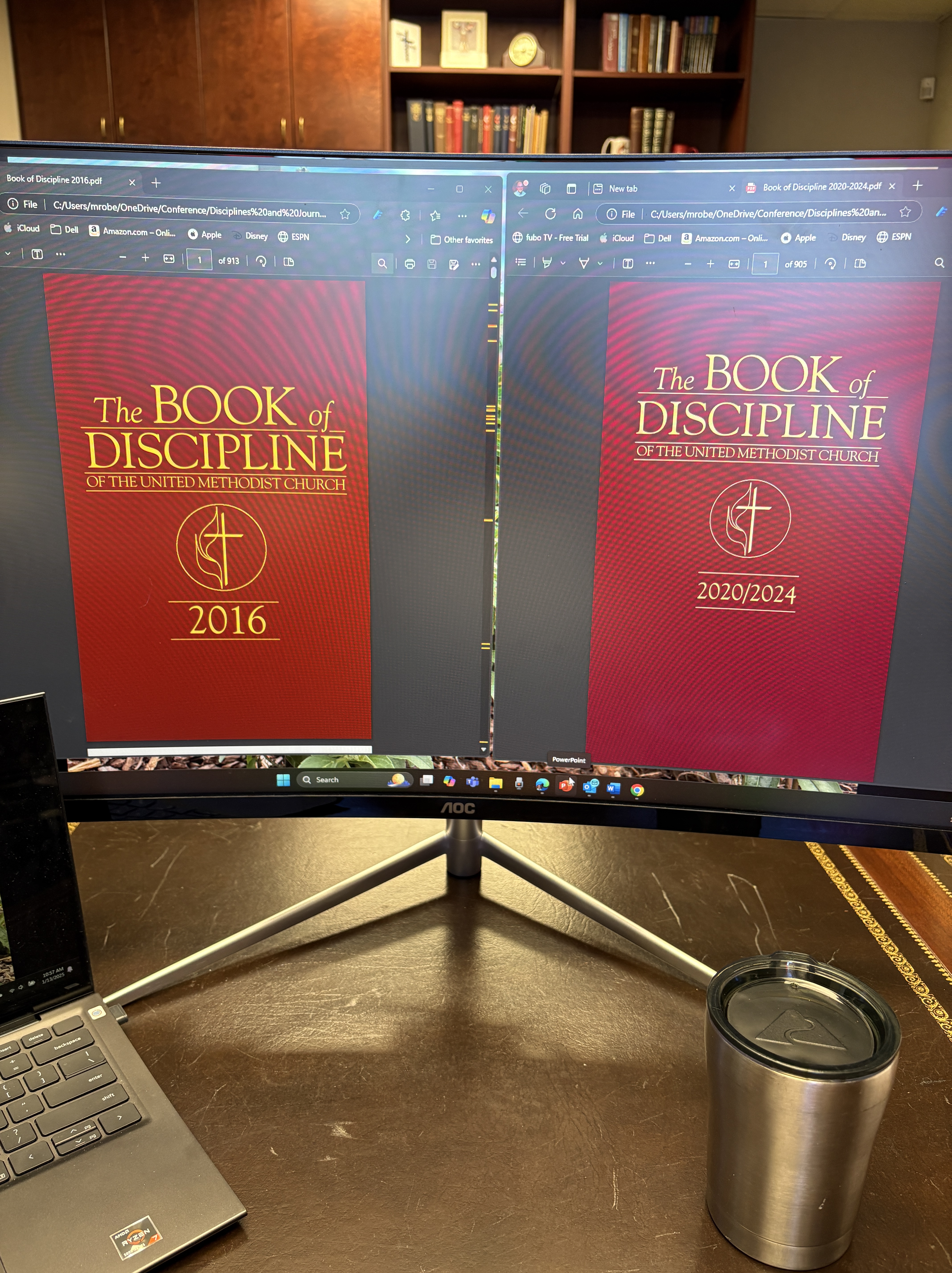
While waiting on my hardcopy of the new Book of Discipline (BOD), I turned to the PDF version. I was inspired to do a quick comparison using the wonderful search feature.
I started by searching the word “incompatible” hoping to see a “zero.” I was a bit disappointed to see that it does appear one time, but in a quote of the previous BOD and in reference to moratoriums on judicial proceedings. By comparison, in the 2016 BOD this word appears eight times with four of these naming one practice or group of people. In another place we read that war is incompatible with the teachings of Christ. In other places we read that military service, science, and abortion under strict circumstances are not incompatible. The new BOD deals with these topics in similar ways but without using this specific term.
My next search was for the word “fidelity.” This word appears seventeen times in the new BOD and eighteen times in the previous version. In both, four of these call for fidelity to the Apostolic Faith and the Doctrine and Discipline of the Church. Another five deal with finances. In both versions the remaining references focus on standards for clergy.
In the 2016 BOD the phrase “fidelity in marriage and celibacy in singleness” appears seven times. The word then appears twice in a definition of marriage. These statements were often used to keep us from considering the calling and character of some. Too often, they came up only when there was a desire to exclude or punish. I am glad they are behind us.
In the new BOD, we see a focus on virtues that are life-giving for all and give witness to the “highest ideals of the Christian life.” There was an effort to strengthen our sexual and moral ethic, without a double standard and without some of the confusion around definitions of terms. This following statement appears seven times, calling for “the exercise of responsible self-control by personal habits conducive to bodily health, mental and emotional maturity, integrity in all personal relationships, social responsibility, faithful sexual intimacy expressed through fidelity, monogamy, commitment, mutual affection and respect, careful and honest communication, mutual consent, and growth in grace and in the knowledge and love of God.”
I do not see this as a move to the radical left – or whatever language might be used to characterize these developments negatively and to cause further division among us. As a person who was at the General Conference and who worked on a committee that initiated some of these changes, I witnessed a beautiful effort to be faithful and to be responsive to the high and holy calling we have been given to love one another well. With God’s grace and guidance, I believe our General Conference did good work that will bear good fruit.
As I opened this new version of the Book of Discipline, my first response is to give praise to God and then to give thanks for all who worked to make this new and faithful witness possible.
I do look forward to getting a hardcopy. I will place it among other treasures that mark significant moments in my life. This one was big.
After the recent election, I found myself in a fog and unsure of what to say as a pastoral leader. I ended up – thank God – in a familiar place and one that rarely fails to inspire. I began to wonder – What does John Wesley have to say about elections? I will jump into the theological deep end and then explore some implications on our human elections.
Generally speaking, there are two very different understandings of election within the Body of Christ. A perspective born out of Augustinian/Calvinist theology uses this word to describe how some are predestined to salvation and others are damned based on an irrevocable decision from a God who is sovereign and knows all, an absolute decree made from the “foundation of the world.” (Matt 25:34; Eph 1:4; Heb 9:26). This perspective puts a lot of weight on, what is called, the foreknowledge of God (Rom 8:28-30; Acts 2:22-24; Rom 11:1f). This perspective is popular in our culture and is being expressed in some bold, even militant forms.
While still using the terms election and predestination, Wesley offers a more nuanced perspective, seeking to honor both the scriptures and our experience of having free will and learning to love in relationship. We are elected or chosen to give witness to a grace and a way of salvation that is available to all. Our election is about so much more than “just believing.” We are invited to open our hearts to God’s transforming grace and to reflect the image of God. Our participation is a part of God’s election, God’s purpose for us, from the “foundation of the world.” And to be clear there are reformed theologies that share a softer approach, to use Wesley’s language.
These two perspectives lead to different understandings of God’s sovereignty. One is often viewed through the metaphor of a monarch (or dictator) with an emphasis on the depravity of humanity and the need to control and protect from the top down. From this perspective we might ask, why would we be more merciful than God? A Wesleyan perspective can be seen through the metaphor of a loving parent, where authority is revealed as respectful, trusting, and empowering love. In this love we are chosen, not for special privilege but to be a blessing (2 Pet 2:9-10; Col 3:12-17). This view is much more optimistic about our capacity to reflect the image of God in the world. From one perspective holiness is viewed through the lens of obedience and perseverance (key terms in Calvinist theology); from the other perspective holiness is seen through the virtues of patience, kindness, humility and a grace that can overcome even our human trespasses with restorative justice rather than punitive or retributive justice.
From Wesley’s perspective, the more hardline perspective turns Christ into a hypocrite. It portrays Christ as one who offers something that he never intends to give (like a cynical view of some politicians). It leads to a “sharpness of temper” that is inconsistent with the virtues to which we are elected or chosen. The “elect of God” practice mercy, humility, kindness, and patience (I Cor 13:1-4; Col 3:12-17). The “elect of God” “bear one another in love” and actively seek “unity of spirit in the bond of peace.” (Eph 4:1-3). In connection to these “tempers” and virtues, Wesley uses the phrase “the elect of God” in at least five of his sermons.
In the scriptures we read that God’s desire is that all would come to salvation (John 1:29; II Peter 3:9). We read that Christ died for the sins of the whole world, not only some who are “unconditionally elected.” (John 4:42; Acts 10:34-36; I Tim 4:1; Heb 2:9; I John 2:2). We read that in Adam all die and in Christ shall all be made alive, but each in their own order (Rom 5:18; I Cor 15: 21-23; there is a mystery to it all). These passages give important clues for how we are to relate to others – even our enemies.
What happens when the “elect of God” betray this trust? It can look like being “mad with party-zeal,” to use a phrase from Wesley. For the sake of the whole body, it is important to remember that the word “party” is built on the word “part.” Attempts to turn a part into the whole, and the arrogance of spirit that is necessary for this endeavor, can be so destructive. Wesley calls the “elect of God” to purify themselves from all party-zeal, from all bigotry and narrowness of spirit, from impatience with differences, and every degree of unmercifulness. All of this only leads us to “bite and devour one another.” (Gal 4:14-15). This is a betrayal of our election.
In addition, please do not think that election from God is a call to be passive or weak. Anchored in these virtues, the “elect of God” work for peace, as peacemakers rather than peacekeepers, and there is a difference. Peacemakers acknowledge brokenness and harm among us, and yet continue to work for reconciliation in a way that restores justice and reveals God’s love for all. The “elect of God” stand with the marginalized, feed the hungry, welcome the stranger/immigrant, and stand with those who are marginalized by the “madness.” (See Matt 25:31-46 in the context of the that can save us from a fate that we deserve).
For a recent (and political) example, I think of how the statement “Your body, my choice” has been used over 50,000 times on Facebook (and that’s only one social media site). I know that some boys in our community are vocalizing this and similar phrases, acting on the bullying and demeaning and abusiveness that has been normalized and is seen as strength in the hearts of many. If our children are scared (and some are), we need to listen and stand with them. This is what the elect of God do.
I think of political ads that stereotype, demean, and misrepresent particular minority groups to score political points. It reminds me of the Greek word “pornia” which can be defined as the objectification of others as a way to justify using them for our own perverted ends. This word is about so much more than the way it is typically applied. The “elect of God” are those called to speak up.
Concerning predestination and election, Wesley is willing to engage in the philosophical argument, but only to a point. He is keenly aware that we can only speak in human terms about the deep things of God. It is a mystery to us how eternity works, with all things being present at once. There is, however, nothing in our experience that should make us think that things happen because they are known. It may also be that God, infinite in wisdom and love, is able to set aside this so-called foreknowledge in time and space for the sake of relationship. Perhaps God can even be surprised, grieved, and overjoyed by what happens in creation. Such attempts to speculate can only carry us so far. It is our experience that we are able to choose and participate in our own salvation, using our God-given free-will.
Therefore, as Wesley says often, a choice is before us. In our culture, it is popular to see elections as win/lose, us/them, righteous/damned. Reading scripture through a Wesleyan lens offers us a different way to see it. The question becomes, which way is more life-giving for you? Which way rings true in your spirit? Which way will lead us into the goodness that God wants for us? I invite you to ponder these things in your heart.
(For a deeper dive, I recommend Wesley’s sermons: Free Grace, On Predestination, The Wedding Garment, Eulogy for George Whitefield, and On Working Out Our Own Salvation, among others. I hope to share a paraphrase of “Free Grace” soon).
Another post in the series – Beyond Soundbites and Towards Holy Conferencing (A Series on the Actions of General Conference). This series includes the topics of Abortion, Clergy Qualifications, Marriage, Israel, Pronouns, and Disaffiliation.
It is a common reaction: “I don’t want my money going to something I can’t support.” In response, I want to start with a perspective on giving in general, using my Annual Conference as an example. Several years ago, our Conference moved away from a traditional apportionment model to a Tithe Initiative, expecting each congregation to tithe. I love the model and witness that this provides.
The tithe represents first fruits, given to support the larger community. The tithe reminds us that we are a part of something bigger than ourselves. As we give in this way, we put our trust in the collective wisdom of the community. We invest in the common good. We give up personal control. And in turn we are blessed beyond measure. The countable funds overflow in abundance and our hearts are opened to the “immeasurable riches of God’s grace.” (Eph 2:7). That’s the hope of this spiritual discipline.
Tithing is a way to acknowledge that we are “the Body of Christ and individually members of it.” (I Cor 12:27). With our first fruits, we build up the whole body with its many and diverse parts, gifts, perspectives, and contexts. At this first level of giving, the goal is not personal engagement with all the ways the resources might be used; the goal is the expansion of ministry and growth in love – love that is patient and kind and serves with a humility that does not insist on its own way. (I Cor 13:4-8). Our giving leads to this transformation within. As a word of caution, withholding can lead to hardness of heart.
At this level of giving, we give beyond our “party,” be it political or theological. We acknowledge that the word “party” is built on the word “part.” We can make a loose connection with taxes and a commitment to the united work of the nation. To only give to support a “part,” or to stop giving because of a disagreement, is dangerous. It can become a disease that infects the whole, opening the way to the destructive spirits of fear, mistrust, division, and other spiritual cancers.
Biblically and positively, we are called to give in a way that illuminates the wideness of God’s mercy. We put our trust in the living God who is at work for good among us, who is “above all and through all and in all.” (Eph 4:6). The call is to clothe ourselves “with compassion, kindness, humility, meekness, and patience, bearing with one another, dealing with complaints with forgiveness, and to clothe ourselves, above all, with love which binds everything together in perfect harmony.” (Col 3:12-17). We are to give in this spirit and to promote this witness (See II Cor 9:6-8). If we only support those things within our narrow level of comfort, and seek to build that up, we miss out on the opportunity to practice this kind of love.
Giving in this way helps us to “grow up,” and keep from being “tossed to and fro and blown about by every wind of doctrine, by people’s trickery, by their craftiness in deceitful scheming.” As we give in this way, we build up the whole body, “joined and knit together,” with each part promoting “the body’s growth in building itself up in love.” (Eph 4:1-16). We are called to give in support of this kind of growth. With our first gifts, we are called to give into the community as a whole, and in support of all we share in common. And practically speaking, it helps to realize that, on the whole, a very small percentage might go to that one thing that we don’t like.
As a spirit of schism and division moves among us, with the promotion of parts rather than the whole, one way to avoid the trickery and scheming that Paul talks about is to move beyond soundbites and towards holy conferencing. That’s the title of this series. I believe it is also a way to characterize the calling we have been given. Soundbites on the actions of General Conference – on the topics of abortion, Israel, marriage, ordination, and more — are often meant to stir up more division. Giving as God intends, in faith, is a way to grow up and to be blessed by the “immeasurable riches of God’s grace.”
Beyond the tithe, we also promote offerings, where individuals give to specific projects or causes that are dear to them. This is a good thing. There is room within the whole body for parts to be promoted and supported. However, from a larger perspective, we bring harm to the whole body when we place a priority on these gifts rather than seeing our offerings as over and above the giving of first fruits. This creates stress on the whole, and can lead to an unhealthy competition between parts, driven by a spirit of scarcity rather than abundance.
At General Conference, we did approve a 42% decrease in our connectional budget. While there are many factors that lead to this reality, one is disaffiliation and schism within the larger body. As we build again, there is a need to repair the fractures among us. What would it look like if this was our focus, as opposed to giving energy to the continuing efforts to divide? How can we “grow up,” and do a better job at being the people that God has called us to be? How can we expand the table rather than shrink it down to our comfort zone? How can we glorify God rather than our own opinions? To use an image from Wesley, to build a community around a “part,” rather than the whole, is not only to build our house on sand, but on the froth of the sea.
Another post in the series – Beyond Soundbites and Towards Holy Conferencing (A Series on the Actions of General Conference).This series includes the topics of Abortion, Clergy Qualifications, Marriage, Israel, and Pronouns.
Paragraph 2553 is no longer an option for disaffiliation. And it is true that General Conference did not approve another plan where congregations could disaffiliate based on disagreements with certain positions in the Book of Discipline. General Conference did approve a Reaffiliation Plan to welcome churches home and to offer opportunities to rejoin the United Methodist Church. In some ways, these two acts could be seen as sides of the same coin.
There may still be ways to bless those who want to leave the denomination, and processes could be developed, but looking at these two decisions together, the hope would be for something very different than what we found with 2553. This paragraph, inserted in 2019, caused great harm. It forced us to focus on division rather than unity, disagreements rather than building community, and voting rather than discernment, with a winner-take-all outcome. It assumed that churches were objects that could easily be moved, when in fact the old saying is true – the church is the people. It divided families, friends, and communities. It continued to turn siblings in Christ into issues and problems. It promoted the use of political tactics that do not honor the calling we have been given – to practice the love of Christ, with patience, kindness, and a humility that does not insist on its own way. If we are to be faithful, we can’t be in the business of schism based on disagreements. This is not who we are called to be. (See Eph 4:1-3; I Cor 13:4-8; Col 3:12-17, for starters).
It may be helpful to note that those who disagreed with our policies around human sexuality between 1972 and 2024, did not have an exit plan, nor was one requested. That was not the focus. The focus was on advocacy, conferencing, and working for change, hopefully in a spirit of holy love and commitment to the Body of Christ. As one who would identify as more conservative on these issues, said to one who had worked for these changes (me), “You didn’t leave when you were in the minority all those years. I admire that. Why would I leave now.”
Another factor in not developing a new exit plan based on disagreement is the overall movement towards contextual freedom, rather than forced agreement. With the actions of General Conference, pastors and congregations have more ability to engage in ministry in their particular contexts, as led by the Holy Spirit. The hope is to live more completely into the Wesleyan spirit of learning how to love alike, even if we don’t think alike about everything.
To live into this hope, it is important to move beyond soundbites and mischaracterizations that are often intended to create more division. (This has been the motivation of this whole series). To review one example, we can point to the accusation that we now say that it is okay for single persons to have sex. This is based on the removal of the line, “fidelity in marriage and celibacy in singleness.” This phrase was a part of the qualifications for ordination. The soundbite ignores the statement that replaced this one. In what is arguably a stronger statement, the call is to practice “fidelity, monogamy, commitment, mutual affection and respect, careful and honest communication, mutual consent, and growth in the grace and in the knowledge and love of God.” The point, in this context, is the kind of character and witness we want from our pastoral leaders, rather than focusing on a marriage license. And still, if legal marriage is the concern, we can note that it is affirmed in multiple places in our doctrine and discipline, as the best way to live out this character and to provide the needed legal protections for both spouses and children involved.
If we assume the worst in people, there may be ways to justify behaviors that would not be approved by some, but that could be true with the previous statement as well. People could have claimed that they were not “single,” or turned to the traditional definition of celibacy as meaning “unmarried.” But that was rarely a concern because the primary purpose of the previous statement was to keep some out. As the new statement stands, a high and holy calling is lifted up for all. There is certainly nothing here to warrant schism.
Moving beyond soundbites and towards holy conferencing is key to life-giving discernment. To do this in a way that honors Christ and our calling, we must find ways to limit the false accusations that cause so much harm – including the claims that we now promote immorality, or don’t believe in the resurrection or in the Bible (on this one I would invite you to read the post, “Wesley and Human Sexuality (and his commentary on often cited verses).” If it is up to the Annual Conference to develop a process, strong safeguards must be developed to guide us in a much better direction than we experienced with 2553.
To consider a request to exit the denomination, a review of key sections of the Book of Discipline might be in order, including our Doctrinal Statements, The General Rules, The Ministry of All Christians, and the section on the Local Church. Based on this understanding of who we are, the questions might be: What is it that leads you to a desire to move in a different direction – beyond one concern over recent decisions, which do not force any changes in how a congregation engages in ministry? Is the room for mutual support? Is there a way to come to an agreement that does not dishonor the sacrifices of generations and a future United Methodist witness within the community?
As was mentioned, General Conference called upon every Annual Conference to develop a plan for Reaffiliation, in a “spirit of grace.” This is what we are about! Welcoming! Practicing Hospitality! Supporting one another in mission! Being in ministry together, as a part of a connection that is larger than our own expression! Learning how to love alike, even if we don’t think alike about everything! Understanding that a methodist is not distinguish by our opinions or styles, but by the love of God written upon our hearts, to paraphrase Wesley’s words. This is who we are!
We would love to help congregations that previously disaffiliated, to begin a process of discernment, which might include an assessment of the General Book of Discipline and our core understanding of who we are, along with an understanding of what it means to be a part of a connection. Stay tuned for more information, as this process is developed.
This series is intended to give a more complete and graceful read on the actions of General Conference in 2024, and to help us move beyond the soundbites and critiques that are often meant to stir up more division. It has been written with input and support from the delegation of the Arkansas Conference of the United Methodist Church.
Topics include Abortion, Qualifications for Ordained Ministry, Marriage, The Israel-Palestine Conflict, and Pronouns. The complete series, to date, is below:
General Conference and Abortion
In some communications circulating about what happened at General Conference, what is being said about Abortion is particularly shocking. On this topic, we read that General Conference affirmed a “right to abortion,” renounced “abortion bans,” and adopted an overall position that is “pro-choice.” The words in quotation are in the commentaries. They are not, however, found in the actual statement that came out of General Conference.
In the statement from the Social Principles, there is one sentence that says, “In these limited circumstances, we support the legal option of abortion.” This is not described as a “right.” It is a conviction shared out of love and concern. The limited circumstances include when the life of the mother is in danger and there are no other medical treatments and when severe abnormalities threaten the viability of the fetus. The whole statement shares a “commitment to the sanctity of human life.” It “unconditionally rejects it as an acceptable means of birth control or a mechanism for gender selection.” It “supports measures requiring parental or guardian…consent.” It opposes “late-term or partial birth abortion.” It urges the seeking of “medical advice and pastoral counseling…” It also speaks against “bullying or shaming people for their decisions or actions.” There are also strong statements in support of access to reproductive health, especially for those who often have limited access. There are statements supporting treatments for infertility. There are no statements about “abortion bans” and the phrase “pro-choice” is not used at all.
In one letter that is being circulated, we read of how the following words were deleted: “We are equally bound to respect the sacredness of the life and well-being of the mother and the unborn child” (a statement from the previous Social Principles). With the new and revised Social Principles, vetted through multiple sessions of holy conferencing around the world, these exact words are not there. The sentiment, however, is expressed throughout, speaking of “the sanctity of life,” the “tragic conflicts of life with life,” and “the life of the fetus.”
In this context, it may be worth comparing our statement to that found in the Social Witness of the GMC. On the topic of abortion, the GMC statement is relatively short. It is only two sentences long. It uses the term “sacredness” instead of “sanctity.” With a similar statement of exceptions, it “compels us to resist the practice of abortion, except in the cases of tragic conflict of life against life…” It says, “we do not accept abortion as a means of birth control or gender selections,” where the Social Principles of the UMC uses the phrase “unconditionally rejects.”
The GMC statement could possibly be considered a brief summary of the much more detailed and arguably stronger UMC statement. It would be so very-extremely-incredibly wrong to use this brief statement to stir up division, without conversation, based on what it does not say or to make it say something that it doesn’t to support one’s own agenda. That would be deceptive, to put it mildly. At the very least, the differences here are not enough to warrant schism and the great harm that that causes within the Body of Christ.
To prepare for holy conferencing, and at the beginning of this series, it may be helpful to note that the Social Principles of the UMC do not carry the weight of doctrine or foundational teachings. They are “not church law” but instead “represent the prayerful and earnest efforts of the General Conference to speak to issues in the contemporary world from a sound biblical and theological foundation.” These principles are “intended to be instructive and persuasive in the best of the prophetic spirit,” while recognizing that the church is a “living body gathered from the many and diverse parts of the human community,” with a calling to love one another well in the midst of diverse understandings. For a brief comparison, the preliminary Social Witness of the GMC, to be brought to their convening Conference, is intended to offer a “consensus vision transcending cultures” with expectations for congregations and those in leadership to affirm, endorse, and subscribe to the positions therein. In preliminary documents, it will require a three-quarters majority vote at the convening General Conference to make changes to the statements.
For more information, a draft of the Revised Social Principles is linked here. The final version is being prepared for publication. The full statement on this topic can be found on pages 28-29.
General Conference and Clergy Qualifications
When it comes to who Churches and Boards of Ordained Ministry can consider as candidates for ministry, one restriction was removed. That one restriction centered around the word “incompatible” for one group of people. Now candidates can be considered based on their calling and character, faithfulness and fruitfulness, without this one barrier standing in the way. Putting this in context, it is worth noting all the qualifications that remain. The qualifications to be considered for ordained ministry include faith in Christ, gifts for ministry, affirmation of the holy scriptures, accountability to the doctrinal standards of the church, and more. This list is long and life-giving for the church as a whole. In all of the rhetoric, with much of it intended to cultivate division, this context is important if we are to make faithful decisions.
General Conference also removed the statement that called clergy to practice “faithfulness in marriage and celibacy in singleness.” This has led to accusations of opening the door to polygamy, fortification, adultery, and immorality, even when there are other statements that directly address these concerns. Putting this in context, it could be said that the call to a moral life was strengthened, not weakened. The General Conference added a call for “fidelity, monogamy, commitment, mutual affection and respect, careful and honest communication, mutual consent, and growth in the grace and in the knowledge and love of God.” What blessings might come if our ministry focused on the cultivation of these values for all? This statement opens the way to evaluate relationships by much more than a marriage license, especially when, up to this point, some legal marriages would not have been recognized by the church because of a statement that was used to keep people out.
Since much of the negative rhetoric is coming from those committed to the GMC, it may be good to make some comparisons. Most of the qualifications in their statement resonate well with those of the UMC. On this one consideration, the GMC statement calls for “fidelity in a Christian marriage between one man and one woman” and “chastity [rather than celibacy] in singleness.” In the GMC, this criteria also extends to laity serving in the church. In the experience of pastors, more and more couples who have come to talk about getting married are older and already partners together. That is reality. Some are active in the church and perhaps called to explore ordained ministry. Depending on how this rule was enforced, they could not be considered. General Conference, in 2024 and in the contexts in which we find ourselves, has opened the way for us to name and encourage the values that are life-giving for all, and to affirm the blessings of marriage for all who feel called into this commitment (which will be the topic of the next post).
General Conference and Marriage
Information beyond soundbites may be the key to the faithful work of finding agreement, building consensus, and making faithful decisions. What does the Book of Discipline say about marriage? Marriage is affirmed as “a sacred and lifelong covenant,” a union with “one another and into a deeper relationship with God and the community of faith.” This is important because it calls those getting married in the church to be a part of the faith community. In terms of policy, it might be helpful to start here, trusting that marriages in the church would be for those whom some in the congregation, including the pastor, would have already given a blessing. A relationship would have already been formed.
Our new principles allow for the understanding of marriage to be between two persons or between one man and one woman. This change opens the way to consider matters of human sexuality with humility and to focus on the virtues that are life-giving for all, rather than a double standard for some. It allows us to remain true to the primary purpose of marriage, in the Wesleyan tradition – to grow in holiness and to “reflect a continued willingness to grow together in Christ…and cultivate a covenantal bond that encompasses intimacy, grace, and love.” We can turn once again to the call for “fidelity, monogamy, commitment, mutual affection and respect, careful and honest communication, mutual consent, and growth in the grace and in the knowledge and love of God.” (For more on this statement see the previous post on Clergy Qualifications; that is the context for this understanding of the values needed for a healthy marriage and life-giving relationships in general).
Next, there is an affirmation of civil marriage, the legal recognition of domestic unions by the state which is vital for guaranteeing family stability, regulation of inheritances, and assuring the rights, benefits, and protections for spouses and children. This is why marriages through the church also require a license. With the expansion of our understanding, room is made to bless marriages in different cultural contexts and to honor the norms and laws in different countries. One country does not get to dictate the practices of another.
There is so much more within the statement, including paragraphs on child marriage, polygamy, and a careful statement on divorce, which “may become a regrettable but necessary alternative when marital relationships are strained beyond repair or become destructive…” It is made clear that “we do not support efforts to withhold ministry from divorced persons…”
In making faithful decisions, it may be helpful to note what the GMC says. There is one short statement: “We believe that human sexuality is a gift of God that is to be affirmed as it is exercised within the legal and spiritual covenant of a loving and monogamous marriage between one man and one woman.” One question might be: Is this the only way to understand human sexuality? From a UMC perspective, human sexuality is expressed in many ways, from our style and dress to our natural attractions, to how we interact with one another. It can be expressed through our desire for intimacy at all levels of relationship, from holding hands, to a kiss, to decisions about commitments and how we might express the values listed above. The affirmation, support, forgiveness, grace, and teachings of the church can be helpful all along the way.
Within the GMC Provisional Discipline, marriage comes up in one other place, in the non-discrimination policy for lay persons in ministry. We read, “There shall be no discrimination on the basis of gender, race, color…” and then there is one exception: “As a part of our witness, individuals employed by the church shall subscribe to the doctrinal and moral standards of the Global Methodist Church and give evidence of the same in their life and ministry.” And early version of this statement interpreted and added these words – “including faithfulness in marriage, understood to be between one man and one woman, or chastity in singleness.” A person who may not fit into this strict definition cannot serve in ministry, regardless of calling, character, faithfulness and fruitfulness.
As an update to the document, the Judicial Council recently ruled that clergy hold the responsibility for deciding whether they will perform the religious marriage service of a couple within the church. Wedding Policies cannot circumvent this authority. At the same time, as our bishops have said, pastors are expected to “exercise their authority with deep pastoral sensitivity to the congregation and community to which they are appointed.” This means that Holy Conferencing is always in order. Rushing into a vote is often divisive and causes harm. As we have with so many tensions that have surfaced within the church, we can approach these tensions with grace. They do not have to divide us.
For one more new statement, the Book of Discipline says that no one, pastor or congregation, will be “penalized for performing or refraining from performing a same-sex wedding.” As with so many statements in the Social Principles, the hope is to make room and give grace. The focus is more on how we treat one another than it is on giving hardline stances. The hope is unity, not division. As we navigate this new territory, It might be helpful to compare our life together in a faith community with that of a marriage, remembering that the scriptures also use this analogy. What might this look like? How might we navigate our discernment together through this lens? How might we love with patience, kindness, and with a humility that does not insist on its own way?
General Conference and the Israel-Palestine Conflict
The way this conflict is being used in soundbites, for the purpose of cultivating more division, needs to be challenged. In one document that is being shared, it is reported that the General Conference voted “to lobby the U.S. government to end military aid to Israel.” The insinuation is that the UMC is anti-Israel.
One petition that is being used to cast shade on the UMC, in its original form, focused on the lack of “a just and lasting peace for the Palestinian people.” (Resolution R6111, found in the Book of Resolution since 2004). Through the committee debate, this was changed to “both peoples.” The original petition urged “the U.S. government to end all military aid.” This was changed to “all governments.” Even the original petition did not say military aid “to Israel,” as the report claims,” but “in the whole region.” The call was to redistribute funds to support the work of “humanitarian health and educational work…” The resolution calls for support of ecumenical and interfaith bodies that advocate for Palestinian self-determination, while affirming “Israel’s right to exist within secure borders.” It calls for “the Palestinian Authority and Palestine religious and political leaders to continue to publicly condemn violence against Israeli civilians and to use nonviolent acts of disobedience to resist the occupation and the illegal settlements.” This, and the other resolutions that deal with this conflict, are calls for peace, according to the call of Jesus and the scriptures.
It is important to note that this came to the Conference in the form of a Resolution. Any and every United Methodist can submit a resolution to be considered with the title of their choice. We should not be drawn in by the title alone. The Israel-Palestine conflict was the subject of several resolutions that were debated and voted upon in committees. On the whole, these resolutions are non-binding and have no financial implications. Those that pass (sometimes with significant alterations) become the perspective of the majority within the committee at General Conference, offered for guidance and discernment – not as law.
Given the nature of Resolutions in general, and the content of these resolutions, there does not seem to be enough to warrant calls for more division among us. All of us can find resolutions with which we would disagree, or at least would restate in another way. They are offered for guidance and discernment, from elected delegates from around the world. They do not justify schism and the harm that brings to the body of Christ.
General Conference and Pronouns
In response to videos that are circulating to show people introducing themselves at General Conference, with the intent of stirring up division, it is important to remember that there were thousands of speeches at General Conference, on the floor and in committees. These videos, making the rounds on social media, show a selective and small sampling. They are acts of deception. The slow cadence that is highlighted and made fun of was encouraged as a way to honor the many languages represented and to assist interpreters. The encouragement for each speaker to identify themselves as clergy or laity, along with their conference, age, ethnicity, sex, and with other identifiers important to the speaker, was about making room for all voices and honoring all children of God. This was monitored and on one day it was reported that just over 50% of those speaking at mics that day were female, which was a first in the history of General Conference. It is sad to see people making fun of what could be described as an intentional effort to model the very kin’dom of God.
In many gatherings in our world today, there are those who encourage the naming of pronouns as a part of the way we introduce ourselves, typically using the phrase, “my pronouns are he-him, she-her, they-them, he-they, etc.” This was not required at General Conference, nor was it something asked for by the monitors. Many did choose to add these identification markers. From the perspective of many, receiving this graciously and with an open heart was (and is) a good thing. Even if there are only a few (or even only one) who prefer non-binary pronouns, giving such grace can be seen as a way to love one another well. Even if there is disagreement, why dis-grace this perspective? What purpose is served by casting negative perceptions with words like elitist, woke, and accusations of not believing in the Bible? These are some of the comments that are being widely shared among us. Truth is found in a more complete and gracious read.






 Connected In Christ