Marriage! This word that signifies coming together in unity and love has also been used to create so much judgment and division in our denomination. In the midst of this tension, I recently had an appointment to do pre-marital counselling and was inspired to approach this meeting in a new way. I started with the Book of Discipline. It can be so helpful to actually look at what the B.O.D. says. With the changes and additions at the last General Conference, we have renewed our focus on the values of marriage that are life-giving for all – “fidelity, monogamy, commitment, mutual affection and respect, careful and honest communication, mutual consent, and growth in the grace and in the knowledge and love of God.”
Imagine using this list as a theological and moral foundation to move into conversations about all the topics in a pre-marital meeting – family history, birth order, finances, religion and faith, expectations, personality types, etc. And to be clear, this particular list is found under Clergy Qualifications but can definitely be used to help us understand the values needed for a healthy marriage and for life-giving relationships in general.
We can also use the Book of Discipline to affirm marriage as “a sacred and lifelong covenant.” Marriage is a union with “one another and into a deeper relationship with God and the community of faith.” Marriage “reflects a continued willingness to grow together in Christ and a commitment to cultivate a covenantal bond that encompasses intimacy, grace, and love.” And there is so much more.* These statements are important because they call those getting married in the church to be a part of the faith community. Imagine using these statements to explore how being a part of the larger community can be a blessing.
We can compare these statements to what we see in another methodist denomination, which says: “We believe that human sexuality is a gift of God that is to be affirmed as it is exercised within the legal and spiritual covenant of a loving and monogamous marriage between one man and one woman.” One might ask: Is this the only way to understand human sexuality? Our new statements give us the opportunity to view human sexuality in a larger context, expressed in many ways, from our style and dress, to our natural attractions, to how we interact with one another. It can be expressed through our desire for intimacy at all levels of relationship, from holding hands, to a kiss, to decisions about commitments, and how we might express the values listed above. The affirmation, support, forgiveness, and teachings of the church can be helpful all along the way. And we can share this grace with a focus on calling, character, faithfulness and fruitfulness – and do this for all without having to automatically exclude some.
As evidenced by the recent Judicial Council ruling, tensions remain.* These tensions, however, do not have to divide. We do not have to give in to the arrogance of spirit that causes so much harm and keeps us from honoring one another. To come full circle, as if it was a ring upon our finger or a seal upon our heart, perhaps the way we relate to one another can be inspired by the values we want marriages to model. How might these values this understanding of marriage be life-giving for the church as a whole?
* For more see: “Beyond Soundbites and Towards Holy Conferencing (A Series on the Actions of General Conference)” at connectedinchrist.net One section in the document on marriage has been revised after the recent decision from the Judicial Council giving clergy the responsibility for deciding whether they will perform the religious marriage service of a couple within the church, and in light of the call of our bishops who expect pastors to “exercise their authority with deep pastoral sensitivity to the congregation and community to which they are appointed.” This means that Holy Conferencing is always in order. Looking at what the BOD actually says can be so helpful.
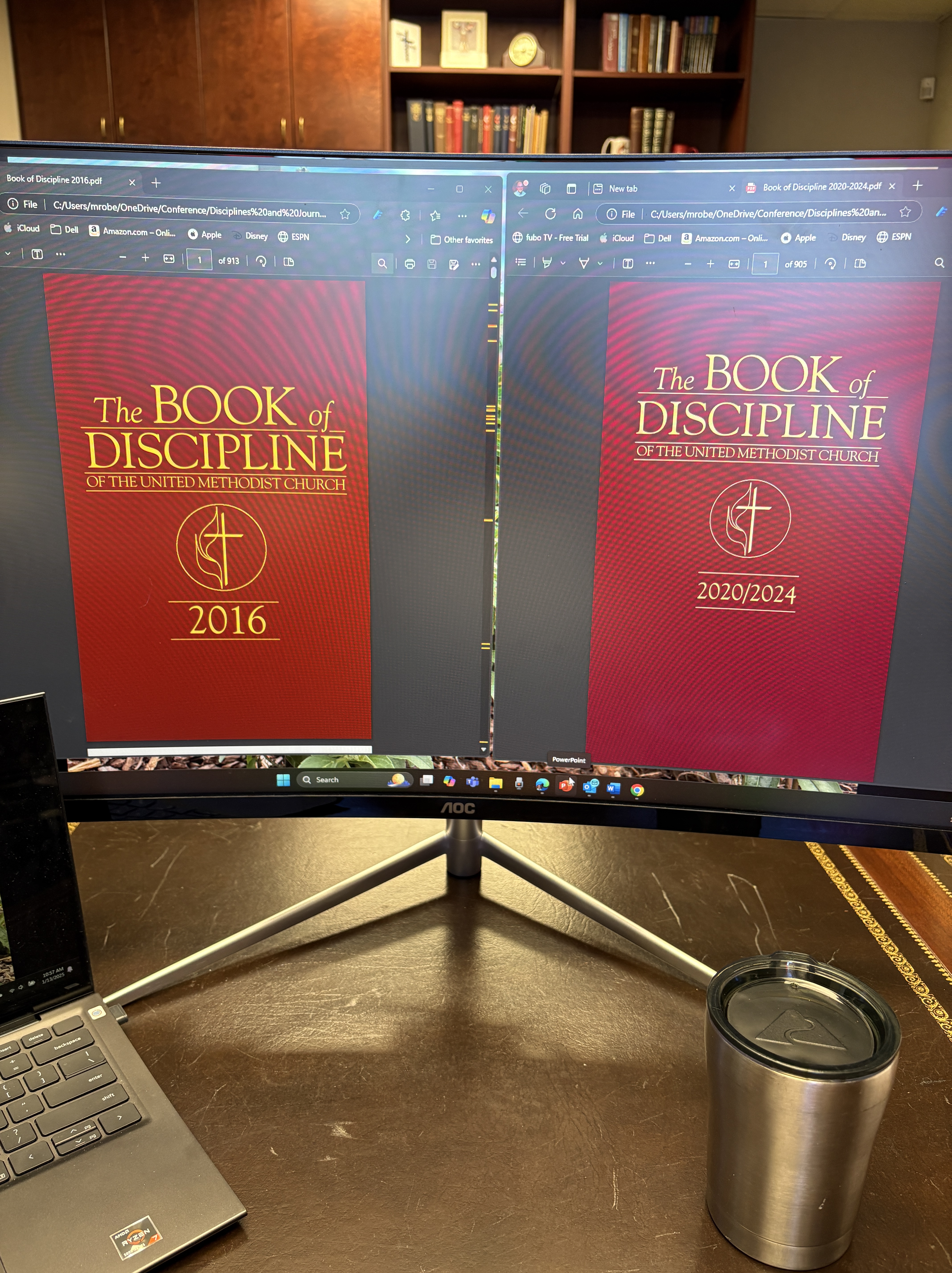
While waiting on my hardcopy of the new Book of Discipline (BOD), I turned to the PDF version. I was inspired to do a quick comparison using the wonderful search feature.
I started by searching the word “incompatible” hoping to see a “zero.” I was a bit disappointed to see that it does appear one time, but in a quote of the previous BOD and in reference to moratoriums on judicial proceedings. By comparison, in the 2016 BOD this word appears eight times with four of these naming one practice or group of people. In another place we read that war is incompatible with the teachings of Christ. In other places we read that military service, science, and abortion under strict circumstances are not incompatible. The new BOD deals with these topics in similar ways but without using this specific term.
My next search was for the word “fidelity.” This word appears seventeen times in the new BOD and eighteen times in the previous version. In both, four of these call for fidelity to the Apostolic Faith and the Doctrine and Discipline of the Church. Another five deal with finances. In both versions the remaining references focus on standards for clergy.
In the 2016 BOD the phrase “fidelity in marriage and celibacy in singleness” appears seven times. The word then appears twice in a definition of marriage. These statements were often used to keep us from considering the calling and character of some. Too often, they came up only when there was a desire to exclude or punish. I am glad they are behind us.
In the new BOD, we see a focus on virtues that are life-giving for all and give witness to the “highest ideals of the Christian life.” There was an effort to strengthen our sexual and moral ethic, without a double standard and without some of the confusion around definitions of terms. This following statement appears seven times, calling for “the exercise of responsible self-control by personal habits conducive to bodily health, mental and emotional maturity, integrity in all personal relationships, social responsibility, faithful sexual intimacy expressed through fidelity, monogamy, commitment, mutual affection and respect, careful and honest communication, mutual consent, and growth in grace and in the knowledge and love of God.”
I do not see this as a move to the radical left – or whatever language might be used to characterize these developments negatively and to cause further division among us. As a person who was at the General Conference and who worked on a committee that initiated some of these changes, I witnessed a beautiful effort to be faithful and to be responsive to the high and holy calling we have been given to love one another well. With God’s grace and guidance, I believe our General Conference did good work that will bear good fruit.
As I opened this new version of the Book of Discipline, my first response is to give praise to God and then to give thanks for all who worked to make this new and faithful witness possible.
I do look forward to getting a hardcopy. I will place it among other treasures that mark significant moments in my life. This one was big.
Another post in the series – Beyond Soundbites and Towards Holy Conferencing (A Series on the Actions of General Conference). This series includes the topics of Abortion, Clergy Qualifications, Marriage, Israel, Pronouns, and Disaffiliation.
It is a common reaction: “I don’t want my money going to something I can’t support.” In response, I want to start with a perspective on giving in general, using my Annual Conference as an example. Several years ago, our Conference moved away from a traditional apportionment model to a Tithe Initiative, expecting each congregation to tithe. I love the model and witness that this provides.
The tithe represents first fruits, given to support the larger community. The tithe reminds us that we are a part of something bigger than ourselves. As we give in this way, we put our trust in the collective wisdom of the community. We invest in the common good. We give up personal control. And in turn we are blessed beyond measure. The countable funds overflow in abundance and our hearts are opened to the “immeasurable riches of God’s grace.” (Eph 2:7). That’s the hope of this spiritual discipline.
Tithing is a way to acknowledge that we are “the Body of Christ and individually members of it.” (I Cor 12:27). With our first fruits, we build up the whole body with its many and diverse parts, gifts, perspectives, and contexts. At this first level of giving, the goal is not personal engagement with all the ways the resources might be used; the goal is the expansion of ministry and growth in love – love that is patient and kind and serves with a humility that does not insist on its own way. (I Cor 13:4-8). Our giving leads to this transformation within. As a word of caution, withholding can lead to hardness of heart.
At this level of giving, we give beyond our “party,” be it political or theological. We acknowledge that the word “party” is built on the word “part.” We can make a loose connection with taxes and a commitment to the united work of the nation. To only give to support a “part,” or to stop giving because of a disagreement, is dangerous. It can become a disease that infects the whole, opening the way to the destructive spirits of fear, mistrust, division, and other spiritual cancers.
Biblically and positively, we are called to give in a way that illuminates the wideness of God’s mercy. We put our trust in the living God who is at work for good among us, who is “above all and through all and in all.” (Eph 4:6). The call is to clothe ourselves “with compassion, kindness, humility, meekness, and patience, bearing with one another, dealing with complaints with forgiveness, and to clothe ourselves, above all, with love which binds everything together in perfect harmony.” (Col 3:12-17). We are to give in this spirit and to promote this witness (See II Cor 9:6-8). If we only support those things within our narrow level of comfort, and seek to build that up, we miss out on the opportunity to practice this kind of love.
Giving in this way helps us to “grow up,” and keep from being “tossed to and fro and blown about by every wind of doctrine, by people’s trickery, by their craftiness in deceitful scheming.” As we give in this way, we build up the whole body, “joined and knit together,” with each part promoting “the body’s growth in building itself up in love.” (Eph 4:1-16). We are called to give in support of this kind of growth. With our first gifts, we are called to give into the community as a whole, and in support of all we share in common. And practically speaking, it helps to realize that, on the whole, a very small percentage might go to that one thing that we don’t like.
As a spirit of schism and division moves among us, with the promotion of parts rather than the whole, one way to avoid the trickery and scheming that Paul talks about is to move beyond soundbites and towards holy conferencing. That’s the title of this series. I believe it is also a way to characterize the calling we have been given. Soundbites on the actions of General Conference – on the topics of abortion, Israel, marriage, ordination, and more — are often meant to stir up more division. Giving as God intends, in faith, is a way to grow up and to be blessed by the “immeasurable riches of God’s grace.”
Beyond the tithe, we also promote offerings, where individuals give to specific projects or causes that are dear to them. This is a good thing. There is room within the whole body for parts to be promoted and supported. However, from a larger perspective, we bring harm to the whole body when we place a priority on these gifts rather than seeing our offerings as over and above the giving of first fruits. This creates stress on the whole, and can lead to an unhealthy competition between parts, driven by a spirit of scarcity rather than abundance.
At General Conference, we did approve a 42% decrease in our connectional budget. While there are many factors that lead to this reality, one is disaffiliation and schism within the larger body. As we build again, there is a need to repair the fractures among us. What would it look like if this was our focus, as opposed to giving energy to the continuing efforts to divide? How can we “grow up,” and do a better job at being the people that God has called us to be? How can we expand the table rather than shrink it down to our comfort zone? How can we glorify God rather than our own opinions? To use an image from Wesley, to build a community around a “part,” rather than the whole, is not only to build our house on sand, but on the froth of the sea.
Another post in the series – Beyond Soundbites and Towards Holy Conferencing (A Series on the Actions of General Conference).This series includes the topics of Abortion, Clergy Qualifications, Marriage, Israel, and Pronouns.
Paragraph 2553 is no longer an option for disaffiliation. And it is true that General Conference did not approve another plan where congregations could disaffiliate based on disagreements with certain positions in the Book of Discipline. General Conference did approve a Reaffiliation Plan to welcome churches home and to offer opportunities to rejoin the United Methodist Church. In some ways, these two acts could be seen as sides of the same coin.
There may still be ways to bless those who want to leave the denomination, and processes could be developed, but looking at these two decisions together, the hope would be for something very different than what we found with 2553. This paragraph, inserted in 2019, caused great harm. It forced us to focus on division rather than unity, disagreements rather than building community, and voting rather than discernment, with a winner-take-all outcome. It assumed that churches were objects that could easily be moved, when in fact the old saying is true – the church is the people. It divided families, friends, and communities. It continued to turn siblings in Christ into issues and problems. It promoted the use of political tactics that do not honor the calling we have been given – to practice the love of Christ, with patience, kindness, and a humility that does not insist on its own way. If we are to be faithful, we can’t be in the business of schism based on disagreements. This is not who we are called to be. (See Eph 4:1-3; I Cor 13:4-8; Col 3:12-17, for starters).
It may be helpful to note that those who disagreed with our policies around human sexuality between 1972 and 2024, did not have an exit plan, nor was one requested. That was not the focus. The focus was on advocacy, conferencing, and working for change, hopefully in a spirit of holy love and commitment to the Body of Christ. As one who would identify as more conservative on these issues, said to one who had worked for these changes (me), “You didn’t leave when you were in the minority all those years. I admire that. Why would I leave now.”
Another factor in not developing a new exit plan based on disagreement is the overall movement towards contextual freedom, rather than forced agreement. With the actions of General Conference, pastors and congregations have more ability to engage in ministry in their particular contexts, as led by the Holy Spirit. The hope is to live more completely into the Wesleyan spirit of learning how to love alike, even if we don’t think alike about everything.
To live into this hope, it is important to move beyond soundbites and mischaracterizations that are often intended to create more division. (This has been the motivation of this whole series). To review one example, we can point to the accusation that we now say that it is okay for single persons to have sex. This is based on the removal of the line, “fidelity in marriage and celibacy in singleness.” This phrase was a part of the qualifications for ordination. The soundbite ignores the statement that replaced this one. In what is arguably a stronger statement, the call is to practice “fidelity, monogamy, commitment, mutual affection and respect, careful and honest communication, mutual consent, and growth in the grace and in the knowledge and love of God.” The point, in this context, is the kind of character and witness we want from our pastoral leaders, rather than focusing on a marriage license. And still, if legal marriage is the concern, we can note that it is affirmed in multiple places in our doctrine and discipline, as the best way to live out this character and to provide the needed legal protections for both spouses and children involved.
If we assume the worst in people, there may be ways to justify behaviors that would not be approved by some, but that could be true with the previous statement as well. People could have claimed that they were not “single,” or turned to the traditional definition of celibacy as meaning “unmarried.” But that was rarely a concern because the primary purpose of the previous statement was to keep some out. As the new statement stands, a high and holy calling is lifted up for all. There is certainly nothing here to warrant schism.
Moving beyond soundbites and towards holy conferencing is key to life-giving discernment. To do this in a way that honors Christ and our calling, we must find ways to limit the false accusations that cause so much harm – including the claims that we now promote immorality, or don’t believe in the resurrection or in the Bible (on this one I would invite you to read the post, “Wesley and Human Sexuality (and his commentary on often cited verses).” If it is up to the Annual Conference to develop a process, strong safeguards must be developed to guide us in a much better direction than we experienced with 2553.
To consider a request to exit the denomination, a review of key sections of the Book of Discipline might be in order, including our Doctrinal Statements, The General Rules, The Ministry of All Christians, and the section on the Local Church. Based on this understanding of who we are, the questions might be: What is it that leads you to a desire to move in a different direction – beyond one concern over recent decisions, which do not force any changes in how a congregation engages in ministry? Is the room for mutual support? Is there a way to come to an agreement that does not dishonor the sacrifices of generations and a future United Methodist witness within the community?
As was mentioned, General Conference called upon every Annual Conference to develop a plan for Reaffiliation, in a “spirit of grace.” This is what we are about! Welcoming! Practicing Hospitality! Supporting one another in mission! Being in ministry together, as a part of a connection that is larger than our own expression! Learning how to love alike, even if we don’t think alike about everything! Understanding that a methodist is not distinguish by our opinions or styles, but by the love of God written upon our hearts, to paraphrase Wesley’s words. This is who we are!
We would love to help congregations that previously disaffiliated, to begin a process of discernment, which might include an assessment of the General Book of Discipline and our core understanding of who we are, along with an understanding of what it means to be a part of a connection. Stay tuned for more information, as this process is developed.
This series is intended to give a more complete and graceful read on the actions of General Conference in 2024, and to help us move beyond the soundbites and critiques that are often meant to stir up more division. It has been written with input and support from the delegation of the Arkansas Conference of the United Methodist Church.
Topics include Abortion, Qualifications for Ordained Ministry, Marriage, The Israel-Palestine Conflict, and Pronouns. The complete series, to date, is below:
General Conference and Abortion
In some communications circulating about what happened at General Conference, what is being said about Abortion is particularly shocking. On this topic, we read that General Conference affirmed a “right to abortion,” renounced “abortion bans,” and adopted an overall position that is “pro-choice.” The words in quotation are in the commentaries. They are not, however, found in the actual statement that came out of General Conference.
In the statement from the Social Principles, there is one sentence that says, “In these limited circumstances, we support the legal option of abortion.” This is not described as a “right.” It is a conviction shared out of love and concern. The limited circumstances include when the life of the mother is in danger and there are no other medical treatments and when severe abnormalities threaten the viability of the fetus. The whole statement shares a “commitment to the sanctity of human life.” It “unconditionally rejects it as an acceptable means of birth control or a mechanism for gender selection.” It “supports measures requiring parental or guardian…consent.” It opposes “late-term or partial birth abortion.” It urges the seeking of “medical advice and pastoral counseling…” It also speaks against “bullying or shaming people for their decisions or actions.” There are also strong statements in support of access to reproductive health, especially for those who often have limited access. There are statements supporting treatments for infertility. There are no statements about “abortion bans” and the phrase “pro-choice” is not used at all.
In one letter that is being circulated, we read of how the following words were deleted: “We are equally bound to respect the sacredness of the life and well-being of the mother and the unborn child” (a statement from the previous Social Principles). With the new and revised Social Principles, vetted through multiple sessions of holy conferencing around the world, these exact words are not there. The sentiment, however, is expressed throughout, speaking of “the sanctity of life,” the “tragic conflicts of life with life,” and “the life of the fetus.”
In this context, it may be worth comparing our statement to that found in the Social Witness of the GMC. On the topic of abortion, the GMC statement is relatively short. It is only two sentences long. It uses the term “sacredness” instead of “sanctity.” With a similar statement of exceptions, it “compels us to resist the practice of abortion, except in the cases of tragic conflict of life against life…” It says, “we do not accept abortion as a means of birth control or gender selections,” where the Social Principles of the UMC uses the phrase “unconditionally rejects.”
The GMC statement could possibly be considered a brief summary of the much more detailed and arguably stronger UMC statement. It would be so very-extremely-incredibly wrong to use this brief statement to stir up division, without conversation, based on what it does not say or to make it say something that it doesn’t to support one’s own agenda. That would be deceptive, to put it mildly. At the very least, the differences here are not enough to warrant schism and the great harm that that causes within the Body of Christ.
To prepare for holy conferencing, and at the beginning of this series, it may be helpful to note that the Social Principles of the UMC do not carry the weight of doctrine or foundational teachings. They are “not church law” but instead “represent the prayerful and earnest efforts of the General Conference to speak to issues in the contemporary world from a sound biblical and theological foundation.” These principles are “intended to be instructive and persuasive in the best of the prophetic spirit,” while recognizing that the church is a “living body gathered from the many and diverse parts of the human community,” with a calling to love one another well in the midst of diverse understandings. For a brief comparison, the preliminary Social Witness of the GMC, to be brought to their convening Conference, is intended to offer a “consensus vision transcending cultures” with expectations for congregations and those in leadership to affirm, endorse, and subscribe to the positions therein. In preliminary documents, it will require a three-quarters majority vote at the convening General Conference to make changes to the statements.
For more information, a draft of the Revised Social Principles is linked here. The final version is being prepared for publication. The full statement on this topic can be found on pages 28-29.
General Conference and Clergy Qualifications
When it comes to who Churches and Boards of Ordained Ministry can consider as candidates for ministry, one restriction was removed. That one restriction centered around the word “incompatible” for one group of people. Now candidates can be considered based on their calling and character, faithfulness and fruitfulness, without this one barrier standing in the way. Putting this in context, it is worth noting all the qualifications that remain. The qualifications to be considered for ordained ministry include faith in Christ, gifts for ministry, affirmation of the holy scriptures, accountability to the doctrinal standards of the church, and more. This list is long and life-giving for the church as a whole. In all of the rhetoric, with much of it intended to cultivate division, this context is important if we are to make faithful decisions.
General Conference also removed the statement that called clergy to practice “faithfulness in marriage and celibacy in singleness.” This has led to accusations of opening the door to polygamy, fortification, adultery, and immorality, even when there are other statements that directly address these concerns. Putting this in context, it could be said that the call to a moral life was strengthened, not weakened. The General Conference added a call for “fidelity, monogamy, commitment, mutual affection and respect, careful and honest communication, mutual consent, and growth in the grace and in the knowledge and love of God.” What blessings might come if our ministry focused on the cultivation of these values for all? This statement opens the way to evaluate relationships by much more than a marriage license, especially when, up to this point, some legal marriages would not have been recognized by the church because of a statement that was used to keep people out.
Since much of the negative rhetoric is coming from those committed to the GMC, it may be good to make some comparisons. Most of the qualifications in their statement resonate well with those of the UMC. On this one consideration, the GMC statement calls for “fidelity in a Christian marriage between one man and one woman” and “chastity [rather than celibacy] in singleness.” In the GMC, this criteria also extends to laity serving in the church. In the experience of pastors, more and more couples who have come to talk about getting married are older and already partners together. That is reality. Some are active in the church and perhaps called to explore ordained ministry. Depending on how this rule was enforced, they could not be considered. General Conference, in 2024 and in the contexts in which we find ourselves, has opened the way for us to name and encourage the values that are life-giving for all, and to affirm the blessings of marriage for all who feel called into this commitment (which will be the topic of the next post).
General Conference and Marriage
Information beyond soundbites may be the key to the faithful work of finding agreement, building consensus, and making faithful decisions. What does the Book of Discipline say about marriage? Marriage is affirmed as “a sacred and lifelong covenant,” a union with “one another and into a deeper relationship with God and the community of faith.” This is important because it calls those getting married in the church to be a part of the faith community. In terms of policy, it might be helpful to start here, trusting that marriages in the church would be for those whom some in the congregation, including the pastor, would have already given a blessing. A relationship would have already been formed.
Our new principles allow for the understanding of marriage to be between two persons or between one man and one woman. This change opens the way to consider matters of human sexuality with humility and to focus on the virtues that are life-giving for all, rather than a double standard for some. It allows us to remain true to the primary purpose of marriage, in the Wesleyan tradition – to grow in holiness and to “reflect a continued willingness to grow together in Christ…and cultivate a covenantal bond that encompasses intimacy, grace, and love.” We can turn once again to the call for “fidelity, monogamy, commitment, mutual affection and respect, careful and honest communication, mutual consent, and growth in the grace and in the knowledge and love of God.” (For more on this statement see the previous post on Clergy Qualifications; that is the context for this understanding of the values needed for a healthy marriage and life-giving relationships in general).
Next, there is an affirmation of civil marriage, the legal recognition of domestic unions by the state which is vital for guaranteeing family stability, regulation of inheritances, and assuring the rights, benefits, and protections for spouses and children. This is why marriages through the church also require a license. With the expansion of our understanding, room is made to bless marriages in different cultural contexts and to honor the norms and laws in different countries. One country does not get to dictate the practices of another.
There is so much more within the statement, including paragraphs on child marriage, polygamy, and a careful statement on divorce, which “may become a regrettable but necessary alternative when marital relationships are strained beyond repair or become destructive…” It is made clear that “we do not support efforts to withhold ministry from divorced persons…”
In making faithful decisions, it may be helpful to note what the GMC says. There is one short statement: “We believe that human sexuality is a gift of God that is to be affirmed as it is exercised within the legal and spiritual covenant of a loving and monogamous marriage between one man and one woman.” One question might be: Is this the only way to understand human sexuality? From a UMC perspective, human sexuality is expressed in many ways, from our style and dress to our natural attractions, to how we interact with one another. It can be expressed through our desire for intimacy at all levels of relationship, from holding hands, to a kiss, to decisions about commitments and how we might express the values listed above. The affirmation, support, forgiveness, grace, and teachings of the church can be helpful all along the way.
Within the GMC Provisional Discipline, marriage comes up in one other place, in the non-discrimination policy for lay persons in ministry. We read, “There shall be no discrimination on the basis of gender, race, color…” and then there is one exception: “As a part of our witness, individuals employed by the church shall subscribe to the doctrinal and moral standards of the Global Methodist Church and give evidence of the same in their life and ministry.” And early version of this statement interpreted and added these words – “including faithfulness in marriage, understood to be between one man and one woman, or chastity in singleness.” A person who may not fit into this strict definition cannot serve in ministry, regardless of calling, character, faithfulness and fruitfulness.
As an update to the document, the Judicial Council recently ruled that clergy hold the responsibility for deciding whether they will perform the religious marriage service of a couple within the church. Wedding Policies cannot circumvent this authority. At the same time, as our bishops have said, pastors are expected to “exercise their authority with deep pastoral sensitivity to the congregation and community to which they are appointed.” This means that Holy Conferencing is always in order. Rushing into a vote is often divisive and causes harm. As we have with so many tensions that have surfaced within the church, we can approach these tensions with grace. They do not have to divide us.
For one more new statement, the Book of Discipline says that no one, pastor or congregation, will be “penalized for performing or refraining from performing a same-sex wedding.” As with so many statements in the Social Principles, the hope is to make room and give grace. The focus is more on how we treat one another than it is on giving hardline stances. The hope is unity, not division. As we navigate this new territory, It might be helpful to compare our life together in a faith community with that of a marriage, remembering that the scriptures also use this analogy. What might this look like? How might we navigate our discernment together through this lens? How might we love with patience, kindness, and with a humility that does not insist on its own way?
General Conference and the Israel-Palestine Conflict
The way this conflict is being used in soundbites, for the purpose of cultivating more division, needs to be challenged. In one document that is being shared, it is reported that the General Conference voted “to lobby the U.S. government to end military aid to Israel.” The insinuation is that the UMC is anti-Israel.
One petition that is being used to cast shade on the UMC, in its original form, focused on the lack of “a just and lasting peace for the Palestinian people.” (Resolution R6111, found in the Book of Resolution since 2004). Through the committee debate, this was changed to “both peoples.” The original petition urged “the U.S. government to end all military aid.” This was changed to “all governments.” Even the original petition did not say military aid “to Israel,” as the report claims,” but “in the whole region.” The call was to redistribute funds to support the work of “humanitarian health and educational work…” The resolution calls for support of ecumenical and interfaith bodies that advocate for Palestinian self-determination, while affirming “Israel’s right to exist within secure borders.” It calls for “the Palestinian Authority and Palestine religious and political leaders to continue to publicly condemn violence against Israeli civilians and to use nonviolent acts of disobedience to resist the occupation and the illegal settlements.” This, and the other resolutions that deal with this conflict, are calls for peace, according to the call of Jesus and the scriptures.
It is important to note that this came to the Conference in the form of a Resolution. Any and every United Methodist can submit a resolution to be considered with the title of their choice. We should not be drawn in by the title alone. The Israel-Palestine conflict was the subject of several resolutions that were debated and voted upon in committees. On the whole, these resolutions are non-binding and have no financial implications. Those that pass (sometimes with significant alterations) become the perspective of the majority within the committee at General Conference, offered for guidance and discernment – not as law.
Given the nature of Resolutions in general, and the content of these resolutions, there does not seem to be enough to warrant calls for more division among us. All of us can find resolutions with which we would disagree, or at least would restate in another way. They are offered for guidance and discernment, from elected delegates from around the world. They do not justify schism and the harm that brings to the body of Christ.
General Conference and Pronouns
In response to videos that are circulating to show people introducing themselves at General Conference, with the intent of stirring up division, it is important to remember that there were thousands of speeches at General Conference, on the floor and in committees. These videos, making the rounds on social media, show a selective and small sampling. They are acts of deception. The slow cadence that is highlighted and made fun of was encouraged as a way to honor the many languages represented and to assist interpreters. The encouragement for each speaker to identify themselves as clergy or laity, along with their conference, age, ethnicity, sex, and with other identifiers important to the speaker, was about making room for all voices and honoring all children of God. This was monitored and on one day it was reported that just over 50% of those speaking at mics that day were female, which was a first in the history of General Conference. It is sad to see people making fun of what could be described as an intentional effort to model the very kin’dom of God.
In many gatherings in our world today, there are those who encourage the naming of pronouns as a part of the way we introduce ourselves, typically using the phrase, “my pronouns are he-him, she-her, they-them, he-they, etc.” This was not required at General Conference, nor was it something asked for by the monitors. Many did choose to add these identification markers. From the perspective of many, receiving this graciously and with an open heart was (and is) a good thing. Even if there are only a few (or even only one) who prefer non-binary pronouns, giving such grace can be seen as a way to love one another well. Even if there is disagreement, why dis-grace this perspective? What purpose is served by casting negative perceptions with words like elitist, woke, and accusations of not believing in the Bible? These are some of the comments that are being widely shared among us. Truth is found in a more complete and gracious read.
Let me count the ways for why I am proud to be a United Methodist in this moment and give thanks to God:
* Because the word “incompatibility,” as it has been used to create a judgement and a barrier only for some, is gone!
* Because barriers have been removed that have kept us from considering candidates for ministry based first on calling and character and commitments to Christ.
* Because we have new Social Principles that focus more on how we are to treat one another rather than offering hardline stances that divide and are intended to be general enough to find meaningful application in different contexts and cultures.
* Because we can now more freely promote values and virtues that are life-giving for all, rather than setting up a double standard for some.
* Because a path has been opened to practice ministry in ways that honor different contexts and cultures, while also emphasizing our unity in mission and in sharing a Wesleyan witness in the world.
* Because there is a spirit of grace among us that honors those who are not as eager to celebrate yet are willing to give room for this and who continue to be in community. Thank you! After General Conference 2019, I (and many) had to make decisions about staying/remaining/abiding, as Christ calls us to do. Reasons included those that we have heard in recent appeals from the Conference – a resolve to share convictions in a spirit of trust, humility and grace, in great appreciation for a community of faith where we can struggle together and love one another even as we disagree. This is the United Methodist way. It is hard. It is beautiful. And it is sometimes pretty messy as well.
* Because there is room for all in the wideness of God’s mercy. And as human beings we all need this!
How might you name this joy? What language would you use to invite others into this hope, and into a new season of ministry as the UMC?
General Conference is in the books! It was historic, messy, and beautiful. Worship with siblings from around the world was profoundly centered in Christ, deeply rooted in scripture, and sooo inspiring. The spirit of the Conference was like nothing I have experienced before in this setting.
Throughout the Conference, there was an attentive gracefulness to hearing the gospel shared through a wide diversity of perspectives. There was an intentional effort to make room for all voices. And the “wideness of God’s mercy” was lifted high. From my perspective, it was inspiring to see delegates live into this practice of radical hospitality that started with introductions that allowed persons to identify themselves as clergy or laity, along with their conference, age, ethnicity, sex, and with other identifiers important to the speaker. This practice helped all of us to be attentive to the goal for a balance of voices and to help us all reflect on our own place at the table.
It has been hard to read attempts to dis-grace this work with name-calling and accusations. I wonder what purpose was being served by casting such negative perceptions with words like elitist, completely corrupt, radically liberal, woke, and accusations of not believing in the Bible. I could venture a guess.
Some big decisions were made, and much of the attention has centered around matters of human sexuality. While this accounted for only a few of the petitions before us, these were big! So much of our focus has been around these matters. In my opinion, we are able to set some things right.
I was blessed to work on the Faith and Order Committee which brought forth legislation to remove harmful language that has served as a barrier to some for decades. Now the door is open to consider all candidates based on their calling and character, faithfulness and fruitfulness. While one barrier was removed, it is worth noting all the qualifications that remain. The qualifications to be considered for ordained ministry include faith in Christ, gifts for ministry, affirmation of the holy scriptures, accountability to the doctrinal standards of the church, and more. This list is long and life-giving for the church as a whole.
We approved language that gives pastors and local churches agency and freedom around marriages of same-sex couples. No one will be penalized for performing or refraining from performing a same-sex wedding. The language is now neutral. From my personal perspective, some leaders are making a little too much of how congregations don’t have to change anything. While that is true. I also think this is an opportunity to invite change. This contextual freedom will give us an opportunity to focus on the virtues that are life-giving for all when it comes to marriage, rather than being bound to a double standard that has caused great harm to some.
I love the perspective of one who identifies as “conservative” saying that the rules that have been in place were not only restrictive but were also condemning. By removing them we are simply making the church look more like the kin’dom of God. To sum it up in a sentence, the word “incompatibility,” as it has been used to create a judgement and a barrier only for some, is gone! Glory to God.
We approved new and revised Social Principles. I love the way these principles focus more on how we are to treat one another rather than offering hardline stances that divide. These principles are intended to be general enough to find meaningful application in different contexts and cultures.
There does seem to be a powerful propaganda machine with the purpose of causing further division in the Body of Christ. For one example, I saw a report that we now promote polygamy, with the follow-up question, “What’s next?” This came with a quote of the general statement on human sexuality in the Social Principles, while leaving out the statements directly on marriage that include the word monogamy, and a direct statement saying that we do not condone polygamy.
Others have said that we now promote immorality, when in fact we strengthened our understanding of morality rather than weakened it when it comes to marriage and sex. We added words calling for fidelity, monogamy, commitment, mutual affection and respect, careful and honest communication, mutual consent, and growth in grace and in the knowledge and love of God. This came out of my committee as well.
For a personal commentary, the Greek word often translated as sexual immorality is the word “pornia.” It could be defined as any attempt to turn another child of God into an object or an issue, to be used for personal pleasure or gain. Attempting to define this word by only pointing to one group of people may just be the heighth of immorality. There is nothing biblical about this projection.
Moving on. 2553 is gone! May healing come from the great harm that was caused and may we confess our role in this as a conference. We may be able to find ways to bless those who desire to leave the UMC, but I hope we never again endorse and implement a process for congregations to vote in this way, especially when the winner takes all. That never felt very Christian to me. And by virtue of my position in the Conference I have directly seen the great harm that was caused – and yes, our own policies and the way we implemented them are implicated as well.
On the last day, and after days of debate, a budget was approved that amounted to a 42% decrease. This is a “rubber hits the road” acknowledgement that we are moving into a new season as a denomination. We will have to find new ways to live into our calling. Perhaps we have no choice but to see this as an opportunity.
And perhaps the biggest development of all was the passing of a plan for regionalization and the concept of giving contextual freedom to engage in ministry, while supporting one another in mission and in the calling to be a Wesleyan witness in the world. This concept, contrary to some reports, had broad support at General Conference across the board, including from Central Conferences in Africa, the Philippines, and Europe.
To close for now, I want to say that it was an honor to be in the room where this all happened and to play a small role in it all. The whole delegation was amazing and worked, prayed, worshiped, and played hard – and a lot of this happened long before we arrived in Charlotte. Thanks to the Arkansas Conference for entrusting me and us to this holy task.
And during conference, some of us got together and made the decision to change our Facebook forum from “Arkansans Staying United” to “Being UMC Arkansas.” Here’s to Being UMC! The new season has begun! May God be glorified!
Many have heard this post-Easter story recently in worship, found in John 20:24-29. The anxiety was high. The disciples had locked themselves in a room, worried about what would happen next. And Thomas was really acting out. We can hear him going off, giving ultimatums about what he would do or not do if he didn’t get what he wanted. He says, “Unless I see the nail marks with my own eyes, I will not believe.”
We can make some loose comparisons to the times when we give anxiety-fueled ultimatums to God. “Oh God, if you will just do this (we can fill in the blank) then I’ll make a commitment – as if faith was transactional. Or we might think of church conferences, like the upcoming General Conference, where it can be tempting to make ultimatums about what we will do or not do if certain decisions are made. Many are experiencing this anxiety right now.
In this light, there are a couple of things to note in this story. First of all, note that Thomas is still there. He stays connected to the community of faith, even with his uncertainty and fears and demands. It is also worth noting that he is not willing to believe what the other disciples believed about the resurrection – not in that moment. But we get the sense that this is okay. He is still there, included in the community.
Secondly, if we read it carefully, we notice that Thomas does not do what he said he would have to do to believe. The risen Christ appears to the disciples, behind the locked doors, and says, “Peace be with you.” Shalom. It is a word that suggest harmony and coming together and it is the first word spoken by the risen Christ in this moment. It sets the tone for what resurrection means for us. And then Christ speaks directly to Thomas. Christ offers to him exactly what he said he wanted. “See my hands. Touch my side.” But there is no indication that Thomas does any of this. He seems to have forgotten his ultimatum. He simply exclaims, “My Lord and my God.”
In this lesson, Christ speaks of those who will believe without seeing. That would be us. Thomas was able to see, but he discovered that faith is not found in seeing or receiving some sterile proof. Thomas comes to believe because of an experience with the risen Christ and the peace that comes from this relationship. Thomas receives presence more than proof. He encounters God’s steadfast and eternal love, and this is so much more than the answers he had demanded. We are able to come to faith in this same way, as the living Christ continues to come and reveal this love for us, in us, and through us.
Like with Thomas and the first disciples, may we be given the grace to turn from our human arrogance and turn to the One who has opened the way to so much more. May our encounters with the living Christ move us beyond locked doors of fear, beyond our personal assumptions and biases that can cause harm, and into a commitment to love more fully, with patience, kindness, and with a humility that does not insist on its own way. May we be less focused on answers and more on questions that will lead us into life-giving relationships with those who come up with different answers than we do. This is the kind of believing that God wants for us.
At General Conference, delegate-disciples from around the world will be confined together in a room. There will be a diversity of answers proposed, along with a variety of expressions of faith. It will produce anxiety. It can also be seen as beautiful, with the possibility of being a life-giving witness to the world. May the living Christ, who is our peace, be encountered and may we all be moved to a bigger faith.
Here is my personal FAQ, with answers to real questions that I continue to hear from those leaning towards disaffiliation. I am thankful for all who are willing to engage in the conversation.
How can we stay in a denomination with such doctrinal drift?
How can we stay in a denomination where people are praying to a “Queer God?”
How can we accept something that goes against the Bible? (This is at the heart for many).
If we disaffiliate, won’t we be able to put this debate behind us, stop talking about sexuality, and get on with the business of being the church?
But we would still be methodist, right? Just not united?
Is this our church or does it belong to the Conference? Is this not an opportunity for us to control our own destiny?
Will we be forced to accept views or policies that do not align with our conscience?
What will happen at General Conference next year?
How can we conference together in ways that glorify God and give a good witness to the world?
How can we stay in a denomination with such doctrinal drift?
In the conversations around disaffiliation, some claim that there is a movement to change the beloved doctrines of our church. In this regard, it is true that isolated examples can be found. There are those within the church who stand at the edges of doctrinal interpretation. There always has been and always will be. To use isolated examples, however, as a justification for disaffiliation must assume that this will not happen in a new denomination. That is unlikely.
Our seminaries are getting much blame for this supposed doctrinal drift. I do not believe it is founded. If we want to judge our seminaries, then I would encourage you to read the ordination papers of students applying to be ordained. Read what they have to say about the trinity, the divinity and humanity of Christ, justification and sanctification, the calling of the church, what it means to be ordained, and more. I get to do this every year, and it is inspiring. The holy apostolic faith will continue to be shared in powerful ways.
In response to accusations that our seminaries teach heresy, it is true that students can learn about other expressions of faith and explore other ideas. The trajectory, however, for those seeking ordination in the UMC is to be able to share the holy orthodox faith of the church in faithful and fruitful ways and to do so within the context and times in which they are called. For a comparison, I suspect you could go to the School of Business at the UofA and take a class on the economics of socialism, but it would not be fair to say that the school is trying to lead students in that direction.
In this larger debate about doctrinal drift, it is worth noting that there are over 30,000 United Methodist pastors in the U.S. In most discernment processes, the same handful of examples are used of people who have stood at the edges of theological interpretation and then used fallaciously to cast shade on the whole. Is it fair to base this decision on such a small sampling?
How can we stay in a denomination where people are praying to a “Queer God?”
In many places where there are people promoting disaffiliation, this has become a major talking point. It is true that such a prayer was recorded at a seminary, during Pride Month, and at a service designed to welcome members of the Plus community. Can we give this a “generous read?” As explained by students, the term ‘Queer” can be used for all who feel like they are different and who are judged because of that. It is not only about sexuality. In this case, the hope was to show that Christ stands with these beloved souls. There is much scriptural backing to say that Christ identified with the outcast, the marginalized, the judged.
In this particular case, was it shocking to hear? Yes, for many. Remembering that this came from an un-ordained student in the process of formulating how to best express her faith, was this worthy of being weaponized and used in ways to cause her harm and to cast unfair concerns upon the church as a whole? The answer is “no” in my opinion. If there is judgement to be made in how this is being communicated, the weight of that judgement should not be put on this one student in her twenties and still in school.
This question, formed in many ways, is at the heart of it all for many. Staying UMC will necessitate a willingness to accept that there may be different faithful interpretations of the passages before us. I would be among those who want to approach the matter with more humility and less judgement, a deeply rooted biblical perspective. I don’t fully understand matters of sexual orientation and identity. I do, however, stand firm on the biblical virtues and values that are life-giving for all. I do not believe a separate standard should be made for some. I want to promote a strong sexual ethic rooted in the values of faithfulness, commitment and all the virtues summed up with the word “love.”
When it comes to assessing who can be leaders in the church, I stand with those who want to focus on calling and character, rather than making blanket judgements around personal identity, that would keep us from even considering whether someone is called or has the character needed for faithful and fruitful leadership in the church.
In one setting, a person asked me, in all sincerity, to share what a different interpretation would look like. He had assumed that the scriptures were clear and that the matter was settled. I started by saying that homosexuality was a term coined in the 20th century as a medical term to denote deviate behavior. After this, the word found its way into scripture as a translation for words that point to abusive and harmful behavior. Both science and most translations have changed this understanding, but even where it still exists, Christians in the Plus community would agree that the behavior described in the original Greek is wrong. They might also say that this has nothing to do with two people wanting to live in a faithful, committed, and loving relationship. When it comes to the passage in Romans 1 and the words about doing what is unnatural, many in Plus community would agree that engaging in behaviors that are unnatural is harmful, but that they have come to a place, through much prayer and struggle, where they are comfortable living into what is natural for them.
Personally, I have come to the point where I honor those who have come to such understandings in their conversations with God through the scriptures and who have found ways to truly grow in God’s love and to be a great blessing to the church. I also lament the possibility that there may not be congregations in certain communities where such understandings would be honored.
For more on this, including a look at Matthew 19, please see my blog posts “Wesley and Human Sexuality, Parts 1 and 2.” These posts have received a lot of attention.
If we disaffiliate, won’t we be able to put this debate behind us, stop talking about sexuality, and get on with the business of being the church?
Disaffiliation is not likely to bring an end to this debate. I had a conversation recently with something committed to joining the GMC. This person was in a church where the music director was gay. The person who wanted to disaffiliate loved this music director and appreciated his giftedness and the spirit he brought to worship. I pointed out that, in the GMC, a gay person who wanted to live in a faithful relationship with another and grow in God’s love through that relationship, could not work in a church, even as a lay person. That would be grounds for dismissal. This led to some rethinking. It might also lead to attempts within the new denomination to change this policy. The debate will continue.
We have another church that has voted to disaffiliate that has a similar situation. That church is considering being independent rather than joining the GMC but that is leading to a whole different debate. Some don’t believe it would be good to be independent in this way; others do. There is now division on top of division.
Changing denominations in unlikely to help. Recently, I have had conversations with both a Baptist pastor and a Church of Christ pastor who came to me to talk about how these same questions were surfacing in their congregations and they both said, in different ways, how much they admire how I was able to talk about it without being fired. Being able to conference together in love is a good thing!
But we would still be methodist, right? Just not united?
This is an assumption that begs a lot of questions. To disaffiliate means that the local church will have to decide many things and to do so quickly. It will lead to more debate, not less, and perhaps to division on top of division. Will you still practice open communion? What liturgies and hymns will be used? What will you believe? What will your policies be? How will not secure pastoral leadership and what criteria will be used. Will you join another denomination or not? The questions will keep coming. And you will need a good lawyer to be involved. It is a good thing, in my opinion, to be rooted in the larger church where direction is given, where resources are shared, and ministry happens together.
Is this our church or does it belong to the Conference? Is this not an opportunity for us to control our own destiny?
The idea of owning our own property and controlling our own destiny is popular in some circles. In response to this, I want to affirm our calling to be in covenant together. I like knowing that I can go to any United Methodist Church and say, “This is my church.” “We share in ministry together.”
Yes, this is your church and, as a United Methodist, you are able a part of a mission that is so much bigger than you or this one place. Together, we have built a global church that makes such a difference in the world. We can think of UMCOR, Global Ministries, United Methodist Women (now United Women in Faith), United Methodist Men, Africa University, Discipleship Ministries, Assembly, and Veritas, just to name a few. The hope of those who want to Stay UMC is that we would build this upon this witness rather than tear it down.
Will we be forced to accept views or policies that do not align with our conscience? (This fear is expressed in different ways).
With so much rhetoric designed to stir up this fear it is hard to speak a word of reassurance. I heard of how one pastor tried to speak a reassuring word into the conversation about how we continue to believe in Jesus, and the other person said, “The video I watched told me you would say that and that it would be a lie.” In this case a video promoting disaffiliation was trusted over a beloved pastor.
In my opinion, there is one official statement that needs to find a way into the noise.In a letter from the Council of Bishop around this tension, we read: “We cannot be a traditional church or a progressive church or a centrist church. We cannot be a gay or straight church. Our churches must be more than echo chambers made in our own image arguing with each other while neglecting our central purpose. Instead, we must be one people, rooted in scripture, centered in Christ, serving in love, and united in the essential [of our shared faith].”
I love that and think that it is worthy of our commitment. Giving this witness would glorify and expresses a way of living the Christian faith that is so needed in our communities. In many communities the UMC may be the only church where this welcoming spirit might be offered.
For many the calling found in Ephesians chapter 4 continues to be a guiding light. The Apostle Paul begs us to live out the calling we have been given, to love one another with patience, gentleness, and humility, being eager to maintain the unity of the spirit in the bond of peace. We are called to a higher unity, represented by something more than uniformity of opinion. Our unity is rooted in a holy love that is patience and kind. It is not arrogant or rude. It does not insist on its own way, as the scripture says. How do we share this calling with one another and together as a witness to the world?
What will happen at General Conference next year?
As a delegate to General Conference, my hope is that this language around the “h-word” and incompatibility will be removed. In my opinion, it is shameful that our Church continues to use a word that hurts and de-humanizes people and turns them into issues and problems rather than beloved souls. At the same time, I do not believe this language should be replaced with language that says it is compatible. I believe we should leave that for continued holy conferencing and seeking God’s guidance, and that we should allow (and protect) clergy and congregations to follow their conscience on how to love others, and in a wide diversity of cultural contexts. That is the perspective of most delegates that I know.
In a global church, with delegates from many places and cultures, I must say that I am not optimistic that this language will change. What is more likely is that some form of regionalization will pass, allowing different regions in the world to develop their own criteria for ministry. Within the U.S, there is a desire to allow more freedom and to cultivate more openness. That is the goal. There is not, however, a desire to replace “may” with “shall.” That is not who we are as United Methodist Christians.
How can we conference together in ways that glorify God and give a good witness to the world?
In all forms of “Conferencing” may we stand together as the Body of Christ, with many parts, rooted in the historic and core doctrines of our faith, and in this rootedness, honoring the various branches of perspective and interpretation that help us all to grow in faith. May we “think and let think,” to use Wesley’s language, trusting that the Holy Spirit is at work among us to keep us centered as a whole and aligned to God’s will, recognizing that somethings this work of the Holy Spirit is a call to appreciate the spirit of those who are serving at the edges.
To build upon Wesley’s guidance, to focus on the opinions of our “party” or to want all to follow this or that “scheme of religion” is “quite wide of the point.” It is worth noting that the word “party” contains the word “part.” Attempts to make a “part” into the “whole” are destructive to the Body of Christ. According to Wesley, a methodist is to be distinguish by the love of God planted in the heart, the love that empower us to be the Body of Christ with many parts. May this continue to be our focus and our witness.
Google GMC and you get a car company. Spell it out and you get the Board of Global Ministries of the UMC. And yet, it is easy to find information about the new denomination called the Global Methodist Church. There are many remarkable, even shocking, things about this proposal. Here are a few personal observations.
To start with, the word “homosexual” is not used anywhere, nor is the word “incompatible,” even though this has been at the center of the struggle for years. I applaud this positive and progressive move. No one should be defined by a “single story” of their lives, especially with a word that was listed as a psychological disorder when originally put into the Book of Discipline and is still misused in some translations of scripture to connote abusive, promiscuous, and hedonistic behaviors. All agree that such behaviors are incompatible with Christian teachings and not to be “practiced.” The irony here is that the UMC could be left with the baggage of this language.
In this struggle, we now read this from the GMC: “We believe that human sexuality is a gift of God that is to be affirmed as it is exercised within the legal and spiritual covenant of a loving and monogamous marriage between one man and one woman.” This statement begs questions like, can human sexuality not be affirmed in any other way? What about a kiss on a date? Is human sexuality not expressed through the way we present and see ourselves? And with these high ideals of legal, spiritual, loving, and monogamous, why is divorce not mentioned anywhere?
The very next statement reads, “We are saddened by all expressions of sexual behavior that do not recognize the sacred worth of each individual or that seek to exploit, abuse, objectify, or degrade others, or that represent less than God’s intentional design for His children.” This statement starts so well, but then ends with code-words that lump a lot of faithful people into this list of truly harmful behaviors, as those in need healing because of “brokenness in their sexual lives.” This is “saddening.”
In a similar vein there is an explicit call to inclusiveness. Again, it starts well, inviting openness and acceptance of many. And then it comes to gender with an explicit definition that leaves no room for anything other than a strict binary understanding. Gender is defined “by a person’s immutable biological traits identified by or before birth.” Many would use the term “sex” in this way, with gender referring to self-identity, and how one fits into expected roles within a particular culture. This statement, however, draws a hard line, alienating and singling out some who do not “fit.”
And then it goes further. While all may “participate in the spiritual life of the Church…inclusiveness means the freedom for the total involvement of all persons who meet the requirements of our Book of Doctrine and Discipline in the membership and leadership of the Church at any level and in every place.” Suddenly it becomes very exclusive! I wonder who can stand up to this scrutiny and who gets to be the judge! In terms of policies, the move to a congregational system of selecting leaders might also delude commitments to inclusiveness at other levels as well – for women and minorities. (There are lots of policy implications to consider around this – term limits, trust clause, no guaranteed appointments, etc.).
In terms of doctrine, the similarities with the United Methodist Book of Discipline are hard to miss. There are certainly not enough differences to warrant schism. One big difference is the inclusion of creeds more directly into doctrine. This is a shift since John Wesley removed the creeds from statements on doctrine and put the Apostle’s Creed into the official liturgy. In the UMC, we are to be formed and transformed as we affirm the creeds together in regular worship. Is there danger in separating them from this context and using them to enforce “right belief” independent from worship? It seems to me that such questions could bring us into conversation rather than pull us apart.
In the UMC, the Social Principles are not law. They are intended to be instructive and persuasive, while “acknowledging differences in applying our faith in different cultural contexts as we live out the gospel.” In the GNC, the statements of “Social Witness” do seem to be enforced at a stronger level. Yet, once again we see a softening. In earlier drafts, the “Social Witness” represented a “clear and unified voice,” with direct implications for policy. In the latest version, it now reads, “As a global church, our Social Witness represents a consensus vision transcending cultures…It is a summons to prayerfully consider how to “do good” and “do not harm…” It almost sounds United Methodist!
Don’t get me wrong, there is much in place to make change difficult, including a threshold of a three-quarters vote to change the social witness. And there is talk of strengthening stances at a convening conference. That seems to be part of the strategy. But, as the saying goes, “life finds a way.” We might add, “Love finds a way.” Our living God finds a way. As a new denomination is being proposed, they seem to be leaving room for change, perhaps struggling with how to be a global church built around one perspective or “party,” and recognizing the overtones of colonialism in this attempt. Perhaps God is getting in, through the cracks, and revealing the harm that is inflicted when a party forgets that it is “part” of a larger whole and tries to become a whole unto itself. All of this leads me to wonder, what is this really about? And, can the UMC be a church where all are welcomed and honored and where our willingness to engage in hard and holy conversation is a part of our witness to the world?




 Connected In Christ