
 At a recent gathering of around 80 of us, under the title of “Uniting Methodists,” we spent time naming our values in a new reality after GC2019. If you were at this meeting you will recognize much of what was said. The hope of the conveners is that these values will serve as a light to guide us into a faithful way forward. We invite you to prayerfully use them for guidance and for holy conversation. We value…
Unity in Love rather than Uniformity by Law
The plan passed at General Conference establishes strict mandatory penalties around only one concern, requires oaths to be taken to serve in certain leadership positions. and takes accountability away from resident bishops and peers. Parts of this plan have been likened by our Judicial Council as establishing an “inquisitional court.” There are many with traditional, progressive, and centrist perspectives who do not believe this represents the calling of Christ. We are called to come together at the holy table where unity is not rooted in uniformity of opinions but in the call to love in the midst of blessed diversity. We will continue to have many theological and social issues to discuss. It is through our struggles together that we learn how to love.
Making Room for All
The value of inclusiveness has been expressed with a variety of constituencies in mind. At the holy table, we value those with traditional, centrist, and progressive perspectives. In the light of our current conversation, we want to affirm our LGBTQ+ siblings, and honor the gifts they bring into the community of faith. We want to encourage young persons to be leaders among us, and we continue our commitment to be more inclusive in terms of ethnicity. As United Methodist Christians, we want to reclaim the “big tent,” practice hospitality, avoid “us and them” language, be transparent, and cultivate ministries that are attentive to contexts. We believe that diversity, within the Body of Christ, is a great strength and helps us give witness to the kingdom of God in our midst.
A High(er) View of Scripture
As the inspired Word of God, the scriptures come to life in holy conversations and relationships. In these conversations, we often do not get easy answers but must struggle with the tensions and different perspectives found within the scriptures themselves. Faithfulness moves us beyond proof-texting and using scriptures to affirm our prejudices and opinions. In community, we honor the whole, notice the context, and seek God’s intended message for us in our time and place. With Wesley as our guide, we look to key texts to help us interpret all of scripture, with the summary of the law and prophets offered by Jesus as the master key, where love is described as the royal law. We read scripture through the lens of the risen Christ and through his will for us and for all.
Wesleyan Holiness
In defining holiness, Wesley consistently used the virtues of humility, patience, and gentleness. He also talked about the opposite of holiness with words like pride, passion, judgment of others, and zeal for our own righteousness. True holiness is rooted in the love God has planted in our hearts.
A Sexual Ethic Rooted in Values rather than Personal Identity
While we affirm unity rather than uniformity, faithfulness does demand some agreement. In humility, we acknowledge that we do not fully understand matters of sexual orientation and identity. At the same time, we affirm a strong sexual ethic rooted in the values of monogamy, faithfulness, commitment, and the virtues summed up with the word love. We affirm pastors and congregations who want the freedom to respond in contextual ways to all who desire to grow in God’s love and live in relationships where they can practice these life-giving values. We want to adopt a denominational policy built on a shared ethic around calling and character, as opposed to policies that make judgments around personal identity.
Being Hopeful and Realistic
We affirm our calling to bear with one another in love and to seek unity of spirit in the bond of peace (Eph 4:1-3). After General Conference, we have concluded that this calling may not manifest itself as “unity of structure.” At the same time, we do not believe we should retreat into another “like-minded camp” where the virtues of our calling – humility, patience, and kindness – are not really needed. We want to cultivate a community where all are welcomed at the table and where we can truly learn how to love.
We also trust that politics, defined as the art of making good decisions for the whole, can be consistent with the call of the Holy Spirit. In this light, we ask you to help elect persons who will be active and vocal advocates for the values we have named above. We do not believe that this is a time for neutrality or to elect those who might approach General Conference with a desire to perfect the Traditional Plan.
 This week we held our first Church Council meeting after General Conference. As an outcome of our conversation, we want to say: “Love still grows here…for all people.” We also affirmed the pastoral letter that was sent out last week and want to highlight this idea: To live into our calling to bear one another in love, with all humility, patience, and gentleness, and to maintain the unity of the spirit in the bond of peace (Eph 4:1-6), “we must humble ourselves and admit that we don’t understand everything about matters of sexual identity and orientation, but we want all to know the love of God. We believe that all persons are created in the image of God and have much to offer. We want to cultivate an environment where all people can grow in faithfulness and in the life-giving love of Jesus Christ our Lord.”
 ight we started an eight-session gathering at the Well (our Wednesday Night Program) leading up to General Conference. Here are my notes for session one, which was intended to set the tone and give an update on where we are at this point. The big goal for this process is clarity about who we are as a congregation, regardless of what happens in St. Louis…
 Another popular argument against the One Church Plan involves the fact that different churches would have different policies on gay marriages or unions. A pastor might have to say to a visitor that some churches have voted to change the default policy of the church (which according to the plan is the traditional view). The concern is that we would not have a unified witness as a denomination.
 To build upon a Jewish Midrash (an art form that Jesus regularly used through parables) there is a story that tries to make sense of the verse saying, “Mercy and faithfulness will meet; righteousness and peace will kiss each other.” (Psalm 85:10). In the story, the angels of heaven are debating about whether or not humans should ever have been created. This debate quickly broke into two general camps. Those on the side of righteousness, justice, and faithfulness to the law argued that humans should never have been created because all they do is pervert God’s law, engaged in self-justification, and turn God’s truth into lies. In contrast, those on the side of mercy and peace said, “But they are so beautiful. They sing lullabies to their children; they care for one another with such compassion. We are glad they were created because we want to see how the stories they tell are going to end.” Both sides were adamant, so God got involved. God tells them that one of the reasons for the creation of humans was to bring them together. Since both sides truly loved God and wanted to do God’s will, they met in the middle, embraced, and kissed.
 It was a shocking realization while sitting at a district gathering to discuss the various plans for the Way Forward. I purposely set next to one of our youth who had recently come out and was now invested in the discussion in a new way. At the table, a man launched into prepared talking points. At the heart of his argument was the popular “slippery slope.” “If we allow this,” he said, “what’s next? – polygamy, bestiality? Sex with animals, is that where this is leading?” He did not seem to be aware of the pain caused around the common table. Since then I have heard this talking point many times and have tried to think through it more deeply.
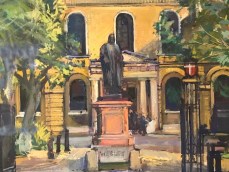 Here is a paraphrase of the sermon John Wesley preached as the foundation was laid for a new chapel in London in 1778. It gives a powerful and timely summary of what methodism is all about. I visited Wesley Chapel in London last week and was moved, once again, by John Wesley’s consistent call to a higher unity within the church. Often the church has fallen short of this calling, but Wesley never gave up on the vision. What might we learn from this commitment?
 The bishops’ commission has been named and people are talking. I’ve read a few comments about the liberals and/or the conservatives on the list, as well as many prayers. My prayer is that this commission, and all of us, will be able to rise above the contention, and truly witness to Christ’s love for all. As you may know, I’ve been engaged in this project of reading Wesley to re-hear what he has to say about matters before us. There is so much! I would say that his use of the word “righteousness” is among the most relevant words for us today.
 Connected In Christ