Searching the New Book of Discipline

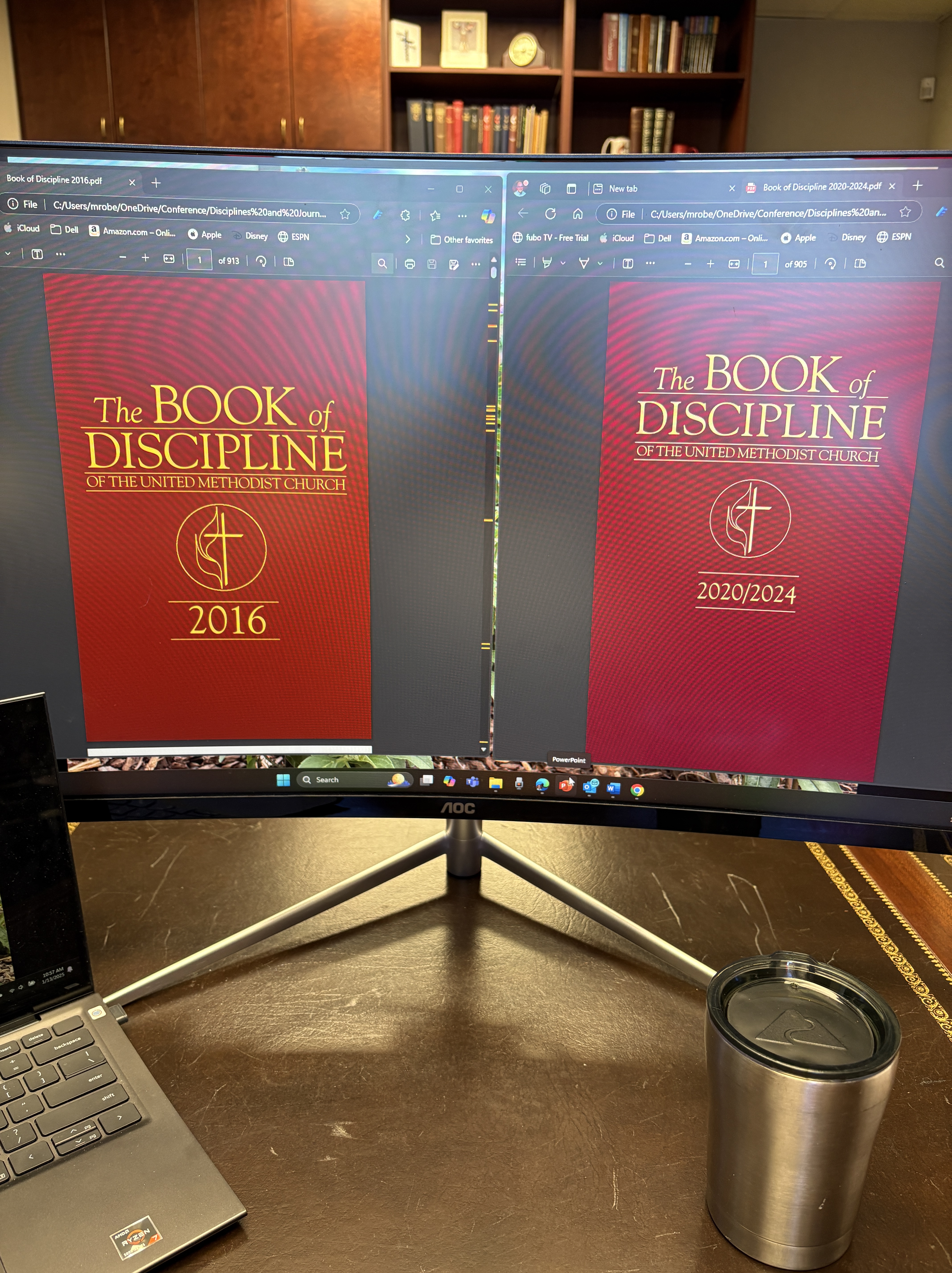
While waiting on my hardcopy of the new Book of Discipline (BOD), I turned to the PDF version. I was inspired to do a quick comparison using the wonderful search feature.   

I started by searching the word “incompatible” hoping to see a “zero.”  I was a bit disappointed to see that it does appear one time, but in a quote of the previous BOD and in reference to moratoriums on judicial proceedings.  By comparison, in the 2016 BOD this word appears eight times with four of these naming one practice or group of people.  In another place we read that war is incompatible with the teachings of Christ. In other places we read that military service, science, and abortion under strict circumstances are not incompatible. The new BOD deals with these topics in similar ways but without using this specific term.

My next search was for the word “fidelity.”  This word appears seventeen times in the new BOD and eighteen times in the previous version.  In both, four of these call for fidelity to the Apostolic Faith and the Doctrine and Discipline of the Church.  Another five deal with finances.  In both versions the remaining references focus on standards for clergy. 

In the 2016 BOD the phrase “fidelity in marriage and celibacy in singleness” appears seven times. The word then appears twice in a definition of marriage.     These statements were often used to keep us from considering the calling and character of some.  Too often, they came up only when there was a desire to exclude or punish. I am glad they are behind us.

In the new BOD, we see a focus on virtues that are life-giving for all and give witness to the “highest ideals of the Christian life.”  There was an effort to strengthen our sexual and moral ethic, without a double standard and without some of the confusion around definitions of terms. This following statement appears seven times, calling for “the exercise of responsible self-control by personal habits conducive to bodily health, mental and emotional maturity, integrity in all personal relationships, social responsibility, faithful sexual intimacy expressed through fidelity, monogamy, commitment, mutual affection and respect, careful and honest communication, mutual consent, and growth in grace and in the knowledge and love of God.”

I do not see this as a move to the radical left – or whatever language might be used to characterize these developments negatively and to cause further division among us.  As a person who was at the General Conference and who worked on a committee that initiated some of these changes, I witnessed a beautiful effort to be faithful and to be responsive to the high and holy calling we have been given to love one another well. With God’s grace and guidance, I believe our General Conference did good work that will bear good fruit.  

As I opened this new version of the Book of Discipline, my first response is to give praise to God and then to give thanks for all who worked to make this new and faithful witness possible.   

I do look forward to getting a hardcopy. I will place it among other treasures that mark significant moments in my life. This one was big.

General Conference and Disaffiliation/Reaffiliation

Another post in the series – Beyond Soundbites and Towards Holy Conferencing (A Series on the Actions of General Conference). This series includes the topics of Abortion, Clergy Qualifications, Marriage, Israel, and Pronouns.

Paragraph 2553 is no longer an option for disaffiliation. And it is true that General Conference did not approve another plan where congregations could disaffiliate based on disagreements with certain positions in the Book of Discipline. General Conference did approve a Reaffiliation Plan to welcome churches home and to offer opportunities to rejoin the United Methodist Church.  In some ways, these two acts could be seen as sides of the same coin.

There may still be ways to bless those who want to leave the denomination, and processes could be developed, but looking at these two decisions together, the hope would be for something very different than what we found with 2553. This paragraph, inserted in 2019, caused great harm.  It forced us to focus on division rather than unity, disagreements rather than building community, and voting rather than discernment, with a winner-take-all outcome. It assumed that churches were objects that could easily be moved, when in fact the old saying is true – the church is the people.  It divided families, friends, and communities. It continued to turn siblings in Christ into issues and problems. It promoted the use of political tactics that do not honor the calling we have been given – to practice the love of Christ, with patience, kindness, and a humility that does not insist on its own way. If we are to be faithful, we can’t be in the business of schism based on disagreements.  This is not who we are called to be.  (See Eph 4:1-3; I Cor 13:4-8; Col 3:12-17, for starters).  

It may be helpful to note that those who disagreed with our policies around human sexuality between 1972 and 2024, did not have an exit plan, nor was one requested.  That was not the focus.  The focus was on advocacy, conferencing, and working for change, hopefully in a spirit of holy love and commitment to the Body of Christ.   As one who would identify as more conservative on these issues, said to one who had worked for these changes (me), “You didn’t leave when you were in the minority all those years.  I admire that. Why would I leave now.”

Another factor in not developing a new exit plan based on disagreement is the overall movement towards contextual freedom, rather than forced agreement.  With the actions of General Conference, pastors and congregations have more ability to engage in ministry in their particular contexts, as led by the Holy Spirit. The hope is to live more completely into the Wesleyan spirit of learning how to love alike, even if we don’t think alike about everything. 

To live into this hope, it is important to move beyond soundbites and mischaracterizations that are often intended to create more division.  (This has been the motivation of this whole series).  To review one example, we can point to the accusation that we now say that it is okay for single persons to have sex.  This is based on the removal of the line, “fidelity in marriage and celibacy in singleness.”  This phrase was a part of the qualifications for ordination.  The soundbite ignores the statement that replaced this one. In what is arguably a stronger statement, the call is to practice “fidelity, monogamy, commitment, mutual affection and respect, careful and honest communication, mutual consent, and growth in the grace and in the knowledge and love of God.” The point, in this context, is the kind of character and witness we want from our pastoral leaders, rather than focusing on a marriage license.   And still, if legal marriage is the concern, we can note that it is affirmed in multiple places in our doctrine and discipline, as the best way to live out this character and to provide the needed legal protections for both spouses and children involved. 

If we assume the worst in people, there may be ways to justify behaviors that would not be approved by some, but that could be true with the previous statement as well.  People could have claimed that they were not “single,” or turned to the traditional definition of celibacy as meaning “unmarried.” But that was rarely a concern because the primary purpose of the previous statement was to keep some out.  As the new statement stands, a high and holy calling is lifted up for all.  There is certainly nothing here to warrant schism.

Moving beyond soundbites and towards holy conferencing is key to life-giving discernment.  To do this in a way that honors Christ and our calling, we must find ways to limit the false accusations that cause so much harm – including the claims that we now promote immorality, or don’t believe in the resurrection or in the Bible (on this one I would invite you to read the post, “Wesley and Human Sexuality (and his commentary on often cited verses).”  If it is up to the Annual Conference to develop a process, strong safeguards must be developed to guide us in a much better direction than we experienced with 2553. 

To consider a request to exit the denomination, a review of key sections of the Book of Discipline might be in order, including our Doctrinal Statements, The General Rules, The Ministry of All Christians, and the section on the Local Church. Based on this understanding of who we are, the questions might be: What is it that leads you to a desire to move in a different direction – beyond one concern over recent decisions, which do not force any changes in how a congregation engages in ministry?  Is the room for mutual support?  Is there a way to come to an agreement that does not dishonor the sacrifices of generations and a future United Methodist witness within the community?

As was mentioned, General Conference called upon every Annual Conference to develop a plan for Reaffiliation, in a “spirit of grace.” This is what we are about! Welcoming! Practicing Hospitality! Supporting one another in mission! Being in ministry together, as a part of a connection that is larger than our own expression! Learning how to love alike, even if we don’t think alike about everything! Understanding that a methodist is not distinguish by our opinions or styles, but by the love of God written upon our hearts, to paraphrase Wesley’s words.  This is who we are!

We would love to help congregations that previously disaffiliated, to begin a process of discernment, which might include an assessment of the General Book of Discipline and our core understanding of who we are, along with an understanding of what it means to be a part of a connection.  Stay tuned for more information, as this process is developed. 

Naming the Joy (of Being UMC in this Moment)

Let me count the ways for why I am proud to be a United Methodist in this moment and give thanks to God:

* Because the word “incompatibility,” as it has been used to create a judgement and a barrier only for some, is gone!

* Because barriers have been removed that have kept us from considering candidates for ministry based first on calling and character and commitments to Christ.

* Because we have new Social Principles that focus more on how we are to treat one another rather than offering hardline stances that divide and are intended to be general enough to find meaningful application in different contexts and cultures.

* Because we can now more freely promote values and virtues that are life-giving for all, rather than setting up a double standard for some.  

* Because a path has been opened to practice ministry in ways that honor different contexts and cultures, while also emphasizing our unity in mission and in sharing a Wesleyan witness in the world.

* Because there is a spirit of grace among us that honors those who are not as eager to celebrate yet are willing to give room for this and who continue to be in community.  Thank you! After General Conference 2019, I (and many) had to make decisions about staying/remaining/abiding, as Christ calls us to do. Reasons included those that we have heard in recent appeals from the Conference – a resolve to share convictions in a spirit of trust, humility and grace, in great appreciation for a community of faith where we can struggle together and love one another even as we disagree.  This is the United Methodist way. It is hard.  It is beautiful. And it is sometimes pretty messy as well.  

* Because there is room for all in the wideness of God’s mercy.  And as human beings we all need this!

How might you name this joy? What language would you use to invite others into this hope, and into a new season of ministry as the UMC?  

Change or Die (a review of a still relevant word)

It is an older but still relevant word, found in an article entitled “Change or Die,” written by Alan Deutschman, and published in Fast Company in 2005.  We used this article in clergy retreats years ago, and it may have been ahead of its time, at least for us in the church. 

The question is posed:  Could you change when change really mattered? This article shares some sobering realities. Change is hard.  As an example, one major study shows that 90% of people with heart disease will not change their behavior, even at the risk of dying, and even after major surgery.  A John Hopkins project explored the reasons for this and came to some helpful conclusions, with implications for our work as leaders in the church.

Several myths are exposed.  For one example, we might think that facts will motivate change.  They do not. For years, physicians have been trying to motivate patients with facts about unhealthy behaviors. Instead of changing, people will often go into denial about bad things happening to them and tell themselves that they will be okay.  The facts are intended to produce fear, but fear can debilitate rather than motivate.  We read, “Telling people who are lonely and depressed that they’re going to live longer if they quit smoking or change their diet is not that motivating…who wants to live longer when you’re in chronic emotional pain?” 

So, what is the remedy? Re-framing!  In reality, our thinking is guided by narratives, not facts.  Mental frames or narratives shape the way we see the world. An example is the frame (or narrative) of seeing a company as an army with ranks and top-down structures.  This determines behavior.  If we saw the company as a family or a commune, people would work together in very different ways.  For facts to make sense they must fit into frames. If they do not, they simply are not received, for reasons beyond “reason.”

To quote the article, “This is why political conservatives and liberals each think that the other side is nuts.  They are working within different frames.” The article does not elaborate but I wonder how these political frames might be named – seeing government as the protector of individual freedoms or seeing government as a facilitator of community.  Is the underlying narrative about advancing individual economic freedom with less interference or facilitating an economy that works for all, with regulations that work for the common good? Does the narrative inspire an openness to different perspectives or a desire to keep other perspectives from being imposed upon those who do not see the benefit or who believe they might be harmful? How we frame the “facts” changes everything!  

The article outlines a John Hopkins project where patients were invited to reframe with the help of emotional and spiritual sources for healing, and to begin to see themselves through a different lens – one of feeling better, of being able to make love to their partner, or take walks through the woods, or play with grandchildren, or learn a new skill, or make a contribution to the world. After three years, 77% of patients who participated in this project, stuck with new lifestyle changes and were able to avoid additional surgeries. It happened because of a change in narrative.  The article also points out the importance of an emotional appeal, rather than facts.  The possibility of something good has to reach the heart.  That makes all the difference.    

What are the implications for us as leaders in the church?  The article hints at this with examples from the business world.  For one example, the story was told about the decline and revival of IBM.  The culture of the company had become overly bureaucratic with demands for uniformity and seemed to feed on depression and hard work.  A radical change was needed.  They moved from selling computers to selling services and helping customers build and run information technology operations.  They even recommended that clients buy from competitors such as Microsoft when it was in the client’s interest.  This sweeping and quick change made a big difference.

Apple served as another example.  For years they had battled for market share and consistency fell behind.  A reframing was needed.  They became a home for creative innovators, who dared to think differently.  Many began to flock to the inspiration that flowed from this new narrative. 

As Jesus said often, “Let those who have ears, hear” or “let it sink in.”  In these times of great change, how might we need to reframe?  How can we move beyond the facts and fears? What narrative is needed that will inspire the courage and wisdom needed to change?  We have such a good story to tell, one of transformation and life! How do we give witness?  

Wesley on Human Sexuality – Part Two

It was a modest project – to look directly at Wesley’s notes on the passages that are often used and to see what he had to say.  I was not expecting to find some of the things I did. With all the attention the previous post received, I want to look again, in light of some of the comments, and ask if my conclusion needs to be modified.

Concerning Wesley’s notes on Romans 1:26-27, much more can be said. Wesley speaks of three degrees of ungodliness – uncleanliness (v.24), being given up to vile affections (vs.25-27) and the vilest abominations (vs.28-31).   The word “abominations” is reserved for his long list that includes envy, deceit, covetousness, gossip, and fornication, which Wesley specifically used as a blanket term for all “pornia.”  Under the second category of “vile affections,” Wesley’s illustration is the “heathen Romans…and none more than the emperors themselves.”  As a point of interest, he also speaks of “American heathens,” in the note on v.31.  Under this category, Wesley speaks of idolatry being “punished with unnatural lust.” The only other time “lust” is mentioned in his commentary on Romans is in the note on 7:7 where it is specifically defined as “evil desires.”  Once again, we can conclude that Wesley wants to point us beyond sexuality only. 

Referring to Wesley’s note on I Cor 6:9-10, I can state it even more emphatically. Wesley wants us to think beyond sex!  He struggles with the word translated as “effeminate” or “soft.”  He gives this definition – those “who live in an easy, indolent way; taking up no cross, enduring no hardship.” At the same time, he does address the type of person that people would have had in mind. He asks, “How is this? These good-natured, harmless people are ranked with idolaters and sodomites!  Wesley has trouble with this group being on the list – whoever he had in mind.  I included more commentary in the previous post, making sure I didn’t make too much of this or impose too much of a 21st century perspective.  With statements like this, I do wonder how this matter can rise to the level of schism.

Referring to Wesley’s note on I Timothy 1:8-11, Wesley gives no commentary on the word “sodomite.” Here I did have to look in other places.  There are a handful of mentions in the Notes. When he elaborates beyond an assumed definition, he points us beyond sexuality.  He equates this word to idol worship (2 Kings 23:2), to corrupt principles and practices of government (Deut 32:32), and all things abominable (Rev 21:8).  In addition to this, he elaborates on the sin of Sodom in his note on Ezekiel 16:47, mentioned in the earlier post.  It is clear that sodomy is not good. It is also clear that we cannot project the sin onto a particular group of people.  Wesley wants us all to understand our complicity and involvement in sin as a step into a life-giving relationship with God.

I spent a lot of time on Wesley’s commentary on Matthew 19 in the previous post.  In the notes of this chapter, and in other notes mentioned, Wesley does have some thought-provoking things to say about eunuchs, including that we cannot always take the term literally.  In the context of current discussions, his words are remarkable – as seen in the previous post.

To conclude, I want to state my previous and modest conclusion with more fervor. ”Wesley’s willingness to struggle with these texts gives us permission to do so as well.” To state it another way, there is much room in Wesley for other perspectives. An honoring of perspectives is woven into Wesley’s larger corpus of teachings.  To paraphrase Wesley’s own words, a Methodist is not distinguished by this or that opinion or scheme of religion.  All of that is “quite wide of the point.”  I love that line! Methodists are to be distinguished by the love of God in our hearts.

Yes, there is room in Wesley.  The question is – is there room in the church? For you? For me? For us together in communion? I say “yes,” with Wesley among our guides.

Dividing the Family Inheritance (thoughts on the lectionary and disaffiliation votes this week)

The gospel lesson from the lectionary this week is ominous, given that votes to disaffiliate begin this week among us.  In Luke 12:13-21, we read where someone wants Jesus to go tell his brother to divide the family inheritance between them.  Jesus refuses and makes it clear that this is not kingdom work. Jesus then takes the opportunity to tell a parable where successful persons focus on building bigger and bigger barns for themselves, with no thought of others, and in the process risk their own souls. 

The analogy does not work exactly because those seeking disaffiliation are not talking about dividing the inheritance in a fair way but rather want to take it all. As one pastor has said, and I paraphrase, “This is a huge deal.”  For only (x dollars) we can “own the whole block and control our own destiny.”

It is easy to see why one who has this desire would think this is a good deal. On the other hand, this is not a good deal for those who believe that faithfulness is about something more than controlling our own destiny. This is not a good deal for those who honor our connectional covenant together and believe that congregations hold property in trust for the larger church. These congregations would not have beloved pastors without the commitment of the larger church to confirm callings, provide training, and develop systems for appointment, support, and shared mission. These congregations are who they are because of a shared commitment to the apostolic faith that has been passed down through many faithful souls.

It is not a good deal for those who believe that the Holy Spirit is at work among us, keeping us aligned in God’s love as a whole, even as some stand on the prophetic edges that make others uncomfortable.  That is a constant dynamic in the church.  To use isolated examples of a few who stand at the edges as a reason for schism only works if it is believed that the new church will never have people inspired by new thoughts and new insights for how to invite all into lives of faithfulness and love.  It works only if the Holy Spirit will no longer be in this work at the edges, even as the Holy Spirit also works among those who feel called to hold fast to views found on the inside.

Perhaps we cannot read too much into it, but it is interesting that this scripture from the lectionary popped up for this week.  Perhaps the Holy Spirit will use this – as the Holy Spirit does and often through the scriptures– to transform hearts.  Perhaps the better way through this tension is to figure out how to share the inheritance that we have all been given and to do so in a way where all are honored.  That would be kingdom work!  

GMC Shock and Awe

Google GMC and you get a car company. Spell it out and you get the Board of Global Ministries of the UMC. And yet, it is easy to find information about the new denomination called the Global Methodist Church.  There are many remarkable, even shocking, things about this proposal. Here are a few personal observations.

To start with, the word “homosexual” is not used anywhere, nor is the word “incompatible,” even though this has been at the center of the struggle for years.  I applaud this positive and progressive move. No one should be defined by a “single story” of their lives, especially with a word that was listed as a psychological disorder when originally put into the Book of Discipline and is still misused in some translations of scripture to connote abusive, promiscuous, and hedonistic behaviors.  All agree that such behaviors are incompatible with Christian teachings and not to be “practiced.”  The irony here is that the UMC could be left with the baggage of this language.  

In this struggle, we now read this from the GMC: “We believe that human sexuality is a gift of God that is to be affirmed as it is exercised within the legal and spiritual covenant of a loving and monogamous marriage between one man and one woman.”  This statement begs questions like, can human sexuality not be affirmed in any other way?  What about a kiss on a date? Is human sexuality not expressed through the way we present and see ourselves?  And with these high ideals of legal, spiritual, loving, and monogamous, why is divorce not mentioned anywhere?

The very next statement reads, “We are saddened by all expressions of sexual behavior that do not recognize the sacred worth of each individual or that seek to exploit, abuse, objectify, or degrade others, or that represent less than God’s intentional design for His children.” This statement starts so well, but then ends with code-words that lump a lot of faithful people into this list of truly harmful behaviors, as those in need healing because of “brokenness in their sexual lives.”  This is “saddening.”  

In a similar vein there is an explicit call to inclusiveness.  Again, it starts well, inviting openness and acceptance of many. And then it comes to gender with an explicit definition that leaves no room for anything other than a strict binary understanding. Gender is defined “by a person’s immutable biological traits identified by or before birth.”   Many would use the term “sex” in this way, with gender referring to self-identity, and how one fits into expected roles within a particular culture.  This statement, however, draws a hard line, alienating and singling out some who do not “fit.” 

And then it goes further. While all may “participate in the spiritual life of the Church…inclusiveness means the freedom for the total involvement of all persons who meet the requirements of our Book of Doctrine and Discipline in the membership and leadership of the Church at any level and in every place.” Suddenly it becomes very exclusive! I wonder who can stand up to this scrutiny and who gets to be the judge! In terms of policies, the move to a congregational system of selecting leaders might also delude commitments to inclusiveness at other levels as well – for women and minorities. (There are lots of policy implications to consider around this – term limits, trust clause, no guaranteed appointments, etc.).

In terms of doctrine, the similarities with the United Methodist Book of Discipline are hard to miss. There are certainly not enough differences to warrant schism.  One big difference is the inclusion of creeds more directly into doctrine.  This is a shift since John Wesley removed the creeds from statements on doctrine and put the Apostle’s Creed into the official liturgy.  In the UMC, we are to be formed and transformed as we affirm the creeds together in regular worship.  Is there danger in separating them from this context and using them to enforce “right belief” independent from worship?  It seems to me that such questions could bring us into conversation rather than pull us apart.

In the UMC, the Social Principles are not law. They are intended to be instructive and persuasive, while “acknowledging differences in applying our faith in different cultural contexts as we live out the gospel.”  In the GNC, the statements of “Social Witness” do seem to be enforced at a stronger level.  Yet, once again we see a softening.  In earlier drafts, the “Social Witness” represented a “clear and unified voice,” with direct implications for policy.  In the latest version, it now reads, “As a global church, our Social Witness represents a consensus vision transcending cultures…It is a summons to prayerfully consider how to “do good” and “do not harm…” It almost sounds United Methodist! 

Don’t get me wrong, there is much in place to make change difficult, including a threshold of a three-quarters vote to change the social witness.  And there is talk of strengthening stances at a convening conference.  That seems to be part of the strategy. But, as the saying goes, “life finds a way.” We might add, “Love finds a way.” Our living God finds a way.  As a new denomination is being proposed, they seem to be leaving room for change, perhaps struggling with how to be a global church built around one perspective or “party,” and recognizing the overtones of colonialism in this attempt. Perhaps God is getting in, through the cracks, and revealing the harm that is inflicted when a party forgets that it is “part” of a larger whole and tries to become a whole unto itself.  All of this leads me to wonder, what is this really about?  And, can the UMC be a church where all are welcomed and honored and where our willingness to engage in hard and holy conversation is a part of our witness to the world?

Episcopacy and the Protocol (Reflections from the SCJ Gathering for Delegations)

Here are a couple of reflections from the South Central Jurisdiction gathering last week. It all started with interviews of six (and only six) episcopal candidates, with each candidate rotating through conference delegations. Each candidate brought gifts and graces that inspired and cultivated hope among us. In terms of gender and ethnic representation, this group was much more diverse than in the past. None of them would identify as I might – as an older, anglo, straight male. Four were women and two of the women were African American. I believe the Holy Spirit is involved in this movement. In times such as these, we need leaders who have more direct experiences on the other side of privilege. Honoring the leadership gifts of those who stay committed to the body through deep struggles, and through experiences of biased harm, will help us all learn how to love more fully and give witness to God’s calling upon the whole church.

A good portion of the second afternoon was spent on “the Protocol.” It started with Bishop Harvey sharing the story of how she broke down after GC2019 was over. Walking away for the arena, she turned to her husband and asked, “Did today really happen?” Her heart-felt emotion in this confession touched me deeply, knowing that she was presiding at the end of the conference, and knowing her commitment to a higher unity and to making room for all, including traditionalists. That was the promise of the One Church Plan. “Did today really happen?” This led her, and many others, to reimagining possibilities and a renewed commitment to stop harm and cultivate holy inclusiveness. (And these are my words building upon her story).

After this, Bishop Schnase asked this question (and I am paraphrasing from memory): “In your heart of hearts, and after GC2019, do you believe that our mission will be best served with one church that is in perpetual conflict over matters of human sexuality or with two churches where people can live into visions that they believe are of God concerning these matters?” In a room of bishops, with much pain, they all answered “two.” From here, he asked us to give the protocol “room to breathe.” He said, very directly, that now is not the time for any of us to support new plans that serve only our own self-interest. With these words, an audible gasp echoed through the room.

While I remain committed to “unity of spirit” I will heed the call to give the Protocol “room to breathe.” I also see merit in giving each other “room to breathe” in a spirit of “grace and reconciliation,” to use language from the Protocol. I will, however, predict that this “room” will not free any of us from the tension. Within minutes of any separation, God will continue to bring transformation to human hearts, different interpretations and insight into the scripture will touch hearts, and the struggle will continue. I am confident that God will see to that.

In this presentation, I appreciated the tone and the way pain and grief were honored. I appreciated the call to work together, even through our hurt and anger, with humility, patience, and grace — or in Methodist-speak, holiness. (My take on what was said). In every conversation that I am in, with people around the country, of all persuasions, that is the spirit. Even when there are outlying voices that blame and malign others, the vast majority of us know that this does not speak to our better selves. Projecting this narrative that we are all blaming and maligning only cultivates fear and division. As leaders, we have the opportunity to call all to a higher way of relating, as opposed to using our influence to build protection for our own side and opinion.

We are two months from General Conference 2020. Please pray! May we all be led to transformation of heart – starting with the one we see in the mirror. May our prayers lead to a conference that will glorify God.

Is There Grace in Gracious Exits?

Around the Way Forward there is much talk about the need for legislation that allows clergy, congregations, and conferences to exit the denomination without penalty.  The proposal is being called “Gracious Exit.” I get the rationale at a surface level, and may even be put in a position to employ it, but I also find it theologically disturbing.  Here are my prayerful musings.

Using the word grace in this context feels like a violation to me.  Grace is a theologically charged word. Grace is much more than a synonym for “kind,” “polite,” or “civil.”  To attempt to define it, grace is the unmerited gift of relationship with the One who is above all, in all, and through all. Grace is knowing that we are not alone and that nothing can separate us from God’s love.  Grace is being included into something bigger than ourselves, indeed into an infinitely larger community where we get to practice the virtues of patience, kindness, humility, forgiveness, never insisting on our own way, and bearing one another in love – virtues not really needed in like-minded religious clubs or if grace is seen only as a personal transaction.  Grace holds all labels loosely.  Grace always works for reconciliation and unity, and in this work challenges our prejudices and holds up a mirror to our narrowly-defined agendas to secure our own comfort and get our own way.  It is this challenge that makes grace hard to accept or trust because this grace requiring so much sacrifice and even more humility.  Faith in something beyond ourselves and our own efforts is so hard, and that’s what is needed to know God’s grace. And so, we often turn away from grace in order to promote our own religious agenda.  And here is the really good news about grace; even in our self-righteousness, grace remains and works for good.  That’s what makes grace so amazing!

In recent days I have heard calls from several “camps” to allow for gracious exits as a part of our Way Forward.  I have heard people call for this freedom to “depart and thrive.”  Often, it feels much more like an invitation for others to leave, wrapped in polite or “gracious” language.  Many want this so that “the issue” will go away and so we can stop talking about it.  It just doesn’t feel right to me to use this sacred word to justify easy divorce and civil schism.  Grace is what beckons us to the common table, not to divide it.  Grace is what allows us to find our true selves in the presence of the Other and “others.”  Grace is knowing we are not alone, and thus the challenge to build life-giving relationships and to truly learn how to love.  Grace is the hard work of our calling.

Yes, we can be polite and civil in our eagerness for divorce, but I wonder, are we denying or cheapening grace in the process? While God can work for good in all things, will we be able to “thrive” with any sense of faithfulness to anything “Other” than ourselves, if we make divorce and cheap grace the accepted norm?   Perhaps our divisions and differences are not “impeding our mission,” as some claim, but are the very realities that make it possible for us to truly fulfill our mission and offer something truly life-giving to the world.  I wonder.

If we make this policy, what are the unintended consequences? Would it not be the de-facto demise of the denomination? What would hold the covenant together in terms of accepting things like apportionments or appointments? Could congregations come and go depending on the current climate?  Could congregations apply this same grace to staying instead of exiting, continuing to act upon the spirit of our doctrine and discipline, as they see it, and with the grace of their contextual colleagues and conference, until another who can claim to have never committed disciplinary sin is thus able to act in righteousness, instead of grace, and start casting stones? (Which may be a good way to look at it).  I wonder and will continue to pray for deeper understanding.

Wesley and the Sin of Sodom (Part Three in the Series, Wesley and the Way Forward)

IMG_4576In this series, the next word from Wesley is “sodomy.”  Wesley uses this word in several places. While we often associate this word with sexual sin, and even homosexual practice, Wesley takes a much broader and more biblical view.  In Wesley’s commentary, he uses this word to describe abusive and harmful actions against others.  Wesley also uses the word “assault” to describe this sin.  At another point, Wesley expands the meaning by highlighting what is said about the sin of Sodom in Ezekiel 16:49.  In Wesley’s notes, he says that the sin of Sodom was “fullness of bread,” “excess in eating and drinking,” and Sodom’s refusal “to help strangers.”  Arrogance, gluttony, and laziness in helping the poor were the source of Sodom’s fall. That’s straight from the Bible!   In another place, Israel is compared to Sodom for their wickedness. This wickedness is defined as failure to seek justice for the oppressed, the orphan, and the widow (Note on Isaiah 1:9-17).  Following the message of the prophets, Wesley wants to remind us that “Their doings were abominable, but thine have been worse.” (Note on Ezekiel 16:47).   This broad and biblical view of the word gives us all cause to look in the mirror rather than project sin onto others.

In the list of sins found in I Corinthians 6, the original Greek word in question is “arsenkoitos.”  It is translated as “sodomy” by Wesley. (We also see this in the NRSV). There are no known previous usages of this word, so it is assumed by many that Paul coined the term.  The word is a combination of two words meaning “male” and “bed,” probably used with sexual overtones. Since there is no literary context for this word, it has been translated and interpreted in many ways. It has been used for men who use others as prostitutes or who use their strength (masculinity) to exploit others. It has also been defined as masturbation, pervert, abusers of boy or children, and with general words like “abominations.”  In the last century it has been translated with the word “homosexual,” thus associating this word with behaviors listed above. With this association, it is understandable why the word “homosexual” has become offensive to many, and is no longer used as a description of one’s identity.  By associating this term with abusive and exploitive behavior, it is “incompatible” with Christian teachings.

In more recent years some translations have combined this word with the previous word to describe the passive and active male (not female) partners in a same-sex relationship.  This move is problematic in many ways.  It veers from the original meaning of the words. It covers up the biblical and historical precedence for using this word to describe abusive and harmful behavior. It also removes the possibility of such a relationship being moral and life-giving. It makes it possible to use this passage against Christians seeking to live faithfully and to grow in the virtues of Christ through their relationship, perhaps with more commitment than those making the accusations. Is this biblical? Is it right? Is our judgment, and the call to accountability, in the proper place?

In any responsible reading of scripture, this word cannot be used to project sin only on to others or seen only in terms of sexuality.  Wesley would not approve.  When confronted with lists like in I Corinthians 6, the first calling is to self-examination. This list, for example, includes “fornicators.” Wesley uses this word to cover “every kind of [sexual] uncleaniness” and the harm that comes from it. The Greek word is “pornia.” It is sex when another is objectified or used, or when one allows themselves to be objectified or used, thus causing harm. I wonder if this would not be a better cause for us. This list also includes “drunkards.” At one point, Wesley speaks of being “drunk with the blood of the saints” believing we can judge others. The list is long, but the point is clear.  When we are “washed” and “sanctified” in the name of the Lord Jesus and by the Spirit of God, we behave differently.  We learn to live in love.

To avoid the labeling that makes it so easy for us to project sin onto others, I like the paraphrase of these verses found in “The Message.” It reads, “Those who use and abuse each other, use and abuse sex, use and abuse the earth and everything in it, don’t qualify as citizens in God’s kingdom. A number of you know from experience what I’m talking about, for not so long ago you were on that list. Since then, you’ve been cleaned up and given a fresh start by Jesus, our Master, our Messiah, and by our God present in us, the Spirit.”  Praise be to God.