Awakening Through Wilderness (a devotional possibility for you and for UMCs)

No doubt we are moving into a new season in the life of the church.  In order to navigate this reality, I am convinced that we need to look into our past as much as we look towards the future.  Or maybe a better image is the need to attend to our roots in order to branch out and bear good fruit. 

With this motivation I, along with Lauran DeLano Grosskopf, have written a series of books where each chapter contains a paraphrase of one of Wesley’s sermons, a devotion on the same theme, and resources for reflection.  With this series, Wesley’s sermons have been rearranged to fit within the liturgical year, thus connecting them to our weekly rhythms.  My hope is that these resources will help us reacquaint ourselves with inspiration from our past and lead us to good fruit as we move into a new season as United Methodists. This would be a good way to go through the year with Wesley.

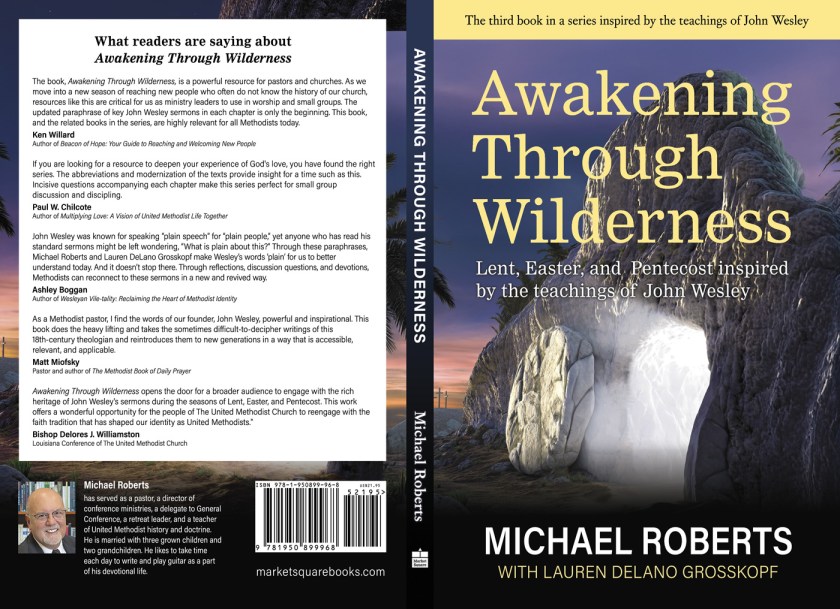
Below is a brief description of the latest book from the publisher. Within the book there are testimonies from Paul Chilcote, Ashley Boggan, Bishop Deloras Williamston, Ken Willard, Adam Hamilton, Bishop Laura Merrill, Rebekah Miles, and more.

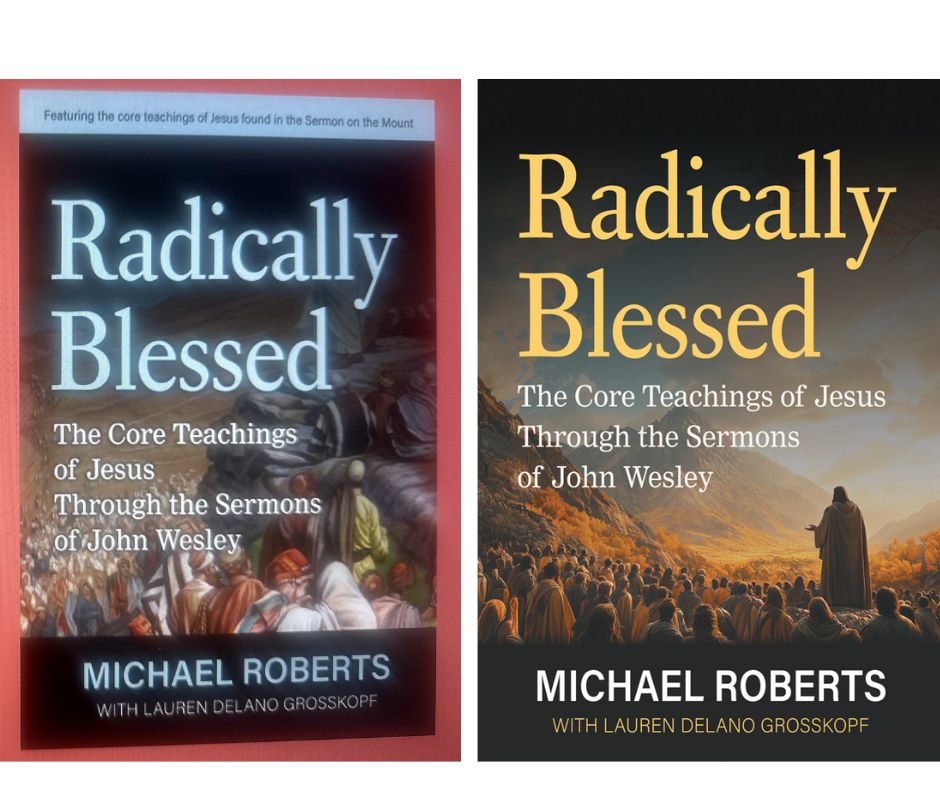
  “Awakening Through Wilderness invites readers on a transformative journey through Lent, Easter, and Pentecost, exploring timeless truths through the voice and vision of John Wesley. This third installment in this acclaimed series builds on previous works, Wanting More and Radically Blessed, continuing the mission to make Wesley’s foundational teachings accessible and deeply relevant for today’s church.

 In this book, each chapter offers a devotional paraphrase of one of Wesley’s classic sermons, followed by a modern devotion and practical questions for reflection. Each chapter masterfully connects Wesley’s original passion for renewal and reform with the liturgical rhythms of the church year, guiding readers through themes of fasting, self-denial, temptation, grace, and resurrection.

 The wilderness becomes a powerful metaphor for life’s trials, doubts, and spiritual dry seasons-those times when God seems distant and faith is tested. Through Wesley’s insights and pastoral reflections from Michael and Lauren, readers discover that the wilderness is not merely a place of hardship but also a space for awakening, transformation, and renewed purpose.

 Whether read individually or used in a group study setting, Awakening Through Wilderness offers a clear, engaging path for spiritual growth. Each chapter’s discussion questions and reflection resources make it ideal for small groups, Bible studies, or personal devotion, especially during Lent.

 The books in this series are written with warmth and clarity, drawing on deep knowledge of Wesleyan theology and a pastoral heart for today’s church. Throughout we are reminded that “God’s love comes to us on its way to others,” inspiring readers to grow in grace and to live out their faith with courage and compassion.

    You are invited to step into the wilderness and emerge awakened to the transforming power of God’s love.”

These books are available through Market Square Books, Cokesbury, and Amazon/Kindle. I would be honored if you would take a look (you can get a sample through kindle) and if you feel so led, share these resources with others.  If you would like to talk about this, please know that I would love to have that conversation.  Many Blessings!

Wesley on Elections (and the challenge of staying in my lane)

After the recent election, I found myself in a fog and unsure of what to say as a pastoral leader. I ended up – thank God – in a familiar place and one that rarely fails to inspire.  I began to wonder – What does John Wesley have to say about elections?  I will jump into the theological deep end and then explore some implications on our human elections.

Generally speaking, there are two very different understandings of election within the Body of Christ.  A perspective born out of Augustinian/Calvinist theology uses this word to describe how some are predestined to salvation and others are damned based on an irrevocable decision from a God who is sovereign and knows all, an absolute decree made from the “foundation of the world.” (Matt 25:34; Eph 1:4; Heb 9:26).  This perspective puts a lot of weight on, what is called, the foreknowledge of God (Rom 8:28-30; Acts 2:22-24; Rom 11:1f). This perspective is popular in our culture and is being expressed in some bold, even militant forms.

While still using the terms election and predestination, Wesley offers a more nuanced perspective, seeking to honor both the scriptures and our experience of having free will and learning to love in relationship.  We are elected or chosen to give witness to a grace and a way of salvation that is available to all. Our election is about so much more than “just believing.” We are invited to open our hearts to God’s transforming grace and to reflect the image of God.  Our participation is a part of God’s election, God’s purpose for us, from the “foundation of the world.”  And to be clear there are reformed theologies that share a softer approach, to use Wesley’s language. 

These two perspectives lead to different understandings of God’s sovereignty.  One is often viewed through the metaphor of a monarch (or dictator) with an emphasis on the depravity of humanity and the need to control and protect from the top down. From this perspective we might ask, why would we be more merciful than God?   A Wesleyan perspective can be seen through the metaphor of a loving parent, where authority is revealed as respectful, trusting, and empowering love.  In this love we are chosen, not for special privilege but to be a blessing (2 Pet 2:9-10; Col 3:12-17).  This view is much more optimistic about our capacity to reflect the image of God in the world.  From one perspective holiness is viewed through the lens of obedience and perseverance (key terms in Calvinist theology); from the other perspective holiness is seen through the virtues of patience, kindness, humility and a grace that can overcome even our human trespasses with restorative justice rather than punitive or retributive justice.

From Wesley’s perspective, the more hardline perspective turns Christ into a hypocrite. It portrays Christ as one who offers something that he never intends to give (like a cynical view of some politicians). It leads to a “sharpness of temper” that is inconsistent with the virtues to which we are elected or chosen.  The “elect of God” practice mercy, humility, kindness, and patience (I Cor 13:1-4; Col 3:12-17).  The “elect of God” “bear one another in love” and actively seek “unity of spirit in the bond of peace.” (Eph 4:1-3).  In connection to these “tempers” and virtues, Wesley uses the phrase “the elect of God” in at least five of his sermons.

In the scriptures we read that God’s desire is that all would come to salvation (John 1:29; II Peter 3:9).  We read that Christ died for the sins of the whole world, not only some who are “unconditionally elected.” (John 4:42; Acts 10:34-36; I Tim 4:1; Heb 2:9; I John 2:2).  We read that in Adam all die and in Christ shall all be made alive, but each in their own order (Rom 5:18; I Cor 15: 21-23; there is a mystery to it all).  These passages give important clues for how we are to relate to others – even our enemies.

What happens when the “elect of God” betray this trust?  It can look like being “mad with party-zeal,” to use a phrase from Wesley.  For the sake of the whole body, it is important to remember that the word “party” is built on the word “part.” Attempts to turn a part into the whole, and the arrogance of spirit that is necessary for this endeavor, can be so destructive.  Wesley calls the “elect of God” to purify themselves from all party-zeal, from all bigotry and narrowness of spirit, from impatience with differences, and every degree of unmercifulness.  All of this only leads us to “bite and devour one another.” (Gal 4:14-15).  This is a betrayal of our election.

In addition, please do not think that election from God is a call to be passive or weak. Anchored in these virtues, the “elect of God” work for peace, as peacemakers rather than peacekeepers, and there is a difference. Peacemakers acknowledge brokenness and harm among us, and yet continue to work for reconciliation in a way that restores justice and reveals God’s love for all. The “elect of God” stand with the marginalized, feed the hungry, welcome the stranger/immigrant, and stand with those who are marginalized by the “madness.” (See Matt 25:31-46 in the context of the that can save us from a fate that we deserve).

For a recent (and political) example, I think of how the statement “Your body, my choice” has been used over 50,000 times on Facebook (and that’s only one social media site).  I know that some boys in our community are vocalizing this and similar phrases, acting on the bullying and demeaning and abusiveness that has been normalized and is seen as strength in the hearts of many.  If our children are scared (and some are), we need to listen and stand with them.   This is what the elect of God do.

I think of political ads that stereotype, demean, and misrepresent particular minority groups to score political points. It reminds me of the Greek word “pornia” which can be defined as the objectification of others as a way to justify using them for our own perverted ends.  This word is about so much more than the way it is typically applied.  The “elect of God” are those called to speak up.

Concerning predestination and election, Wesley is willing to engage in the philosophical argument, but only to a point. He is keenly aware that we can only speak in human terms about the deep things of God. It is a mystery to us how eternity works, with all things being present at once.  There is, however, nothing in our experience that should make us think that things happen because they are known.  It may also be that God, infinite in wisdom and love, is able to set aside this so-called foreknowledge in time and space for the sake of relationship.  Perhaps God can even be surprised, grieved, and overjoyed by what happens in creation.  Such attempts to speculate can only carry us so far.  It is our experience that we are able to choose and participate in our own salvation, using our God-given free-will.

Therefore, as Wesley says often, a choice is before us.  In our culture, it is popular to see elections as win/lose, us/them, righteous/damned.  Reading scripture through a Wesleyan lens offers us a different way to see it.  The question becomes, which way is more life-giving for you?  Which way rings true in your spirit?  Which way will lead us into the goodness that God wants for us?  I invite you to ponder these things in your heart. 

(For a deeper dive, I recommend Wesley’s sermons: Free Grace, On Predestination, The Wedding Garment, Eulogy for George Whitefield, and On Working Out Our Own Salvation, among others. I hope to share a paraphrase of “Free Grace” soon).

We Believe in the Trinity! So What?

This past Sunday we celebrated Trinity Sunday, which sparked these reflections (which were shared in our weekly church newsletter).  In my mind, these thoughts seem so relevant in a time when the spirits of division and fear are so active among us.

As United Methodists we believe in the Trinity.  It is the first doctrinal statement in our Articles of Religion. All of our official creeds are written in trinitarian form, and we use one of these creeds in all of our worship services almost every Sunday. In the sanctuary, we also sing the doxology regularly, giving praise to our triune God.

My question right now is “so what?”  How does this affirmation affect our actual living?  First of all, this understanding helps us to know that God is always bigger than any one perspective or description.  The God we worship is more than creator, savior or spirit, judge, redeemer, or sustainer, parent, friend, or bestower of gifts. No one name will suffice, when trying to comprehend the fullness of a God whose ways are not our ways (Isaiah 55:8-9).  This perspective helps to keep us humble, curious, and open.  It has the power to spark a desire to grow in the ways of God (Psalm 85:10-13).

For another answer, this understanding of God gives us an option to the binary way of thinking that gets us in such trouble.  Either/Or, Win/Lose, Red/Blue, In/Out.  The outcome of this perspective too often leads to division, judgment, competition, exclusion, and so much fear.  Is there a better witness?    

What would a trinitarian witness look like? Within the Trinity we see cooperation rather than division, mutual trust rather than competition, grace rather than judgment, inclusion rather than exclusion.  Within the Trinity, the value is not power over others; the value is love.  And we know what this love looks like.  It is patient and kind. It serves with a humility that does not insist on its own way (I Cor 13:4-8; Eph 4:1-6).  It is so different from a witness that calls for uniformity of opinion rather than unity in love. 

I invite you to take a moment and reflect on these two different witnesses? Which perspective gives glory to God, honors Christ, and bears the fruits of the Holy Spirit?  Which perspective is more likely to be life-giving for relationships?  Which perspective comes closer to illuminating the fullness of God?      

We believe in the Trinity!  So what?  “May the grace of the Lord Jesus Christ, the love of God, and the fellowship of the Holy Spirit be with all of you” (2 Cor 13:14).

Building Upon the Rock as United Methodists

This post was inspired by a comment on my personal Facebook page yesterday. It was deleted by the author so I have generalized my response.  At the end is a quote from Wesley that is worth much pondering, in my opinion:

To all who call us to bless one another and move on as we divorce, I want you to know that you never lost my desire to bless you. This hope is still there. I did not want this divorce. I do not believe it is a good witness. I wish we were still “arguing” at Annual Conference together and I lament if there is anything I said or did that made you come to the conclusion that divorce was the answer.

Even when I was in the strong minority with my advocacy for those who continue to be harmed by our current stance in the BOD, I did not threaten to leave or want others to leave. This goes against our calling, as I see it, to be a witness to a love that is patient, kind, and humble; a love that does not insist on its own way; a love that is not arrogant or rude, a love that leads with less judgment and more compassion; a love that keeps vows and seeks to grow in this same love especially when disagreement occur; a love that honors contextual freedom for engaging in ministry and honors where people are on their faith journey; a love that seeks first to understand; a love that does not end in divorce, disaffiliation, and so much demonizing; a love incarnate in our Lord and Savior Jesus Christ.

Drawing upon Wesley’s word, Jesus Christ is the rock, whose character does not change, who remains faithful, and who calls us to build our lives upon the love given to us. As we all live into the harm and hope of disaffiliation, I continue to be blessed and challenged by this word from Wesley, which captures a consistent theme in his witness. I quote it directly, and please forgive the lack of inclusive language:  “How nearly then does it concern every child of man, practically to apply these things to himself! To diligently examine what foundation he builds, whether on a rock or on the sand! How deeply are you concerned to inquire, ‘What is the foundation of my hope? Whereon do I build my expectation of entering into the kingdom of heaven? Is it upon my orthodoxy, or right opinions, which, by a gross abuse of words, I have called faith? Is it upon my having a set of notions, supposedly more rational or scriptural than others have?’ Alas! What madness is this! Surely this is building on the sand, or, rather, on the froth of the sea!” (See Matthew 7:21-27 and Wesley’s 13th Discourse on the Sermon on the Mount).

I truly hope to be a part of a church that strives to build upon the rock and not the froth of the sea. This is why I remain faithful as an Elder in the United Methodist Church. May we move onward in this way.

Wesley on Human Sexuality (and his commentary on often cited verses)

Certain passages keep coming up in our conversations about human sexuality and the future (and possible division) of the church.  Since Wesley’s notes on the New Testament are a part of our doctrine, it might be good to know what he has to say.

One verse from Matthew 19 is often quoted to make a point about marriage. In this passage, Jesus speaks of marriage between one man and one woman, and how the two become “one flesh.” In context, this is an answer to a question about divorce.  The law of Moses gave “men” permission to dismiss a wife for most any cause. Jesus says that this is because of our hardness of heart and calls “men” to a higher standard, with some arguing that this call was given to provide more protection for the wellbeing of women. While Jesus honors this form of marriage in his illustration, the point of his answer, as Wesley says, is not about marriage; it is to speak against two things: polygamy and divorce.

And then things get very interesting. Even after lifting up this high standard, Jesus makes it clear that he is not giving a new law to be enforced. He tells us that not everyone can accept this, but only those who are given the ability to accept it.  Jesus shifts the conversation to those who are not called to marriage in this traditional sense. In this context, he speaks of eunuchs – some who are born this way, some who are made this way, and some who choose this way to glorify God.  The term “eunuch” was used in the ancient world as a euphemism for those who we might call “gay” today. Wesley does not make this connection directly but does tell us that we cannot always take this term literally.  He speaks of those who are eunuchs “by natural constitution, without their choice: to others by violence, against their choice; and to others by grace with their choice.” This is remarkable language, with much to ponder. (Also see notes on Acts 8:27, I Cor 7:7, and Dan 1:3). 

Jesus ends this challenging passage by saying, “Let anyone accept this who can.”  It is with this word that Jesus offers his teaching on marriage, divorce, and the honoring of those who do not, or cannot, enter into a “traditional” marriage.  These are all complex matters that call for much grace.

Next, we turn to verses within the first chapter of Roman that are often cited (Romans 1: 26-27). Wesley points out that this passage is about “abominable idolatries,” where people exchange the truth of God for a lie and worship the creature rather than the creator. The illustration is used of men and women exchanging what is natural for them for what is unnatural for them. From our perspective today, we might say that this is not healthy for any of us.  Whatever else we might say, the illustration is not the point or purpose of the passage.  It is about idolatry that leads to “the vilest abominations.” Wesley lists these abominations in his commentary – Injustice, Unmercifulness, Maliciousness (“a temper that delights in hurting others.”). Whispering (to “defame others.”) and Backbiting (speaking “against others behind their backs.”).  

In terms of sexuality, Wesley puts “fornication” on his list. The Greek word is “pornia” which can be defined as any sexual expression which objectifies self or others. As Wesley says, it is a term that “covers every species of uncleanliness.” By this understanding, this term includes much more than our common definition. In his notes on this passage as a whole, Wesley emphasizes the point that Paul is trying to make.  If we judge others, we only condemn ourselves (Romans 2:1).  This passage is about so much more than what we like to focus upon.   

Next, there are two other passages in Paul’s letters that are often cited, I Corinthians 6:9-10 and I Timothy 1:8-11.  In both of these passages we find a list of vices that do not represent the kingdom.  More specifically, we see a list of certain types of people who “will not inherit the kingdom of God” – as if they deserve it apart from God’s amazing grace. The lists include idolaters, fornicators, adulterers, male prostitutes, sodomites, thieves, drunkards, revilers, robbers, murderers, slave traders, liars, perjurers, and all that is contrary to sound teaching.  

The word translated as “male prostitute” in the NRSV, literally means “soft.” In Wesley’s bible it was translated as “effeminate.” This same word is used in the gospels to compare the “soft” or “luxurious” clothing worn by those in royal palaces with the clothes worn by John the Baptist (Mt 11:8; Lk 7:25).  In reference to sex, there is a history of this word being used to describe the passive partner, the effeminate (which was seen as a vice by many). In his notes, Wesley describes those “who live in an easy, indolent way; taking up no cross, enduring no hardship.” It is clear that Wesley saw this in a broader way. In other contexts, Wesley uses this same word in a positive light. He calls for a “softening of the heart” and for a “soft and yielding spirit.”  In his commentary of the phrase “Love is kind,” he describes “kindness” with the word “soft.” He also says that peacemakers are those who “quiet turbulent passions” and “soften the minds of contending parties.”  Being “soft” can be a good thing.

As a part of his commentary, Wesley does allude to the common use of this word to describe a particular kind of person. He asks, “How is this? These good-natured, harmless people are ranked with idolaters and sodomites!”  Whoever he has in mind, he struggles with them being on this list. To make sense of this he speculates that we must all guard against sins thought to be the least in order to secure ourselves from the greatest sins. With all of this, it is clear that Wesley sees this notion of “being soft” is a broader context, beyond sex alone, and he also calls us all to look in the mirror. 

The next word on this list is even more challenging. Translated as “sodomites” in Wesley’s day, it is a combination of two words, one meaning “male” and the other meaning “bed.” While very rare in ancient literature, it is mostly seen as a reference to abuse and exploitation of another. In some contemporary translations, it is used to denote the active partner in a same-sex (male) intercourse. In the history of translation, it has also been associated with pedophiles or abuse of boys or children (This is how Luther, for example, translated it).  There is evidence that Wesley defined this word in ways that move beyond sex. In Wesley’s notes on Ezekiel 16:49, he says that the sin of Sodom was “fullness of bread,” “excess in eating and drinking,” and Sodom’s refusal “to help strangers.”  Arrogance, gluttony, and laziness in helping the poor was the source of their fall. Following the message of the prophets, Wesley wants to remind us that “Their doings were abominable, but thine have been worse.” (Note on Ezekiel 16:47).  In other words, when we see this word, we cannot only think of “those people.”  On the whole, this term is used in the context of exploitive, abusive, neglectful, selfish, and harmful behavior, often seen in the context of sexual relationships.

In the last century, this word was sometimes translated with the term “homosexual.”  It is worth noting that this 20th century term was used to denote an official mental disorder.  It was often used to suggest practices that we would all consider “incompatible with Christian teachings.”  The American Psychiatric Association did not fully remove this classification and these associations until 1987.  Because of these associations, we have been asked to stop using this term. It is hurtful and undermines the hopes for a life of faithfulness and love found in many who might be labeled in this way.

According to Wesley, we are to interpret all scripture, especially challenging scriptures, through the grand truths that run through the whole, using passages that “take hold of our conscience.” (See note on Romans 12:6 and Sermons “On Charity and “On Laying the Foundation”).  Jesus himself used this method when he gave us the great commandment to love and called this the summary of all the law and the prophets. Wesley calls this love the “chief of all graces” and the “royal law.”  In addition to the Great Commandment, Wesley also turned to passages like I Corinthians 13 and I John 4 to serve as a lens through which to interpret the whole and be able to “rejoice in the truth.”  These passages express the “grand truths that run through the whole.”  

It is worth noting the connection between love and truth. Biblically speaking, truth is that which reveals God’s love and makes it known. The word itself means “to reveal” or “uncover.” Truth is not rooted in the law. In fact, sometimes the law covers up the truth.  Jesus himself dealt with this. Truth is revealed by love that is patient and kind and does not insist on its own way (I Cor 13:4-7). It is this love that invites all of us to struggle with our own perspectives and prejudices and to be transformed, from one degree to another, into the likeness of Christ. By the practice of this love, truth is made known through us. That is the Wesleyan way.   

 In my mind, Wesley’s willingness to struggle with these texts gives us permission to do so as well. His commentary opens the way for us to acknowledge that we do not fully understand matters of sexual orientation and identity and thus can approach such matters with less judgment and more compassion.  At the same time, we can affirm a strong sexual ethic rooted in the values that are life-giving for all – faithfulness, commitment, and all virtues summed up with the word “love.”  We can focus on these biblical values for all, rather than setting some aside by a different standard.  In this light, it is worth noting that Wesley consistently defined holiness with the virtues of patience, kindness, and humility.  May we all aspire to this kind of holiness and to the call to love one another well.

A Way Forward Bible Study and Holy Conversation – Session 2, Interpreting Scripture

Here are notes from our second session where we focused less on General Conference and more on who we are called to be as a congregation as we look beyond General Conference.

How many of you have had an experience like this, where you wanted to know God’s will for your life, or to be inspired in some way, so you opened the Bible and tried to find something, but ended up more frustrated than inspired?  Or you made a commitment to read through the Bible, but had trouble understanding what you were reading or found yourself stuck in some way? That’s because this book is complex and difficult to understand as a whole without understanding certain rules for interpretation.  This book is a collection of  history, poetry, prophecy, song , letters, laws, arguments over laws, differing opinions, parables, stories, with some passages that are straightforward, and many that are highly symbolic, all taking place in a culture that is ancient and foreign to us…AND, on the other side, it is experienced as the Word of God, as divinely inspired, as transformative and so we find it extremely and even eternally valuable.  It is so worth the effort and the internal struggle that it creates.  And so, we keep coming back.

Before we look at some key scriptures, I want to talk some about methods for interpreting the scriptures.  The big, seminary-level, word for this is hermeneutics (on screen).  This word describes the systems we use to interpret scripture and draw our conclusions. When we do not have some clarity about what we are reading and how to read it, that’s when we get lost or come to decisions that may not be the most faithful and fruitful.  Here are a couple of popular hermeneutical methods.

Proof-Texting.” Have you heard this term?  This is a very common method for interpreting scripture.  Proof-texting is when we search for scriptures to prove an opinion.

The next one is a more positive variation of this method. I call it a focus on Devotional Verses.  This is where we focus on key verses for inspiration and guidance.  Employing this method, we focus on parts not the whole – key verses that speak to us.  This method can be very helpful.  At the same time, some caution is in order. Concerning our topic, a version of this method can be used to say that something is right or wrong.   Someone might say, “The Bible says,” and then quote a verse as if that settles it.  Then, perhaps, they can walk away feeling righteous without noticing how hurt others might be, or without dealing with all the other verses that might lead to a different or transformed perspective.  We might think that we are glorifying God by upholding some ideal, and in reality, cause deep hurt to individuals and to the body of Christ.

To avoid this kind of harm, and to open ourselves up to true inspiration, we need a deeper hermeneutic or method of interpretation.  Here are some key principles of what I call a Wesleyan Hermeneutic:

  1. All Scriptures are Inspired. We proclaim that all scriptures are inspired and contain all that is necessary for growth in salvation. The Bible is our primary source for understanding who we are called to be.
  2. There are Scriptural Keys to Help us to Interpret the Whole. There are key scriptures that help us interpret all other scriptures. We can call these “Master Texts” or Hermeneutical “Keys” that open up meaning within the scripture – and help us make determinations about what might be historically conditioned, or how to discern deeper truths beyond the words, or how to make decisions between different perspectives within the scriptures themselves (and yes, the scriptures are full of different perspectives). It is worth noting that Jesus used this principle when he summarized all of the law and prophets with the Great Commandment – Love God and Love your neighbor as a part of yourself.  Wesley, following Jesus’ lead, called this love the “royal law.”  So, for example, Jesus could fulfill the law, even as he broke the law or rebelled against the way the law had been applied around issues related to the Sabbath, to diet, to healing, to who could or could not be touched, to who to include.  His guiding light was the “royal law of love.” And we could list other passages that serve as keys for us.  Last week we looked, for example, at Ephesians 4:1-6 and I Corinthians 13: 1-8. (See Authority of Scripture, A Wesleyan Hermeneutic, and the Way Forward, for a deeper explanation).
  3. Read with Resources. Resources are needed and helpful — commentaries, language studies, interpretations from the tradition. As Methodists we “believe that the living core of the Christian faith is revealed in Scripture, illuminated by Tradition, vivified in personal Experience, and confirmed by Reason.”  We call this the Wesleyan Quadrilateral.  To make a connection with our topic, we might use this principle to ponder a distinction between marriage and unions/covenants. Would it be possible to honor and bless unions of anyone who desires to practice faithfulness and grow in the virtues of love, while also honoring the historic meaning of the term marriage?  How might we apply scriptures to honor the diverse perspective within the body of Christ and actually grow in our ability to love one another?  There are so many resources to help us.
  4. Behavior over Beliefs. Beliefs are so important, but the Holy Spirit is more concerned with behavior and using scriptures as a guide for how we treat one another. In the midst of our denominational struggle, I have heard many say that they have not made a decision because they are hoping for the Holy Spirit to show up and guide us into the right policy or plan.  I see this a bit differently.  As a Wesleyan, I am not focused on the Holy Spirit showing up with some extraordinary sign (Wesley talked a lot about this).  I am interested in the ordinary everyday calling to represent God with patience, gentleness, humility, bearing one another in love, and being eager to maintain the unity of the spirit in the bond of peace.  I might say that the Holy Spirit enjoys our variety of perspectives and is likely to not give us a uniformed perspective, because the point of it all is how we love one another.  The Spirit is always revealed, less in our opinions, and more in how we treat one another in the sharing of our opinions.  Even in the scriptures we see so much diversity of perspective.  The scriptures do not give us uniform opinions but does give us a common calling.  We need to be the church that focuses on that.  Applying this principle, we could focus on behaviors around issues of human sexuality and give priority to the virtues that we want to promote – monogamy, faithfulness, commitment even when sacrifice is required, treating others with honor without objectifying them or using them only for our pleasure, and all the virtues of love. This level of consideration gets lost in the debate because the focus is on the physical dimension of sexual practice.
  5. Here are a couple of other principles, (briefly): “Discernment happens best in Community.” We engage in life together, not to come to agreement but to learn how to live as the body of Christ with all its blessed diversity. And for one more, “Our Calling is to Self-Examination over Judgement of Others.”  Often when we engage the scriptures and truly practice holy conversation with others, we learn a lot more about our own prejudices and need for transformation than we do about what others might need or about how they should live.

At our tables, I want us to have some conversation around these principles using three passages that are not directly connected to the issue but speak to who we are called to be.  I will read them with some commentary and then we will discuss them at tables and as a larger group, asking: Why is this in the Bible? What are some different ways to interpret this passage? How can we apply it today?  What does this passage say about who we are?”

Genesis 11:1-9 – The Tower of Babel

  • This passage is given the context of God calling the people to scatter and fill the earth…
  • They want uniformity and safety, and it leads them to do some stupid things…
  • Note their use of inadequate resources – baked mud and tar, instead of stone and mortar.
  • Note their arrogance, believing that they made it to heaven and how God has to come down to see this tower.

Luke 4: 16-30 – Jesus in his Home Town

  • Highlight dimensions of purpose he is given.
  • The people are pleased, until he mentions God’s work through foreigners. With this they are enraged…

Ephesians 2: 14-22 – Christ is our Peace

  • The word peace or shalom is about coming together and practicing faith together.
  • Here God’s people are called back together, to give witness to God in a new way…

As a report, the conversation of the 80 people in the room was lively and inspiring.  When we came back together, one of our youth acknowledged the diversity of views within the room, even on the issues at hand, and called us to stay united around something bigger. Another highlighted how stupid we can act when there isn’t someone to say, “Hey, maybe there’s another way to do this.”  One pointed out how diversity is healthy in all ecosystems.  One reflected on how hard it is to change – to “scatter,” to appreciate new “languages” — and yet that is what we are called to do.  One reflected on how Jesus walked away and how he might do that with us if we fail to listen or become enraged by his challenge.  In our current political climate, the need to break down walls and build diverse communities of peace did not go unnoticed, although when I picked the scriptures I was narrowly focused on issues within the church and did not make this connection.  Maybe that was the Holy Spirit at work.

Next week we will apply these methods to some of the texts that are used in the debate before us, with emphasis on Romans 1. 

A Way Forward: Bible Study and Holy Conversation – Session 1

Last nway forwardight we started an eight-session gathering at the Well (our Wednesday Night Program) leading up to General Conference.  Here are my notes for session one, which was intended to set the tone and give an update on where we are at this point. The big goal for this process is clarity about who we are as a congregation, regardless of what happens in St. Louis…

I want to invite all of you into a vision.  In a very real sense I want you to envision this place in 100 years.  Picture our spiritual grandchildren (and some biological grandchildren) worshiping here and gathering here to grow in a relationship with a living Lord.  In 100 years from now they may come in flying cars, or beam in, or have mini interactive screens projecting from their eyes –who knows — but they will be here – and I believe will be worshiping in the Wesleyan tradition in some way.

What does that mean? What does it mean to envision a congregation worshiping here in the Wesleyan tradition in one hundred years? Here are a few summary statements:

  • It means that they will err towards grace over judgement.
  • They will be open to people who are different.
  • They will see that our primary task on this earth is to learn how to love more fully and grow in the virtues of patience, kindness, forgiveness, humility, generosity and gracefulness. In Wesleyan language, this is called Holiness.
  • They will hold fast to the core truths of the faith (as outlined in the creeds we say every week) and beyond that they will “think and let think.” (How many of you have heard that?)
  • They will see salvation as more than a decision about the future, but a present reality connecting us to eternity. (This is from Wesley’s first sermon in the standard sermons).

Can you envision this kind of congregation here in the future?  During these next few weeks, I want to invite you into this vision. And I will be bold to say that this is a calling from God.  I do want you to trust me on that, but not totally take my word for it. I don’t have the whole answer. We’ve got to figure that out together.  And, to do so, we must stay connected to God’s inspiration and guidance, in two essential ways – through the Holy Spirit and through the Scriptures. We need to plant this vision into the scriptures, prayer, and tradition of the church and see if this vision can grow from there.

With that hope, I’ll start with a passage that we will use to frame this whole conversation.  (On screen) The Apostle Paul says, “I beg you to lead a life worthy of the calling to which you have been called, with all humility and gentleness, with patience, bearing with one another in love, making every effort to maintain the unity of the Spirit in the bond of peace…” (Eph 4:1-6).  We will look at this text, and several others, as we journey together these next few weeks.  Tonight, I want to focus briefly on a couple of words. The first one is “beg.”  The Apostle Paul is doing more than “inviting” us into a vision.  Inviting is a bit soft. Paul is begging, urging, pleading with us to live into the calling of God upon our lives. And here is an important thing to note.  This calling is not rooted in doctrine or policies – these are important as resources and guides – but are not at the core of this calling– this is not about defending doctrine — at the core of our calling is to a particular way of behaving; it is about how we treat one another.  Paul begs us to give a particular kind of witness to the world in how we love one another.

There is one other word that I want to highlight tonight — Unity (as a preview).  The normative function of the Spirit is to lead us into unity – with synonym like reconciliation, community, and harmony. I suppose the Spirit could lead to division and divorce in some circumstances, but that would be very rare.  I don’t think we are that special – that we are above or beyond the calling to engage in the hard work of loving one another. Therefore, we can presume that the work of the Holy Spirit in all of this is to lead us into unity.  (We will see this through many passages).

And so, if we can start with this premise, then we need to understand what this unity is and is not.  Here are a few summary statements that will guide us:

  • Biblical unity is not defined by uniformity. These are not the same thing. In fact, a great case can be made that biblical unity is actually found in the opposite of uniformity.
  • Unity is found in the body of Christ with many and diverse parts, gifts, perspectives.
  • Unity is found in a community where virtues like patience, kindness, and humility are required. These virtues are not needed in a community where everyone is the same.
  • Unity is found in love that “never insists on its own way.” That is our challenge.

We are called to give witness to this kind of unity or community.   That has always been a part of who we are as United Methodist Christians.

With that I want to get to our purpose tonight and that is to give an overview and update on the Way Forward at the denominational level.  (Go to onechurchplan.org and show the Countdown to General Conference in February and talk a little about this) At this special called session of General Conference there will be 3 proposals that have come from the Bishops and the Way Forward Commission. The charge of this commission and to the bishops was to work towards unity and help us find a way forward together.  (We have given this background before and it is available). Tonight, I want to focus on an updated versions of the plans — and my impressions.

I will start with the plan that has gotten the least attention until this week when our Bishop came out with his call for us to give this plan a new look…

 The Connectional Conference Plan. 

(for details see the Bishop’s Reflections at arumc.org or the ARUMC Facebook page)

In brief, this plan does call us to unity in a higher way than our opinions on the issues at hand, while at the same time protects convictions around these issues.  Through a series of complicated legislative moves, this plan would create one church with three branches – progressive, traditional and unity, all around one issue — and conferences, congregations, and clergy could vote to align themselves with a particular branch. This plan would require the passing of multiple constitutional amendments (elaborate a bit).  For a few impressions that might fit with other plans as well, I personally don’t like the labels.  Such labels can imprison us and lock us out of our own growth.  I don’t want to be a part of a church where everyone is expected to think the same way.  That takes away possibilities for transformation, which comes, most often in my experience, when we are free to question and seek and be challenged by others.  Withdrawing into like-minded camps may be comfortable but it is not healthy for the Body of Christ. Then I ask, “what about the next issue?” Are we going to create more branches?   And finally, I must ask why this proposal is getting renewed attention at this point.  Many are speculating that three options make it harder for anything to pass.

The Traditional Plan

This plan is built around the firm conviction that the church cannot allow or bless any covenant relationship where sex might be involved that is not between a biological male and female.  In addition, no one can serve in ordained leadership who have relationships outside of this same arrangement. Within this plan, a person’s sexuality takes precedence over calling, gifts, faithfulness, character, and fruitfulness.  This plan not only keeps all restrictive language around homosexuality within the Book of Discipline, but it also strengthens ways to enforce all prohibitions that are currently there.  In its original form, this plan sets up a structure for the bishops to enforce these restrictions.  The Judicial Council of the United Methodist Church (a body like the Supreme Court) ruled that many parts of this plan were unconstitutional, including a section that said that bishops were never intended to be an “inquisitional court.”  With this ruling, the plan was modified to ask General Conference to form a separate body which would serve this function of policing and enforcing around this one issue.  This plan would possibility lead to an increase in church trials and hard decisions.  One way that this plan mitigates this possibility is by offering, what is called, a “gracious exit” for all who do not want to live by this strict standard and who believe that there are other ways to faithfully interpret scripture and live together as the Body of Christ.

The One Church Plan 

(See onechurchplan.org and my blog, connectedinchrist.net. I have written a lot on this and thus makes it hard to summary)

This plan removes language that calls the practice of homosexuality incompatible with Christian teachings.  It does not, however, add any language that says it is compatible. In many places, it adds language to protect convictions and religious freedoms of all in various contexts and cultures.  No conference, congregation, or clergy would ever be compelled to act contrary to their convictions.  This plan defaults to a traditional understanding of marriage, while offering congregations the opportunity to change their wedding policies to allow for same-sex unions or marriage. This is the only time a vote would be needed within this plan.  In addition, a pastor could not perform (or offer the vows) for such a union at the church without this direct consent by the congregation.  (Even now, pastors can participate in such ceremonies short of leading the vows).  This plan would also allow boards of ordained ministry to develop their own evaluation systems for who they would ordain around issues of sexuality.  With that said, it is also important to note that this plan clearly upholds biblical values of monogamy, faithfulness, and relationships where people can truly grow in the love of God. The plan even strengthens a commitment to these values.  These values would be the primary criteria for evaluating candidates for ministry, while still allowing conferences to include the same restrictions that are currently in place if that was the will of the body.  This plan provides “a generous unity that gives conferences, churches, and pastors the flexibility to uniquely reach their missional context without disbanding the connectional nature of the United Methodist Church.”  To explain this, I did write one piece where I called this the “Very Traditional One Church Plan.”

Another Option is that nothing passes.  This is a real possibility.  It is one of the reasons that I want to spend the next few weeks, not talking directly about General Conference and what might happen, but about who we are as a congregation regardless of what happens.  What do we represent?  How are we to live as a witness to the love of God?  How will we love one another and give witness to true unity in the midst of whatever happens or doesn’t happen?

Table Discussion:

We had around 70 in the room, gathering around tables.  We invited them to reflect together on this initial question: “what questions do you bring to this conversation, to become a part of our conversation the next few weeks?” Here are the questions reported back from the tables:

  • Are same-sex couples welcomed to be full participating members of our church? Depending on which plan is passed, would they feel welcomed? What can we do to encourage them to remain a part of the church?
  • What can pastors do, or not do, now? What freedom do you have now to marry or not marry couples?
  • What are the values we want to promote in covenant relationships and marriages? Monogamy, faithfulness, etc., or focus primarily on sexuality?  Are there different values for different people?
  • What happens to gay clergy who are in the closet? What about those who come out or already have in the hope of change?
  • Would the Conference be able to ordain a gay pastor?
  • If and when a vote happens at the church, with the youth get to participate in the vote?
  • How will we support one another post decision? If a majority likes the decision, how do we support the minority?  How do we stay Conway FUMC once a decision for one side or the other is made?
  • What are the financial implications? If we lose people, we lose money as well?
  • How do we draw more people into this conversation so that people aren’t just waiting for a decision to be made and then decision whether to stay or go?
  • How do any of these plans bring about unity? Why is unity important?
  • How can I “defend” my opinion, with good theological and biblical grounding, with family members who have a very different perspective?
  • What glorifies God? To hold true to traditional views?  To support marriages?  To turn people away who want to live in committed relationship that honor God and helps them to grow in God’s love? Does that glorify God?
  • What if nothing changes? Or what if we come together around a witness and nothing changes at General Conference?

Middle Way Behavior (The Wesleyan Way)

A Mempic- trinity 3e put out by the Wesleyan Covenant Association says, “We actually believe what the UMC says it BELIEVES…and how THAT MAKES us anything but the CENTER, I have no idea.”

It’s a nice soundbite and rings true at a basic level.  If being in the center is equated with being in the majority of the global church, then this is a valid claim. – at least at this time and on specific issues.  Likewise, if being in the center is about beliefs, then this statement is accurate as well.  From this perspective, to be in the center is to affirm the official position on any given issue, and by implication, to also be right.

In the light of this claim, it is important that we, as Wesleyans, acknowledge another perspective on what it means to be in the center.  John Wesley calls us to the middle way.  In doing so, he is not talking about politics, party, opinion, or even beliefs.  He is talking about behavior.  Even with strong opinions, Methodists are to BEHAVE in the middle.  We do so because our faith is not centered in doctrines or opinions, but in a relationship with a Living Lord, and in virtues that promote life-giving relationships in the world.  This is not to imply that doctrines and opinions are unimportant, but only that they are resources to support the larger purpose.  To confuse means with ends can easily lead to a betrayal of the Body as a whole.  It is a first step to dividing the body into “us” and “them,” in support of sides or causes.

One important example of this calling to behave in the middle is found in Wesley’s sermon, “The Witness of the Spirit.”  Here Wesley defines the middle way in opposition to both extremism and enthusiasm.  He is concerned about the temptation to mistake our own imaginations for the witness of the Spirit, and thus to become “the worst kind of enthusiasts,” where we are convinced that God is in our opinions and that our job is to come to God’s defense.   When one is “drunk from [this] spirit of error,” it is almost impossible to see that we may be fighting against God rather than for God.

Continuing this thought, Wesley turns to the other extreme where “reasonable people,” who “see the dreadful effects of this delusion,” assert that “the witness of the Spirit” must have only belonged to the apostolic age and that the Spirit does not move among us in the same way.  At this extreme, people are weary of any claim of God’s direct guidance. Here, faith runs the risk of drying up into an intellectual exercise or becoming little more than a resource to help us feel good about ourselves.

In seeing the harm done by these extremes, Wesley asks: “May we not steer a middle course?  Can we not distance ourselves from the extremes of error and enthusiasm without denying the gift of God and giving up the great privilege of being God’s children?”  He is convinced that we can steer this middle way.

To do so, we must see ourselves as people who BEHAVE in the middle.  As Wesleyans, the evidence of the Spirit is not found in our enthusiastic defense of our way as God way, but rather in the opposite; the Spirit is revealed in the “holy tempers” of humility, gentleness, patience, temperance, and “kindly affection for all.”  The Spirit is always revealed, less in our opinions, and more in how we treat one another in the sharing of our opinions.  That is to be our witness to the world.

In a culture that seems to thrive on extremes and divisiveness, on winning and pitting ourselves against one another, what would it look like if we could “steer a middle course?” What if this was the focus of our conversation? Would this not be much more in line with the witness of the Spirit?  For one more quote from this sermon, this witness just might save us all from “the pain of proud wrath.”

Virtues for the Days After (A Pastoral/Wesleyan Perspective on the Presidential Election)

I’ve had a week to reflect and to hopefully respond rather than react.  Therefore, I’m going
to weigh in on the presidential election as a part of my calling to give spiritual guidance – and to hopefully give more than platitudes like “It’s time to come together.”  While true, that’s too easy without some explanation.

First, for thosepic-election of us who voted for Donald Trump and claim to not have been motivated by any underlying racism, sexism, or any hate in our hearts, may the rest of us trust that and seek understanding of greater motives, including a deep desire for change.  At the same time, I believe we also must understand why many are afraid right now. To share one personal story, last week I met with young women who were truly frightened and felt that we had given an endorsement to demeaning and abusive behavior.  Considering this meeting, our calling as Christians is clear in my mind. We all have an obligation to model and teach respect for one another, and to each work on our own attitudes that might objectify and marginalize others.

In the last few weeks, our President-Elect has said repeatedly that he has this kind of respect.  While he has said many things to raise legitimate questions, at this point, my hope is that the weight of this new responsibility will make this word to be a word from the heart, and not just rhetoric from the mouth to achieve a purpose in the immediate moment.  Our words have power to heal and hurt, create and destroy.  Our words lead to actions. May we all hold one another accountable to appropriate words and actions.  May all of us go out of our way to honor one another – even as Donald Trump has seemed to do at times after the election.

Likewise, for all of us who voted for Hillary Clinton, I hope the rest of us will honor the noble desires for equality, opportunities, peace in the world, and even to see a glass ceiling broken.  Most of us hold these desires, even if we disagree about how to achieve them. Since Clinton did not win, there is little reason to speculate on the hurt or fear that might have been generated by her election.  At this point, may we all honor her respected service to our country, even as Donald Trump did after the election.  As an Arkansan and a United Methodist, some of us know her, not as a caricature, but as a person. We see much to be praised. Those who know Donald Trump as a human-being could give similar praise. We must see each other as persons– all flawed and in need of much grace, even as we hold one another accountable to higher virtues.

Regardless of our differences on economic policies and how to deal with social problems, may this election give us all a renewed resolve to promote basic scriptural virtues so needed for healthy community – humility, respect, kindness, honesty, patience, compassion, temperance – “bearing one another in love and eager to maintain unity of the Spirit in the bond of peace” (Eph 4:1-3). I truly believe that it all comes down to the virtues of true holiness in our Wesleyan tradition, combined with the Wesleyan/Christian calling to look in the mirror more than out a window to see the faults of others.  We are called to build each other up from the inside out.

In Christ, there is no “us and them.” If we let this division and judgment into our hearts, we are all in trouble. Please do not revert into comfortable camps or stay only on one side of the aisle with backs turned to the other.  That way is much too easy…and puts us all at risk.   As people of faith, on both sides of the so-called aisle, we can be the ones who can lead the way to reconciliation and restored moral decency.  Together, we have the spiritual resources, perspective, and temperament to do this, if we are also willing to embrace the needed spiritual courage.

RIGHTEOUSNESS AS THE WAY FORWARD (A Word from Wesley)

img_0502-1 The bishops’ commission has been named and people are talking.  I’ve read a few comments about the liberals and/or the conservatives on the list, as well as many prayers. My prayer is that this commission, and all of us, will be able to rise above the contention, and truly witness to Christ’s love for all. As you may know, I’ve been engaged in this project of reading Wesley to re-hear what he has to say about matters before us.  There is so much!  I would say that his use of the word “righteousness” is among the most relevant words for us today.

In his sermon “The Lord Our Righteousness,” Wesley starts by grieving the dreadful contests that arise among the body of Christ. He is disheartened by the way we can turn our “weapons against each other.”  For Wesley, the primary cause is attachment to opinions and modes of faith-expression which leads us to lose sight of our common faith and our common cause.

So, the question becomes, how do we rise above the evil fray? – and yes, Wesley does call it evil.  A glimpse of true righteousness helps.  In a long and involved exposition, Wesley says that true righteousness is found in the One who is the image of God for us.  In Christ, we see a reflection of who we are called to be.  At the heart of true righteousness is “love,” a word more fully illuminated by the virtues of reverence, humility, patience, and gentleness.   This understanding of righteousness stands in sharp contrast to the more common definition of justifying our positions as right over and against others.  True righteousness is rooted in peace rather than war.

In several other places, Wesley cautions us against those who are overly enthusiastic for their positions and are “righteous over much.”  Anytime we put our trust in ourselves and magnify our own ways as “right” for everyone, then we block the light of Christ’s righteousness rather than reflect it.  May this not happen to those commissioned to lead us forward.

In this sermon on true righteousness, Wesley stews over the broad diversity within the church of his day, focusing on differing denominational confessions and practices.  In the midst of much contention, he truly sees this diversity as an opportunity to give witness to Christ and to grow, if not in agreement, certainly in love. With great optimism, Wesley believes that it is possible for us to “take off the filthy rags” of our own righteousness and put on Christ, where we partake of the “same precious faith” even as we celebrate our diverse expressions of this faith.  I wonder, are we up for this kind of courageous witness?

Wesley also quotes “Mr. Hervey,” with words “worthy to be written in letters of gold:” “We are not solicitous as to any particular set of phrases. Only let [us all] be humbled as repenting criminals at Christ’s feet, let [us] rely as devoted pensioners on his merits…” Meeting on the common ground of Christ’s merits, and with the call to love by the virtues of true righteousness, there is no room for “contention about this or that particular phrase,” according to Wesley, or condemning others as “Antinomians” or law/covenant breakers.  There is no place for divisive or destructive “wrangling” over opinions and expressions of faith – not as we stand together as “repenting criminals at Christ’s feet.”  To count ourselves among such “contending parties,” says Wesley, is to be “an enemy of peace, and a troubler of Israel, and a disturber of the Church of God.”

In our current contention, there is much labeling of self and others, often in flowery and soft spoken attacks. There is so much “us-them” language, and talk of “winning” and “defeating.”  Is it possible for us to rise above the fray? The answer is, “Yes!”  We can “join hearts and hands in service to our great Master,” even as we “think and let think” on matters of opinion and practice. We can stand together as “repenting criminals” on the common ground of Christ’s righteousness, rather than our own, and we can truly grow in Christ’s love. I can’t help but believe that this is our time to embrace this identity and give such a witness to the world.